
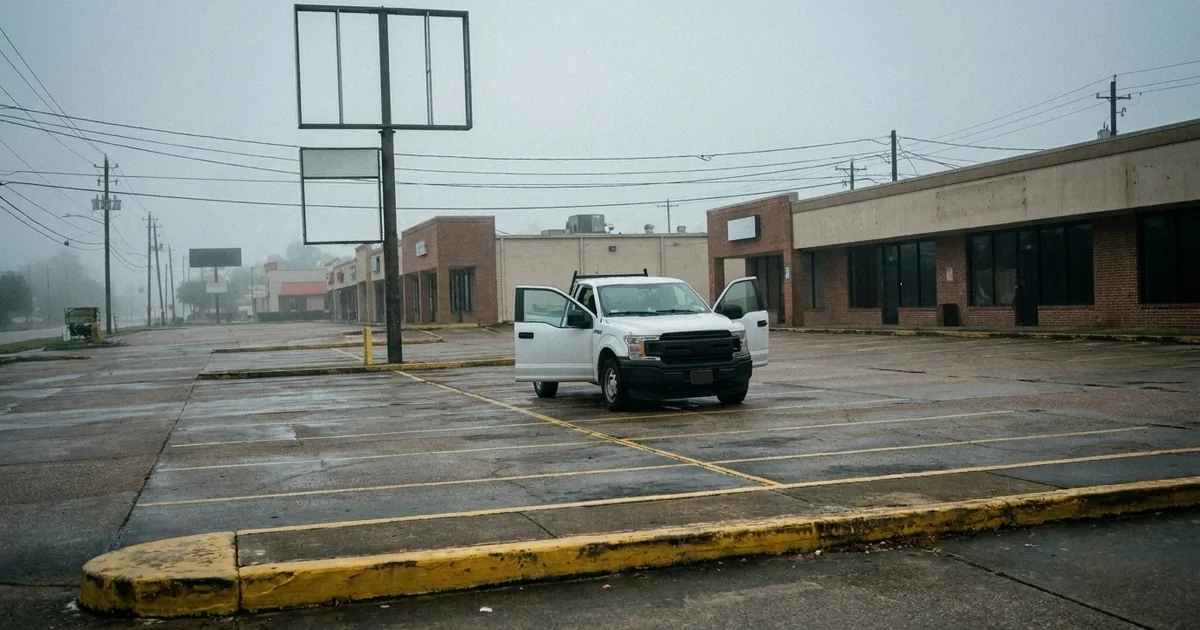
At about 7:30 on Saturday morning, surveillance cameras in a northwest Houston parking lot recorded two men climbing out of a white pickup and running in different directions, and a black SUV chasing one of them from behind. The SUV belonged to Immigration and Customs Enforcement. When it stopped, Miguel Parra-Hernandez, 48, had two broken legs.
Harris County District Attorney Sean Teare has watched the footage, and he is not calling it an accident. “This was an intentional striking and running over of the person by the vehicle,” he said, “and in that case, that is an aggravated assault with a deadly weapon in Texas.” A charging decision, he added, will come “in relatively short order.”
Coverage has framed the question as whether Teare will charge. The harder question is whether a Texas courtroom will ever get to hear the case, because a federal agent charged by a state can ask to move the prosecution into federal court and claim immunity, and the first test of that defense in this year’s run of cases has not been decided.
Minnesota’s ICE Cases Are Still Waiting on a Judge
Teare would not be first. We pulled together where the state prosecutions of federal immigration agents we could find stand this year, and the pattern is plain: charging one is the easy part.
| Agent | What prosecutors allege | State charge | Where it stands, October 15 |
|---|---|---|---|
| Gregory Morgan Jr. (Hennepin County, Minn.) | Feb. 5: pointed his gun at two motorists who blocked him on the shoulder of Highway 62 | Two counts of second-degree assault, the first such charge in the country | Asked to move the case to federal court. U.S. District Judge Nancy Brasel heard two days of testimony, ending Tuesday; her ruling waits on briefs due in several weeks. |
| Christian Castro (Hennepin County, Minn.) | Jan. 14: fired through a closed front door, hitting Julio Cesar Sosa-Celis in the thigh | Four counts of second-degree assault, one of falsely reporting a crime | Texas did not send him north; a federal judge in Texas declined to force the governor’s hand on Aug. 26. Arrested in Minneapolis Sept. 16. Separately indicted on six federal counts of lying to the FBI, to which he has pleaded not guilty. |
| Unnamed agent (Harris County, Texas) | Oct. 10: drove an SUV into Miguel Parra-Hernandez, breaking both legs | Under review as aggravated assault with a deadly weapon, a second-degree felony | Decision expected soon. ICE has not given the DA access to the vehicle. |
The Castro row holds this year’s sharpest irony in American federalism. Castro is a Texas-based ICE officer. When Minnesota asked Texas to send him north to face assault charges, Gov. Greg Abbott did not sign the request; he ordered his secretary of state to investigate whether Castro even counted as a fugitive, and a federal judge in Texas declined to order him to act, ruling that Abbott had not technically denied anything. So the state that would not hand an ICE agent to another state’s prosecutor now has its own prosecutor lining up to charge one. Teare needs no one’s signature. The conduct happened in his county.
ICE’s version is short. “As ICE officers attempted to apprehend the illegal aliens, Miguel Parra-Hernandez ran in front of an ICE vehicle and was struck,” a spokesperson said, calling claims of an intentional strike “reckless and false.” The agency says Parra-Hernandez was riding with Jose Mendoza-Cervantes, the man with a deportation order its officers were hunting. His attorney, Kim Bruno, says he does not know Mendoza-Cervantes and was not with him.
Then there is the evidence. ICE drove the SUV, a Jeep Cherokee, away from the scene and has refused to let Teare’s office download its crash data recorder, which would show speed, steering and braking. Body camera footage from the officers is under internal review at the Department of Homeland Security. Two people detained in “an entirely different operation” were sitting in the back seat during the pursuit, which puts two potential witnesses in federal immigration custody. “In my 20-year career, I’ve never heard of anything like that,” Teare said of the vehicle leaving.
What Teare cannot control is the venue. A federal law, 28 U.S.C. 1442, lets a federal officer move a state prosecution into federal court, and once there the officer can argue that he reasonably believed what he did was necessary and proper to his federal job. If a judge agrees, the case ends. If not, it stays a state prosecution under state law, heard in a federal courtroom, which is the “historic legal scenario” Minnesota is waiting on in Morgan’s case. The last famous test, Idaho’s manslaughter charge against the FBI sniper from Ruby Ridge, survived a federal appeals court in 2001 and was then dropped by the county prosecutor.
Washington has already shown how it handles its own agents. Federal prosecutors in Minnesota wanted to charge Castro with a civil rights crime, and Main Justice limited them to false statements. Local prosecutors are filling the space the Justice Department walked away from, and that is the right instinct.
We think Teare should charge if the full footage shows what he says it shows, and that a man on foot run down by an SUV is about the worst possible fit for an immunity defense built around actions necessary and proper to enforcing federal law. Chasing someone across a parking lot is part of an ICE officer’s job. Driving over him is not. ICE’s own version, that he simply ran in front of the vehicle, is a claim the agency could test in minutes by releasing the body camera video and the crash data from the SUV it drove off the scene. It has done neither. An agency confident in its account does not drive away with the evidence.