
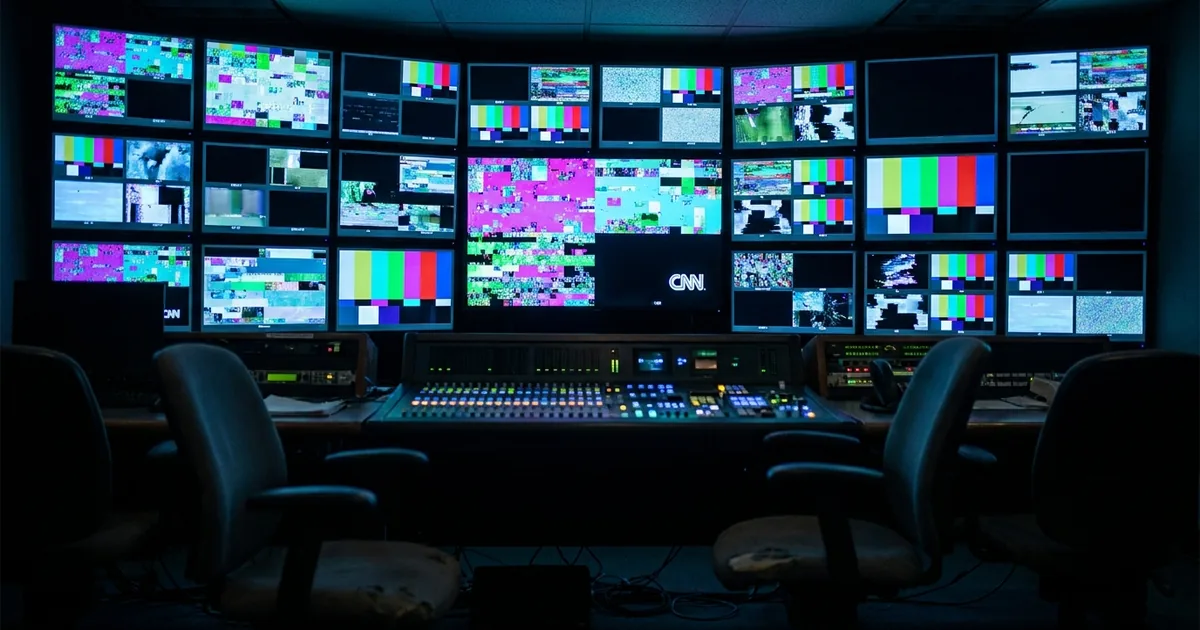
Shortly after noon Eastern on Monday, August 24, the picture on CNN froze and shattered into colored blocks while an Inside Politics panel worked through President Donald Trump’s trade war with Canada.
A week later, the story worth telling is not the outage. It is that Warner Bros. Discovery has still not said what broke, and that almost nobody who covered the incident stopped to read the company’s own apology as the disclosure it actually was.
The coverage was uniform and it was thin. Trade and general outlets alike ran the glitch, the roughly half hour of scrambled signal, and Dana Bash telling viewers at 12:51 p.m. that “there was a technical issue across Warner Bros. Discovery’s channels that resulted in losing our signal.” Then the story ended. What none of them did was treat that sentence as information. It is the only technical detail the company has released, and it says something specific: CNN did not lose its signal because something failed at CNN.
What the Statement Actually Admits
CNN’s own posted statement, issued while the channels were still coming back, is worth reading slowly.
We are aware of a technical issue across Warner Bros. Discovery that resulted in losing CNN channels for a period of time today.
Across Warner Bros. Discovery. Not at CNN, not at a transmission facility, not at a distribution partner. A fault somewhere in the corporate layer took down a news network’s air, and it took HBO, TNT and TBS with it, as Mediaite reported alongside CNN’s own account of the disruption. The broadcast trade press logged the same pattern under the same heading of multiple Warner networks failing together.
One detail from the engineering trades sharpens it further. TV Technology noted that the disruption varied depending on which platform a viewer was watching on. A fault that reaches cable, satellite and app subscribers differently, at the same moment, on unrelated channels, is not a broken transmitter. It sits upstream, at the point where Warner Bros. Discovery assembles and hands off feeds for everything it owns. That is a single point of failure, and on August 24 it failed.
CNN’s press operation declined to elaborate on the underlying cause to The Desk, which obtained the statement. Seven days on, that has not changed.
The Plumbing Was Built to Be Shared, on Purpose
This is where the story stops being about an outage and starts being about a balance sheet.
When Discovery absorbed WarnerMedia in 2022, the deal was sold to investors on cost. Within months the company had raised its cost-cutting target to $3.5 billion, a number you do not reach by trimming travel budgets. You reach it by collapsing duplicated functions: one set of technical operations instead of several, shared origination, shared vendors, shared everything a viewer never sees. Turner’s networks, HBO and the Discovery channels stopped being separate businesses that happened to share an owner and became channels running through common infrastructure.
That was the entire point. It worked, in the narrow sense that it saved money. It also means the company now has exactly the failure profile it engineered: efficient, entangled, and capable of losing five brands to one fault.
Paramount is promising to run the same play again. Before it prevailed in the fight for Warner Bros. Discovery, it was already telling investors it saw substantial further cost savings in a combination, even after years of cuts at both companies. There is no version of that promise that does not mean more shared plumbing.
Two Companies, One Failure Point
Here is the part nobody has connected, and it is not a subtle connection.
Warner Bros. Discovery has spent more than a year trying to tear itself in half. The plan announced in June 2025 splits the company into a studios and streaming business holding HBO and Warner Bros. Pictures, and a linear networks business, branded Discovery Global, holding CNN, TNT Sports and the Discovery channels. HBO goes one way. CNN goes the other. The Hollywood Reporter has tracked the same separation through Discovery Global’s own upfront planning.
On August 24, HBO and CNN went dark together.
Layer on the acquisition. Paramount Skydance is buying the whole company for roughly $110 billion, a deal twelve states led by California Attorney General Rob Bonta are suing to block, and which we covered when the states filed. Paramount’s chief legal officer, Makan Delrahim, told a Politico conference in California on August 12 that selling CNN outright is on the table as a way to settle that case. Bonta has said a CNN divestiture alone would not resolve it.
So the questions the outage raises are not hypothetical, and none of them have public answers:
- Who owns the systems that failed, once CNN and HBO sit in separate public companies?
- If CNN is sold to a third party to clear an antitrust suit, does it leave with the ability to put itself on air, or does it leave renting that ability from the buyer of everything else?
- What does separating those systems cost, and has anyone put a number on it?
We wrote at the start of the month that CNN has to live somewhere until the trial that begins in March 2027. August 24 answered a narrower question that had not been asked: what it currently lives on. The answer is infrastructure belonging to a company being dismantled around it.
Our View
“Technical issue” is not a disclosure. It is a phrase chosen to close a news cycle, and it worked, because the press covering it accepted a description of a symptom as an explanation of a cause.
Warner Bros. Discovery should say what failed. Not because viewers are owed a root cause analysis of every dropped feed, but because this company is in front of a federal court and a dozen state attorneys general arguing about what happens when media assets get combined and recombined. The degree to which its networks are technically fused is a material fact in that argument. It is evidence about how hard the proposed unwinding actually is, and the company is the only party holding it.
David Zaslav’s Warner Bros. Discovery and David Ellison’s Paramount are both asking regulators, shareholders and a judge to believe these networks can be cleanly sorted into new corporate boxes. Half an hour of colored blocks across five channels is a small, concrete piece of evidence that they cannot, at least not cheaply. The states challenging the deal should be asking for the incident report. So should the FCC, which is already handling this transaction with a conflict problem of its own.
There is a plainer point here about press independence too. CNN is a news organization whose ability to broadcast currently depends on infrastructure controlled by a parent that is negotiating whether to sell it. That is not a conspiracy, and nothing about August 24 suggests anything other than an accident. It is simply a bad structural position for a newsroom to occupy, and the outage made it visible for about half an hour.
The next time it happens, and the architecture suggests there will be a next time, the useful question is not what viewers saw. It is whose equipment it was.