
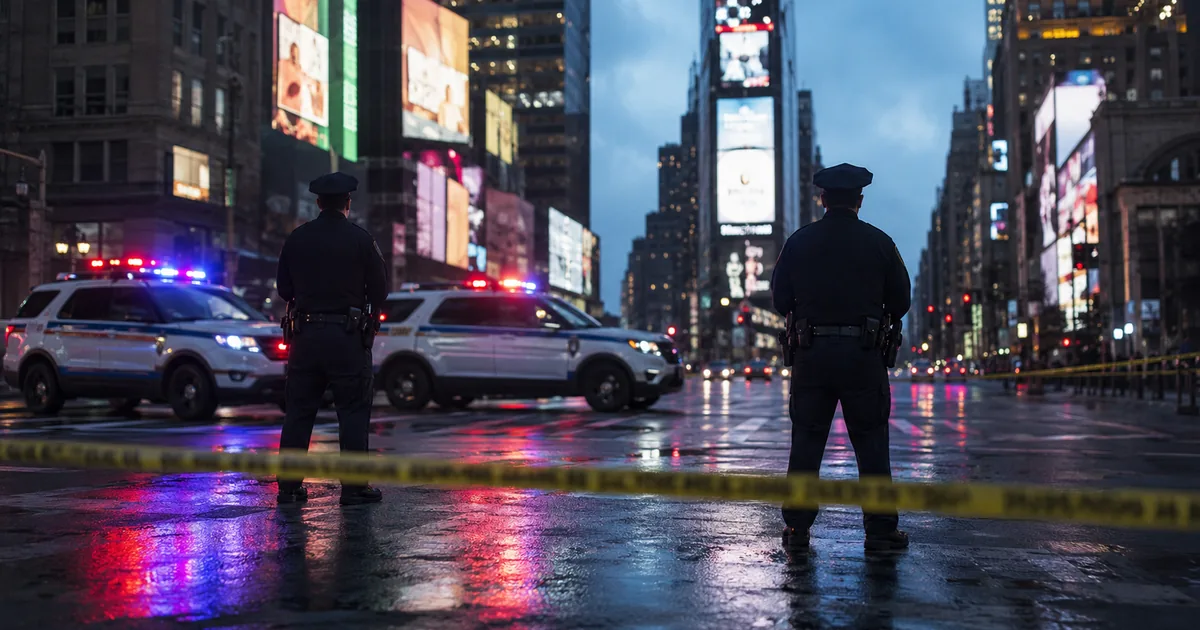
A woman carrying two kitchen knives stabbed two people along Seventh Avenue in Times Square on Monday afternoon, and by the end of the encounter she and one of her victims were dead.
Every account published tonight contains the same two facts, and not one of them sets those facts side by side.
So here they are together. ABC7 New York reported that the stabbings came in around 4:26 p.m. and that officers fired at 4:27. In that gap, according to the Associated Press account of videos from the scene, at least ten officers had formed a ring around her, one of them fired a Taser, and it did not incapacitate her. She kept moving at them. As one officer backed away, he and at least two others drew their handguns.
That sequence is not a footnote to the story. It is the story. Tonight’s wire copy files the Taser at paragraph six as texture and treats the timestamps as chronology, when read together they describe a police department climbing the de-escalation ladder in the correct order, reaching the top of it in about a minute, and finding nothing above it.
What Happened on the Block
The facts are still thin and some of them have already moved twice. Police say the woman was carrying two large kitchen knives, which CBS New York reported she had pulled from a red Target bag, and that she attacked two strangers within about twenty seconds of each other. Officers were on it almost immediately, responding just after 4:20 p.m.
The geography matters for understanding how fast this ran. The attack began in the low 40s on Seventh Avenue and the woman moved north toward the NYPD’s Times Square substation, near West 43rd Street, which is where officers caught up with her. amNY reported that a Taser struck her, and that she then extended her arm with the weapon in hand and walked toward the officers. She was pronounced dead at a hospital. Law enforcement officials told NBC News the attack does not appear to be terrorism.
One victim, a woman, was taken to Bellevue Hospital and pronounced dead. Early reports described her as a tourist. The man she stabbed survived, and here the reporting genuinely splits: CBS New York, citing police, put him at 68 and in stable condition on Monday evening, while ABC7 New York still had him listed critical. That spread is ordinary in the first hours of a story like this, and it is worth naming rather than smoothing over, because the same churn is why the initial dispatch went out as a knifepoint robbery before police revised it. They now say the woman appeared to be emotionally disturbed and that there is no clear motive. Neither victim has been publicly identified. Anyone writing tonight with confidence about who she was or what she wanted is filling in blanks the department has not filled in.
The Rung Below Lethal Force Is Not Reliable
The reason the Taser matters is that its failure is not an anomaly, and that is the part nobody covering tonight has said out loud.
APM Reports built an entire investigation on this exact failure mode. Its “When Tasers Fail” series identified more than 250 fatal police shootings nationwide between 2015 and 2017 that happened after a Taser failed to incapacitate someone. In 106 of those cases, the person became more violent after absorbing the shock. The same reporting found officers in several large departments rating the weapons unreliable as often as 40 percent of the time, against manufacturer Axon’s field-effectiveness claims in the range of 86 to 97 percent.
The academic literature lands in similar territory. A five-year less-lethal analysis catalogued in the National Criminal Justice Reference Service library logged 2,113 Taser deployments, of which 1,459 ended the confrontation on the first application. That is a 69 percent success rate, which is respectable for a tool and catastrophic for a plan. Roughly one time in three, the device meant to prevent a shooting does not prevent a shooting.
Departments have spent two decades selling the Taser to the public as the humane middle option, the answer to what officers are supposed to do when a person is armed and sick at the same time. On Monday afternoon, on the most heavily policed block in America, the middle option was tried and it did not hold.
Sixty Seconds Is Not a Training Gap. It Is the Design.
The officers did everything the policy asks for, in the order the policy asks for it, and the policy ran out of road in about a minute.
Consider what a minute forecloses. It is not enough time to summon a crisis-intervention team. Not enough for a clinician to arrive, or for a supervisor with more training to take over the scene, or for anyone to spend twenty minutes talking someone down, which is the thing that actually works on a person in psychiatric crisis when there is room to do it. New York has spent years promising a mental-health response that reaches people before an encounter becomes this one. Whatever version of that system currently exists, it does not arrive on Seventh Avenue inside sixty seconds while someone is stabbing strangers.
None of that is an argument that the officers should have waited. Two people were already bleeding on the sidewalk, twenty seconds apart. It is an argument that by 4:26 the range of available outcomes had mostly been set, and that the decisions worth arguing about were made long before anyone reached the block.
We have watched the framing collapse this way before. When a stabbing at Covent Garden put similar questions to the Metropolitan Police, the story turned on what the force chose to call the attack before it knew what the attack was, and on how fast a mental-health emergency gets reclassified into something more legible. The vocabulary always arrives ahead of the facts.
Where We Come Down
Two readings of this are already forming and both are wrong, for the same reason. One says police executed a woman in psychiatric crisis in the middle of Times Square. The other says it was a clean shoot, she had two knives, there is nothing here. Both fail against the same piece of tape, because the tape shows officers doing what they were trained to do, in the sequence they were trained to do it, and running out of options anyway.
The argument worth having is not about what one officer decided in second fifty-nine. It is about why the rung directly below lethal force is a device with a documented failure rate that departments keep describing as reliable, and why a city that has promised a real mental-health crisis response for years still fields nothing that shows up inside a minute. Those are procurement decisions and budget decisions. They were made in advance, by people who will not be named in any of tonight’s coverage, and they are why the menu was that short when it counted.
The NYPD should release the body-camera footage, and quickly. When it does, the question to ask is not whether the shooting was justified under the standard as written, because on what is known so far it very likely was. The question is how many seconds of real option those officers had, and who set that number long before Monday.
Two people are dead and neither has been named. A 68-year-old man spent the evening in a hospital bed because he walked through Times Square at the wrong moment. That is the running cost of a system whose answer to a person in crisis with a knife is a device that works about two times in three.