
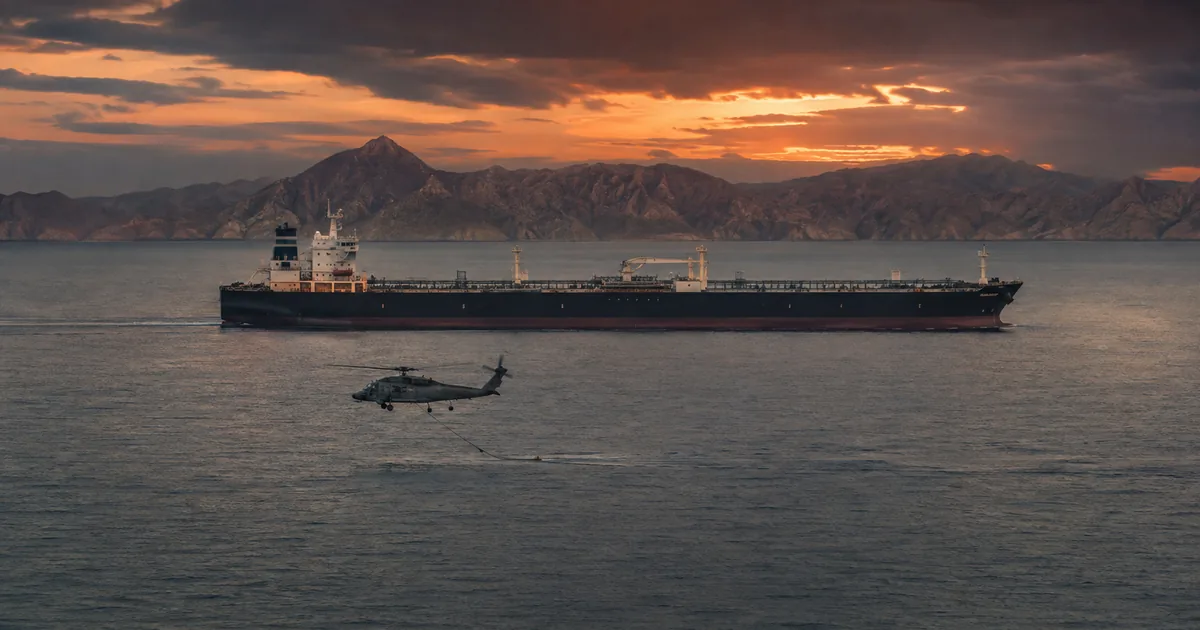
President Donald Trump justified Tuesday’s strikes on Iran as retaliation for what he called a failed attempt at adding sea mines to the Strait of Hormuz, barely a week after announcing that the mines in the waterway had already been removed and detonated.
Both claims can be true at the same time, and the fact that nobody covering Tuesday’s escalation has stopped to say so is the reason the coverage keeps missing what this war is now about.
The day’s reporting has settled into a scoreboard. CNN counted the targets, NBC News carried Trump’s description of “large and powerful” strikes, and the wires logged the Iranian promise of revenge. What none of it examines is the premise underneath the whole campaign: that a naval mining threat is something you can finish. Mine clearance is perishable. An all clear in a mined waterway describes a moment, not a condition, and pricing that distinction correctly is the difference between a strait that is open and one that merely has no confirmed mines in it today.
What Tuesday Actually Hit
US Central Command said on X that the strikes followed attempted IRGC attacks on commercial shipping in the strait and on American service members in the region. Iranian state broadcaster IRIB reported impacts along a long stretch of the southern coast: Bandar Abbas, Jask, Minab, Sirik and Qeshm Island around the strait itself, and the twin ports of Chabahar and Konarak several hundred miles east on the Gulf of Oman.
That target list is worth reading closely, because it is two different campaigns wearing one press release. Bandar Abbas and Qeshm sit on the chokepoint. Chabahar and Konarak do not; they sit outside it, on open Indian Ocean water, and Chabahar is the one deep-water port Iran can use when the strait is unusable. Striking both sets on the same afternoon is not chokepoint defense. It is an argument about whether Iran gets a maritime economy at all.
Iran’s response arrived within hours. An IRGC spokesman said that “a severe punishment awaits the aggressors,” and Tasnim claimed an American MQ-9 had been downed near Khomein. Trump, for his part, called the operation a “very justified attack” and said the US was still holding back what he described as the biggest attack of them all.
“Removed and Detonated” Has a Short Shelf Life
Late last month the US announced it had cleared the international shipping lanes, with Trump saying the mines had been removed or detonated and threatening to destroy any vessel that tried to lay more. On Sunday, US forces struck two rocket launchers on Larak Island that officials said were preparing to fire mines into the strait, an operation we covered as the first break in a month-long lull. Iran answered by firing on two American bases in Jordan, where the military said it intercepted at least eight missiles. Then came Tuesday.
So the sequence runs: mines cleared, mines being laid again, strikes to stop the laying, retaliation, more strikes. The clearance held for something under two weeks, and the campaign designed to enforce it has produced three rounds of escalation in five days.
The Premise Itself Is Contested
There is a further wrinkle that the day-one coverage has skipped almost entirely. It is not settled that Iran can do the thing these strikes are meant to prevent.
Al Jazeera put the rocket-mining claim to naval specialists and got a sharply skeptical answer. Retired senior US naval officer Harlan Ullman called the concept implausible, noting that a rocket hitting the water at speed would do considerable damage to the mine it was carrying. Against that, Iranian state television demonstrated the technique in January 2025, and Iran has advertised the capability itself using its Fajr-5 launchers.
Both things point the same direction, which is the uncomfortable part. Whether or not the tactic works, the advertisement works. Iran does not need a functioning rocket-delivered minefield. It needs shipowners, and more precisely their underwriters, to believe one might exist.
The Number That Is Actually Closing the Strait
This is where the strike campaign and the war it is fighting come apart.
War risk premiums for Hormuz transits went from roughly 0.25% of hull value to between 1% and 3% when underwriters reclassified the waterway in late February. On a $150 million tanker that moves a single crossing from about $375,000 to somewhere between $1.5 million and $4.5 million. At the peak of the panic in early March, CNBC reported that benchmark rates for very large crude carriers hit an all-time high of $423,736 a day, a jump of more than 94% in a single trading session, as insurers pulled back from war risk cover.
A mine that has been cleared costs an insurer nothing. A mine that might be laid tomorrow costs about the same as one that is already there.
Crude has tracked belief rather than barrels. It ran past $188 late in April, fell back toward $70 by late June as the ceasefire held, and closed above $94 on Tuesday. Nothing about the physical supply of oil changed on Tuesday afternoon. What changed was the market’s estimate of how long the next all clear will last, which is the same variable that has kept traffic depressed through every reopening this year, and the reason the strait never returned to normal even when the ceasefire was holding.
Our View
The United States is running a counter-platform campaign against a counter-confidence weapon, and it is losing on the exchange rate. Every launcher destroyed is real and verifiable. None of it touches the number on the underwriting slip, because that number is set by the possibility of mines rather than the inventory of them. Iran can restore the threat with a televised demonstration and a rocket that may not even work.
The specific error worth naming is the announcement. Declaring the strait cleared converted a military claim into a market signal, and it created a standard the Pentagon then had to defend with strikes on seven coastal locations within a fortnight. A quieter posture, holding the lanes open without certifying them safe, would have cost nothing militarily and would not have handed Tehran a headline to falsify. The clearance was the achievement. Announcing it was the mistake, and Tuesday is the bill.
Watch the war risk rates rather than the target lists. If underwriters hold near current levels through the week, Tuesday was noise. If they move back toward the February reclassification, then the strikes on Chabahar and Konarak will have told Iran something useful about how far the US is willing to go, and Tehran will have learned it for the price of a rocket it may never need to fire.