
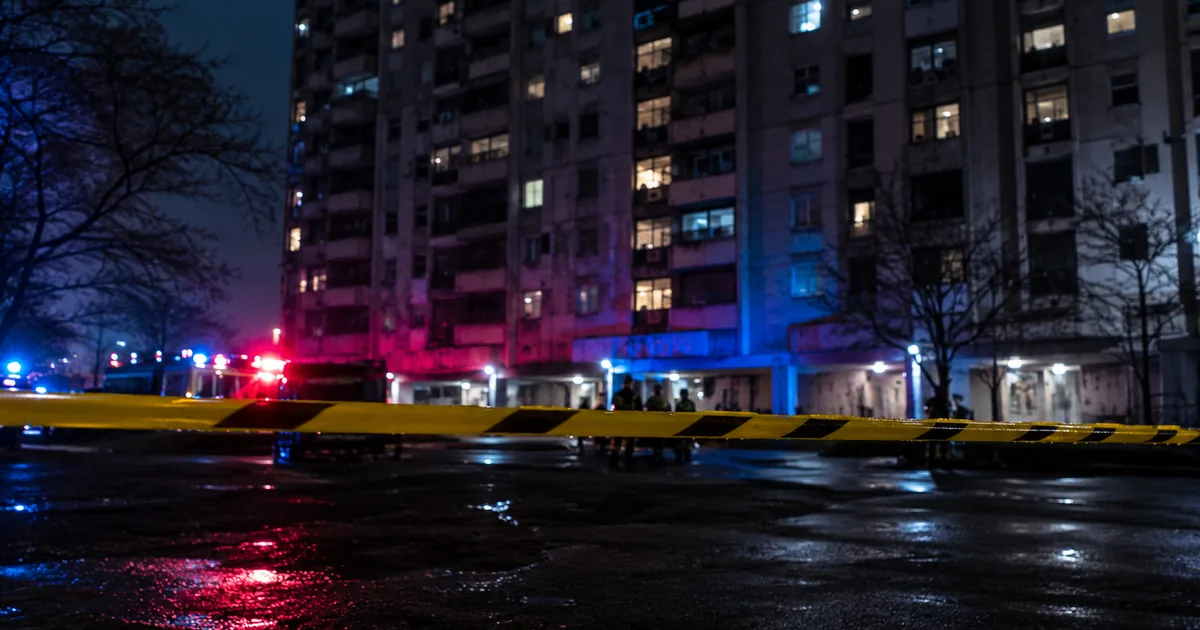
Minneapolis police entered an apartment building on East Grant Street late Wednesday afternoon and a gunman opened fire on them, wounding two officers and leaving at least six people shot.
Every outlet covering this is calling it a downtown Minneapolis shooting, which is true and which misses the thing that matters most about it.
The address is 15 East Grant Street. That is Loring Towers, a 230-unit subsidized high-rise that the City of Minneapolis financed through a bond issuance recorded in its own council files, and it is the same building where two residents were shot dead in a hallway and a lobby eleven months ago. Nobody covering tonight has connected those two events. They should, because the recurrence is the story. A city that can put officers from eight outside agencies on one address inside twenty minutes has not managed to change anything inside that address since the last time people died in it.
What Is Confirmed, and What Is Very Much Not
Hold the numbers loosely. They moved twice while this piece was being written.
Police were called to the building and, according to law enforcement sources cited by KSTP, “when officers entered the building, a shooter opened fire on them.” Initial reports came in around 4:50 p.m. Central. CBS Minnesota, in an update timestamped 6:15 p.m., put it at one civilian dead and six injured, with seven people transported to Hennepin Healthcare. KSTP and BNO News were reporting at least two civilians killed by early evening. Treat the toll as unsettled.
One officer was shot in the stomach and was in surgery as of 5:39 p.m. The other was shot in the leg and the wound is not life threatening. A high ranking official told WCCO that both officers are “likely to be alright.”
The suspect’s status is the part being reported least carefully elsewhere, so here it is plainly: officials have not released it. A University of St. Thomas alert told students a shooter had been located and one person was in custody. A source told WCCO that a suspect was down, which scanner traffic appeared to corroborate. The gunman reportedly ended up on the ninth floor. Those accounts have not been reconciled by anyone in a position to reconcile them, and until Minneapolis police say so on the record, we are not going to tell you how this ended.
Police asked the public to stay clear of the area bounded by 12th Street, Franklin Avenue, Hennepin Avenue and Third Avenue South.
The Address Is Not Incidental
On September 27, 2025, Gregory Scarver, 42, and Prince Jhun Nebres, 43, were shot to death inside Loring Towers, one man in the first floor lobby and the other in a second floor hallway, both with shotgun wounds. Robert Cardell Warren, 51, was charged with two counts of second degree murder. The Star Tribune reported that case as an ambush. All three men lived in the building.
Police Chief Brian O’Hara said something at the time that reads differently tonight.
While today’s event is not random, it is still yet another painful reminder of how quickly arguments can turn deadly when guns are involved.
Loring Towers is not a luxury tower with a doorman. City and state housing records describe 189 studio apartments and 41 one bedrooms, in service since 2004, housing elderly, disabled and formerly homeless residents. It is exactly the kind of building where a single armed resident in a corridor is a catastrophe, and exactly the kind of building whose residents have the least capacity to move somewhere else after the first one.
Two ambushes in the same building inside a year is not a coincidence anyone should be comfortable calling a coincidence.
Everything Arrived, and It All Arrived Afterward
The response Wednesday was genuinely fast and genuinely large. Minneapolis officers were inside the building quickly enough to be among the first people shot, which forecloses any argument that this was a slow or thin response. It was not. They went in and they got hit going in.
Then came everyone else: ATF agents out of the St. Paul field division, the Hennepin County Sheriff’s Office, the Minnesota Bureau of Criminal Apprehension, the State Patrol, and officers from St. Louis Park, Edina, the University of Minnesota and transit policing. Governor Tim Walz said his public safety team was responding and that “state officials are on the ground to support local law enforcement.” FBI Director Kash Patel said he would offer “any and all resources necessary to assist local authorities.”
That is an impressive amount of state capacity, and every bit of it is downstream of the gunfire. None of it was available to the people in that building at 4:49 p.m.
Here is where we come down. The surge is not the achievement it is being presented as. Minneapolis has spent the eleven months since the last Loring Towers ambush litigating how many officers it is legally required to employ, and roughly none of that argument has been about the specific building where people keep getting shot. Mayor Jacob Frey told the city in his State of the City address on May 5 that the department is “currently sitting at 642 officers, up from around 550, and next year, we’re hoping to reach our charter number of 733.” A 2022 Minnesota Supreme Court ruling in Spann v. Minneapolis City Council held that the mayor has a legal duty to employ at least 731. The force stands at 649, and a judge has since found that Frey “violated and continues to violate his duty,” ordering him to hit the charter number by January 4 or face a contempt trial in April. The city’s Office of Community Safety says the criticism is unfair, noting it has “brought on more than 150 officers since the beginning of 2025.”
We are not going to pretend the headcount explains what happened Wednesday, because there is no evidence that it does and plenty that officers got there fast. The point is narrower and, we would argue, harder to answer: the entire public safety conversation in this city is about how many people show up after a call, and a building with a known, repeated, specific problem generated a second mass casualty ambush anyway. Staffing is a real fight worth having. It is not a prevention strategy, and it is being used as one.
The other Minneapolis pattern worth holding alongside this is how often the city’s violent incidents now pull in federal agencies by default, a reflex visible in January’s fatal shooting of a US citizen by federal agents. More badges from more jurisdictions is the answer the system reliably produces, because it is the answer the system knows how to produce.
What to Watch
The immediate questions are the identity and status of the shooter, whether the death toll holds at one or rises, and whether the two wounded officers stay on the good side of “likely to be alright.” Those will be answered within a day.
The question worth returning to in a month is narrower and nobody will hold a press conference about it: what, if anything, changed at 15 East Grant Street between last September and this one, and what will change now.