
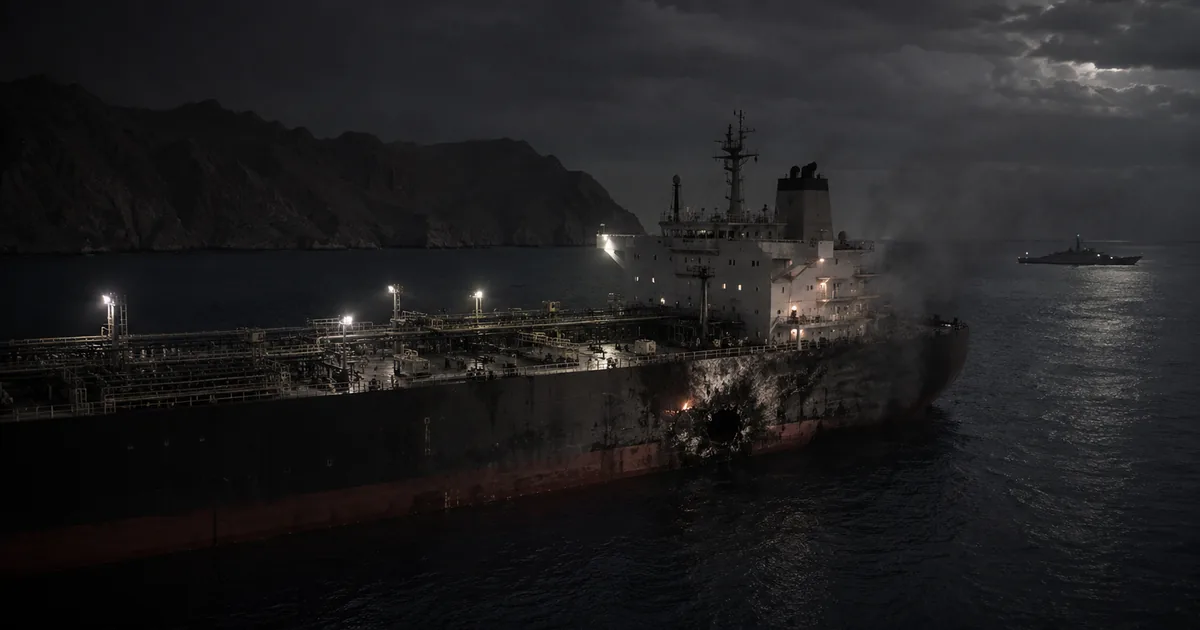
Saudi Arabia said Wednesday that an Iranian attack on the tanker Sidr killed two Filipino seafarers in the Strait of Hormuz, and Iran’s answer is that a supertanker struck mines while using a route Iran had not authorised. Both stories describe the same waterway, one where Tehran decides who crosses it safely, which is why the fight over which version is true matters far less than the coverage suggests.
Almost every account of this has framed the mine-versus-missile question as the thing to resolve. It is worth resolving, but nobody has said the obvious part out loud: Iran’s alternative explanation is not exculpatory. It is the accusation in softer language. A government that says your ship was destroyed because it took an unapproved path through an international strait is claiming the same authority as a government that shot at it. And this is now the second crew fatality in that corridor in a little over two weeks, both of them under a standing American assurance that the strait is open.
Three Governments, Three Accounts, One Pair of Hulls
The facts everyone agrees on are thin. The Sidr, operated by Bahri, Saudi Arabia’s national shipping company, was hit at 23:40 local time on Monday, August 31, north of Oman’s Musandam Peninsula, while completing an outbound transit. Minutes away and the same night, the Senegal Prosperity, run by South Korea’s Sinokor Group, was struck by three projectiles roughly 17 nautical miles east of Khasab. No one aboard the second ship was hurt. Two Filipino seafarers on the Sidr were killed.
From there the accounts split three ways. Saudi Arabia’s foreign ministry named Iran as the attacker on Wednesday and said the kingdom “stressed the necessity of halting escalations, and respecting international maritime safety and the security of global energy supplies,” a formulation so careful it reads like a country deciding in real time how angry it is allowed to be. Bahri would only say it was “in continuous contact with the vessel and coordinating closely with the relevant authorities and maritime industry stakeholders.”
Iran’s Revolutionary Guard offered a different version entirely: a supertanker on the strait’s southern route hit two mines, caught fire and was brought to a complete stop. US Central Command rejected that outright.
No ships have hit mines in the Strait of Hormuz. This is yet another IRGC attempt to intimidate regional commercial shipping through disinformation.
That is three official narratives about two hulls, and they cannot all be right. Two of them cannot even be partly right at the same time. Iran had not responded to the Saudi accusation as of publication.
The Mine Story Is Not the Defence Iran Thinks It Is
Here is what makes the Iranian version self-defeating. Tehran did not simply say a mine went off. It said the tanker was on an unauthorised route, which is a direct callback to the warning Iran’s military command issued in July, when it told shipowners that any deviation from Iran’s designated routes would draw a forceful response: failure to comply with “the navigation protocols of the Islamic Republic of Iran in the Strait of Hormuz will be met with an immediate and forceful response from the armed forces, endangering the security of the violating vessels.”
Read the two Iranian statements together and the mine explanation stops being a denial. In July Iran promised consequences for ships that route themselves independently. In September Iran explained a lethal incident by noting the ship had routed itself independently. Whether the consequence arrived as a mine or a missile is a forensic detail. The claim underneath it, that a strait recognised as international water is Iran’s to license, is identical in both tellings, and it is the part that should worry anyone with cargo or crew in the Gulf.
Our position is straightforward: the mine-versus-missile argument is a distraction that serves every government involved and none of the people who died. It lets Iran contest attribution without retracting the threat. It lets Washington win a fact-check while the traffic numbers keep saying the opposite of its talking point. Neither of those helps the next crew that has to make this transit.
The Second Dead Crew in Two Weeks
The Sidr is not the first ship in this corridor to send someone home in a coffin this month. On August 18 a cargo ship was struck by a projectile while exiting the strait, damaging its engine room and killing a crew member, with Oman’s coast guard assisting the survivors. That same day President Trump described the Strait of Hormuz as “open and operating.” CNBC checked the claim against the shipping data and found observed traffic at a five-day average of ten crossings, the lowest since May, against a pre-crisis baseline in the high double digits. Roughly a fifth of the world’s oil and liquefied natural gas moved through this strait before the United States and Israel began striking Iran on February 28.
We made a version of this argument on Monday, hours before the Sidr was hit, when we wrote that the mines nobody can find were doing more to close Hormuz than the ones the Navy cleared. The point then was about insurance. It is sharper now. “Open and operating” is not a neutral description when owners route ships on the strength of it. It is an assurance, and two crews have now been killed sailing on it. The administration should either escort the traffic it says is safe or stop describing it as safe, because the current arrangement outsources the risk of American messaging to merchant sailors who have no say in any of it.
Who Is Actually Standing on These Decks
The nationality of the dead is not incidental detail, and it is the part the wire copy drops after the first paragraph. The Philippines remains the world’s largest supplier of seafarers, with 203,179 officers and 256,968 ratings in the most recent count from the Baltic and International Maritime Council and the International Chamber of Shipping, ahead of India, China, Russia and Indonesia. Filipinos are roughly a quarter of the global maritime workforce.
Run that against a shooting war in a shipping lane and the arithmetic is grim and predictable. The casualty list from a confrontation between Washington and Tehran will skew Filipino, not because the Philippines is a party to it, but because Filipino contract workers are the ones standing watch on other countries’ hulls carrying other countries’ oil. Manila’s Department of Migrant Workers has been reduced to asking manning agencies to observe safety protocols on high-risk transits, which is what a government says when it has no leverage over any of the parties actually shooting.
What Comes Next Is Already Visible
The regional response arrived fast. Bahrain condemned the attack, called it a violation of international law and asked the UN Security Council to act, while the UAE denounced Iran’s hostile attacks across the region after Iranian missiles and drones hit Bahrain, Jordan, Kuwait and Iraq. Iran has spent the week converting neutral neighbours into aggrieved ones, which is the sort of own goal that outlasts any single tanker.
There is an irony worth noting in the timing. A multinational maritime defence coalition began its operational phase on Wednesday from headquarters in Saudi Arabia, under Saudi command with a Pakistani deputy and thirty-nine countries at its last planning meeting. Its stated focus is Bab al-Mandeb, the Red Sea and the Gulf of Aden. The two sailors died in the Strait of Hormuz, several hundred miles outside the mandate, on the day the coalition opened its doors.
Bahri has now lost or had attacked four vessels since July, the Wedyan, the Masa and the Amzan in the Red Sea at Houthi hands, and now the Sidr at the other end of the Arabian Peninsula. When a national carrier is being hit on both of its main routes by two different sets of shooters, the question stops being who fired and becomes whether anybody intends to hold the sea lanes open at all. Nobody has answered that. Two families in the Philippines are waiting on it.