
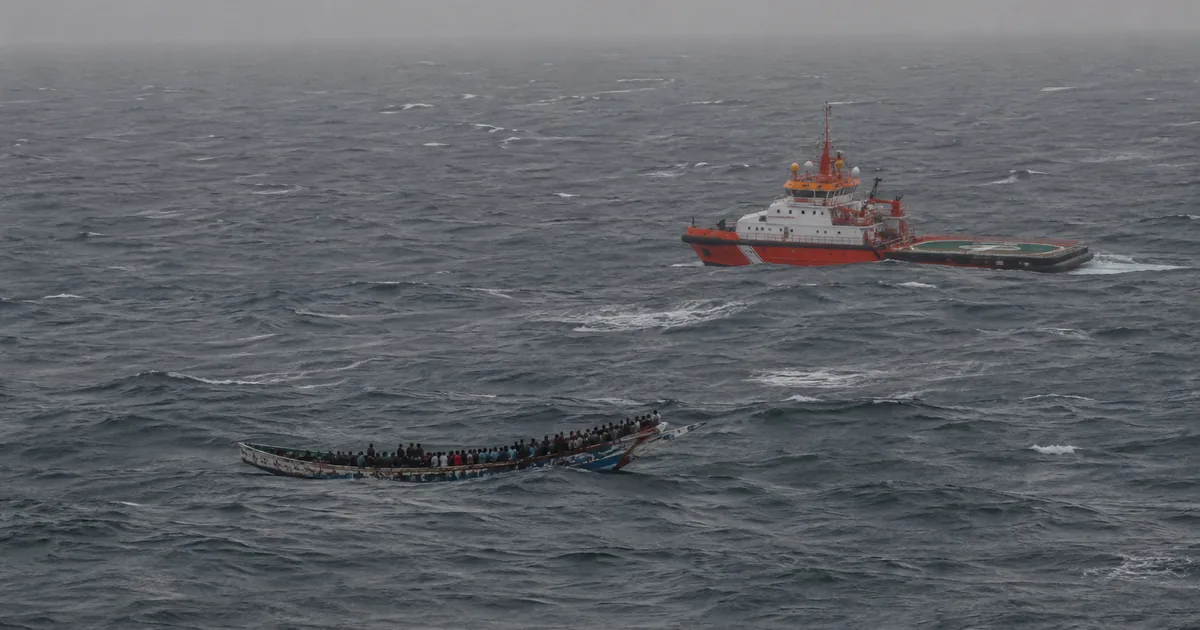
The wooden boat that Spanish rescuers reached 65 nautical miles southwest of Arguineguín on Wednesday afternoon was still floating.
It had been floating the entire time, which is the fact that explains this disaster and the one almost nobody has led with.
Coverage since Thursday morning has settled into a familiar package: a death toll above 80, a line from the president of the Canary Islands about the Atlantic being a death trap, and the running annual count of people who die trying to reach Spain. What that package leaves out is that this vessel never capsized. Spanish Maritime Rescue found it intact, with dozens of people alive on board and five bodies lying among them, after roughly 26 days at sea on a crossing that normally runs five to eleven days. There was no shipwreck to report. The people who died on that boat died of elapsed time, and elapsed time is something policy sets.
The Boat Never Sank
A Salvamento Marítimo search plane spotted the cayuco on Wednesday afternoon, around 120 kilometres south of Gran Canaria. The rescue vessel Guardamar Urania did not reach it until roughly midnight. Three survivors in serious condition were airlifted out, and the remaining 41 were brought into the port of Arguineguín in the early hours of Thursday, according to reporting carried by the Jerusalem Post from Reuters. The survivors are men from sub-Saharan Africa. A baby is among the dead.
The boat had left The Gambia in early August. Helena Maleno Garzón, who founded the Spanish monitoring group Caminando Fronteras, puts the death toll at 83. That number is not a count of bodies. It is the difference between the number of people who got on and the number who came off, and everyone involved understands what happened to the gap: they went over the side, one at a time, across three and a half weeks.
Cayucos are big wooden fishing boats, up to about 25 metres, and they are the sturdiest thing on this route. They are the boats people choose when they can. This one did its job. It stayed on the surface for 26 days with more than a hundred people on it and delivered 44 of them alive to a Spanish port. The failure was not structural.
Twenty Six Days on a Crossing That Takes Ten
Here is the arithmetic that the wire copy leaves as background colour:
- From Mauritania or Senegal, the run to the Canaries is typically five to eleven days.
- From the southern departure points it stretches past two weeks, over roughly 1,700 kilometres of open Atlantic.
- The Gambia sits further south again.
- This boat was at sea for 26 days, which even the Spanish reporting describes as exceptional for the route.
Boats end up adrift this long for reasons that are not mysterious. They run out of fuel, or water, or food, and the Canary Current carries them west into nothing. The people aboard are then alive, visible from the air, and entirely dependent on somebody flying over the right patch of ocean. Every day that does not happen kills a few more of them.
Which reframes the whole event. If a boat capsizes in heavy weather, the meaningful variables are the vessel, the load, and the sea state. This boat presented none of those problems. The only variable that mattered was how long it took anyone to find it, and it was found on day 26 by an aircraft, not by a rescue service that knew it was out there.
Nobody Can Say Whether 127 or 128 People Got On
The English-language wires, working from the Press Association, report 127 people aboard at departure, 44 survivors and 27 days adrift. The Spanish outlets working from EFE, among them Infobae and TheObjective, report 128, 45 and 26. The distances agree, because 65 nautical miles and 120 kilometres are the same measurement.
Treat the discrepancy as information rather than sloppiness. There was no manifest. There is no passenger list to check a survivor count against, so the totals come from what 44 exhausted men could tell officials in the hours after they landed, and they differ by one because human recollection differs by one. The number of people who died on this boat is a reconstruction, and it will stay a reconstruction. That is true of most of the deaths on this route, which is worth holding in mind whenever the annual figures get quoted with a decimal point.
The Ocean Did Not Change
Fernando Clavijo, who heads the Canary Islands government, said it is intolerable that lives continue to be lost and that the Canaries cannot accept as normal that the Atlantic is still a death trap. The sentiment is decent. The framing is not, and it is the framing every outlet picked up.
The Atlantic is not a death trap. It is an ocean, and it is the same ocean it was five years ago. What changed is where the boats now start from, and that changed because Europe paid for it to change. Spain pledged 210 million euros to Mauritania to stop departures from the closer stretches of coast. Caminando Fronteras, in its monitoring work this year, records departure points shifting toward more distant areas as controls tighten, including boats now leaving from Essaouira in Morocco, 175 kilometres north of Agadir.
Once the rescue was complete, adverse weather conditions in the area, featuring 20-knot winds and 2.5m waves, made it impossible to recover the five bodies found on board the vessel.
The result of that shift is measurable, and Caminando Fronteras measured it. Arrivals to Spain fell 72.1% year on year while deaths fell only 57.2%, which is the group’s own way of saying the route became proportionally deadlier as it got quieter. A total of 1,317 people died trying to reach Spain in the first five months of 2026, and as the Catalan daily Ara reported, 635 of those deaths were on the Atlantic route to the Canaries. Fewer boats, longer crossings, a higher share of the people on them dead on arrival.
Our position on this is not complicated. A deterrence policy that pays other governments to push departures further from patrolled water has chosen longer voyages, and longer voyages on this route mean more days adrift and more people dying of thirst on a boat that is still afloat. Those deaths are the policy working as designed, not the policy failing. Calling the ocean a death trap moves the agency onto the weather, and the weather did not sign a 210 million euro agreement. Spain and the European Union did. If the measured outcome of that spending is a smaller number of crossings and a deadlier one, the honest response is to say so and to fund detection at the same scale as interception, rather than to mourn the arithmetic as though it arrived from the sky.
This is the same logic that produced the 57 deaths at Ceuta and the 48,300 returns to Morocco inside two days earlier this summer: enforcement measured by the volume it stops, never by what happens to the people it displaces onto a worse route.
Five Bodies, Left
The detail that should stay with anyone reading this is the last one. Spanish Maritime Rescue took 44 people off that boat and then could not take the dead, because 20-knot winds and two and a half metre swells made it impossible, and because the living needed a hospital more than the dead needed a port. So the cayuco was left on the water with five bodies still on it.
That is what the end of a 26-day drift looks like, and it happened 120 kilometres from a Spanish island with an airport, a coastguard and a hospital. The question worth asking is not whether the Atlantic is dangerous. It is why a boat carrying 128 people can sit on the surface of it for most of a month, inside the search range of a European state that spends heavily to know where these boats are, and be found on day 26 by accident.