
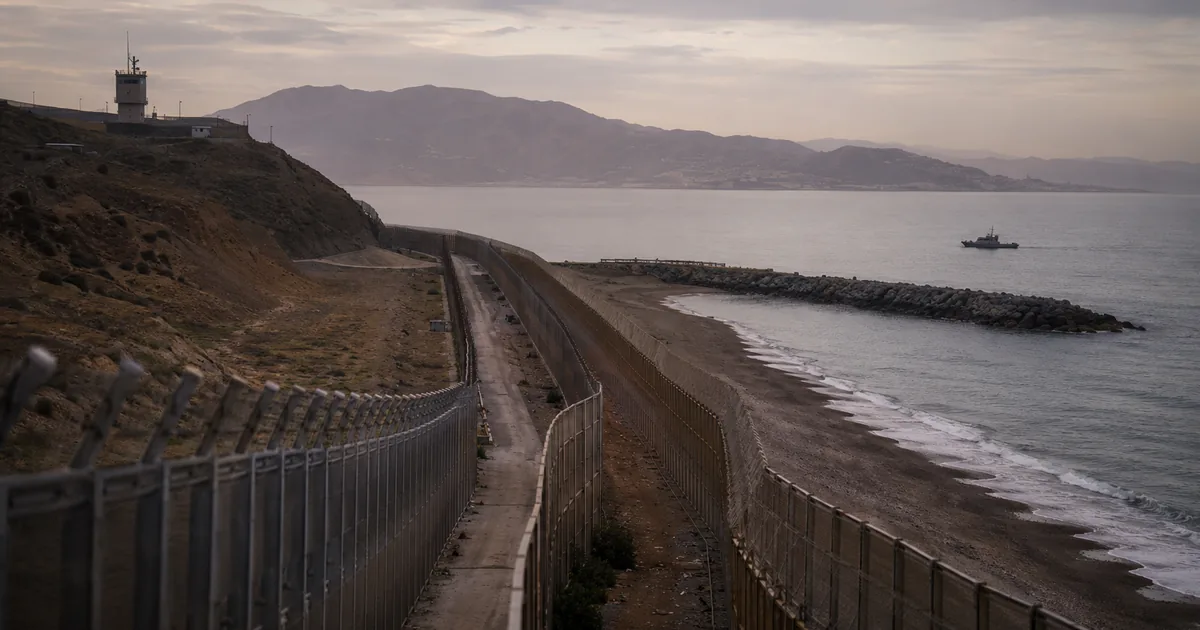
Spanish authorities confirmed on Friday evening that 57 people died trying to reach Ceuta, many of them drowning and others crushed against the breakwater at Tarajal beach. By six o’clock that same evening more than 48,300 of the roughly 50,000 who had made it across were already back in Morocco, which is a striking piece of logistics for a government that spent the day describing itself as overwhelmed.
Almost every account of this week has settled on the same explanation, and Spain’s own ministers have been the loudest voices pushing it: a Supreme Court ruling opened a door, smuggling networks advertised it, and 50,000 people walked through. That story is doing a great deal of political work right now, and it is worth being precise about what the court actually said, because the ruling being blamed for the deadliest day at this border in years did not cover most of the people who crossed.
The Ruling Everyone Is Blaming Was Narrower Than the Crisis
Spain’s Aliens Act contains a provision permitting what the country calls rechazo en frontera, a summary return carried out at the border with no individual case file and no meaningful review. It has always been the state’s fastest and least accountable immigration power, and its legal trigger is specific: the person has to have crossed a physical border containment element. A fence, in other words.
The Supreme Court issued its ruling on June 29 and it was made public on July 8. As Euronews reported in its account of the legal dispute, the court held that someone who swims around the breakwater has not crossed a containment element at all, because there was no barrier in the water to overcome. People arriving that way therefore cannot be pushed straight back. They are entitled to an individual file.
Read the holding carefully and it is almost mundane. It did not grant anyone a right to enter Spain, and it did not touch the fence at all. Anyone climbing the land border remained summarily returnable on Friday exactly as they had been in June. What the court created was not an opening but a distinction, and distinctions are legible. Spain’s Interior Ministry has said that human trafficking networks are exploiting the ruling to encourage the flow of undocumented migrants, mostly young people, and Prime Minister Pedro Sanchez has blamed mafias for misinterpreting it. Time’s explainer on the surge traced how the decision was amplified across Moroccan social media in the weeks that followed.
Both of those framings are half right in a way that flatters the government. The networks did not misinterpret anything. They read a procedural line between the water and the fence, and they transmitted it accurately as a routing instruction: swim, do not climb. The Spanish state wrote that instruction itself, in the structure of its own returns law, and the court merely declined to pretend the water was a wall.
The Arithmetic of 48,300
Here is the number that has drawn the least scrutiny this week. Spain’s Interior Ministry put returns to Morocco at more than 48,300 by six o’clock Friday evening, out of close to 50,000 arrivals that began Thursday morning. CBS News reported the same figure as authorities worked through the enclave.
Run the arithmetic. Even spread across a full day and a half of continuous operation, that is better than twenty people processed and moved across the border every minute, without pause, overnight. Euronews described the bulk of them as having returned voluntarily.
Set that against the ruling. The court’s requirement, for sea arrivals, was an individual case file. It is difficult to reconcile a rate of twenty a minute with individualized assessment of anything, which leaves two possibilities. Either the overwhelming majority of these arrivals were classified as land crossings and returned under the summary power the court left completely intact, or the individualized process the court demanded is being performed at a speed that empties the word of content. Neither reading supports the claim that the judiciary tied Spain’s hands. The government just demonstrated, at scale and in public, that its returns machinery works.
Morocco’s Hand Is on the Valve
There is a reason Ceuta produces these events and the rest of Spain’s coastline does not. Morocco disputes Spanish sovereignty over Ceuta and Melilla, and border enforcement on the Moroccan side has functioned for years as an instrument of that dispute rather than a fixed quantity.
The precedent is recent and close to exact. In 2021, amid tensions over Western Sahara, Moroccan controls loosened and roughly 8,000 people entered Ceuta in two days. This week the same border produced something over six times that in a comparable window. Morocco’s ambassador has said the situation is not wanted by the Kingdom of Morocco and that it prioritizes legal, orderly and safe immigration, and Moroccan forces did deploy water cannon at the crossing gates. Both things can be true at once. A frontier capable of yielding 8,000 in one year and 50,000 in another, on the strength of a decision taken in Madrid’s courts, is a frontier with a valve on it, and no Spanish judge controls the valve.
Italy Reached for Schengen Within a Day
The European reaction moved faster than the Spanish one. Italy temporarily restored some border controls on travel from Spain, and Giorgia Meloni raised suspending Schengen free movement outright, a step EU legal experts questioned was even available to her. France’s interior minister ordered controls on the Spanish border strengthened immediately. European Commission President Ursula von der Leyen called the images unacceptable and demanded rapid returns and the dismantling of smuggling networks.
That sequence deserves more attention than it is getting. An event confined to a nineteen-square-kilometre enclave on the African coast, lasting roughly thirty-six hours and already reversed by Spain’s own returns before most of Europe had reacted, was enough to put internal Schengen borders back up in two countries. The suspension mechanism was built as an emergency valve of last resort. It is being reached for earlier with each cycle, and each reach lowers the threshold for the next one.
What the Bill Would Actually Change
The People’s Party has put forward an amendment to the Aliens Act’s tenth additional provision that would extend summary returns to anyone entering Ceuta or Melilla irregularly through any unauthorised point, whether by land or by sea. It would erase the distinction the Supreme Court drew, which is the entire point of it. Migrant advocacy groups have warned that it would strip individual safeguards, with unaccompanied minors the clearest casualty.
Sanchez, for his part, called the crossings a violation of Spain’s territorial integrity and pledged to defend Ceuta as if it were Madrid, while Ceuta’s regional president Juan Jesus Vivas described a serious humanitarian crisis in his own city. Both men were describing the same forty-eight hours. Al Jazeera reported that the government’s confirmed toll of 57 arrived Friday evening, well after Vivas had put it at 34 earlier in the day, which tells you how little anyone on the ground could see while it was happening.
Fifty-seven people drowned or were crushed on a route they took because it was the route that required paperwork. The response taking shape in Madrid is to remove the paperwork. It is worth asking, as that bill moves, whether anyone supporting it will be made to explain how a faster deportation would have kept a single one of them from going into the water.