
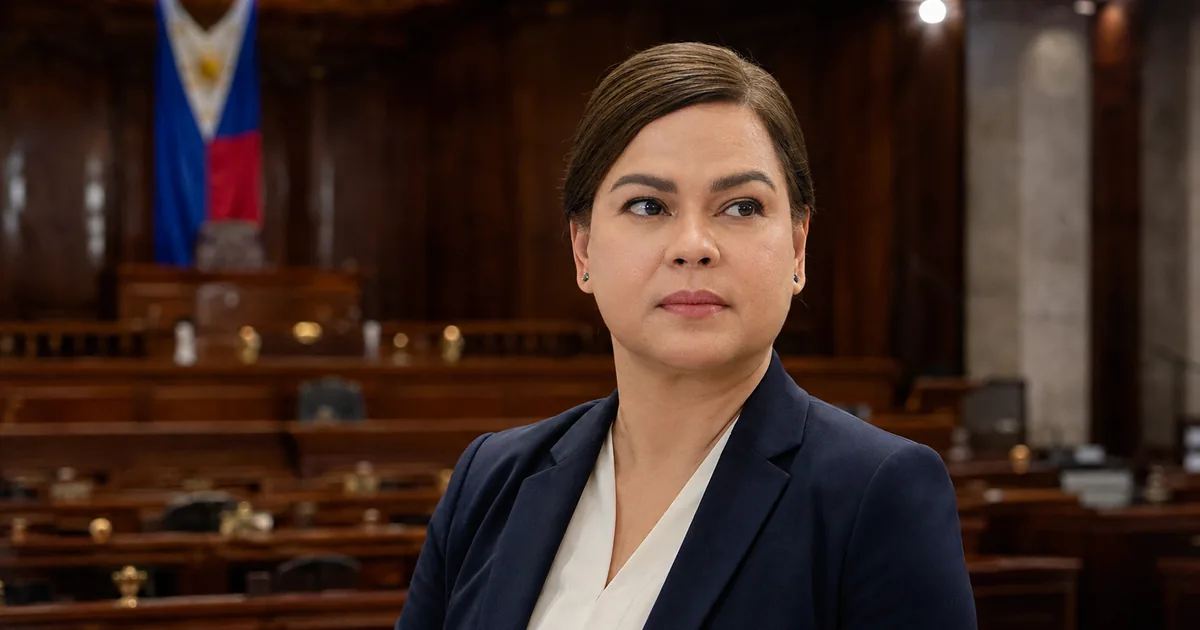
A Quezon City court ordered the arrest of Philippine Vice President Sara Duterte on Friday, and her lawyers were talking about posting bail before most of the coverage had even published.
That tells you most of what you need to know about the warrant everyone is leading with.
Nearly every account of Friday’s order frames it as the moment the walls closed in on the sitting vice president of a treaty ally of the United States. The framing is backwards. Two separate proceedings are running against Duterte off the same remark she made in November 2024, and the criminal one that produced Friday’s warrant is by a wide margin the weaker of the pair. It is bailable at 120,000 pesos a count, and under Philippine law it does not stop her running for president in 2028. The Senate impeachment trial that opened on July 6 is the one that can end her career permanently, and it did not generate a single push notification on Friday.
What the Warrant Actually Costs Her
The Quezon City Regional Trial Court issued the warrant over three counts of grave threats, and Rappler reported that it set bail at 120,000 pesos on each count. That is roughly 360,000 pesos in total, or about 6,000 US dollars, to stay out of a cell while the case proceeds. Her counsel Paul Lawrence Lim confirmed the warrant had been received and said she has no intention of evading the law and will keep pursuing her legal remedies. GMA News reported that her camp intended to post bail as soon as possible.
Bail is not the only reason the criminal track is the softer one. Philippine election law generally permits candidates to run for office while criminal charges are pending against them, a point TIME made in its account of the warrant. A grave threats conviction is not the kind of disqualification that keeps a name off a ballot, and Duterte has already said she intends to contest the presidency in 2028, when President Ferdinand Marcos Jr. reaches the end of his single six-year term.
So the sequence that actually happened on Friday is this. A court found probable cause, issued a warrant, set a price, and the vice president’s lawyers moved to pay it. House prosecutor Zia Alonto Adiong was right when he said the warrant indicates the court found probable cause in the threat cases. He was describing a procedural finding, not a reckoning.
The Ruling Underneath the Warrant
The genuinely new thing in Friday’s order is not the warrant. It is what the court had to decide before it could issue one.
Duterte had moved to quash the case on jurisdictional grounds, arguing that impeachable officers carry a limited procedural immunity while they hold office and cannot be hauled before a trial court in the middle of a term. Her lawyers had asked the court to hold off on any warrant while that motion was pending. The court denied it. That reading has always been shaky: the 1987 Constitution grants immunity from suit to the president, and it conspicuously does not extend the same shield to the vice president. Constitutional scholars have made that point for years, including the late Joaquin Bernas, one of the charter’s framers, who argued long before this case that the country’s second highest official enjoys no such protection.
A trial court rejecting vice-presidential immunity is a precedent that outlives this defendant and this feud. It is the part of Friday worth filing away, and it is the part almost nobody put in a headline.
The Remark That Both Cases Are Built On
The underlying facts have not changed since late 2024. During a midnight online press conference on November 23, 2024, held while her chief of staff was being detained, Duterte told viewers she had arranged for Marcos to be killed if she were killed first. Al Jazeera covered the remarks the same day.
I already talked to someone. I told him, if I am killed, kill Marcos, Liza Araneta and Martin Romualdez.
She said she was not joking, twice. Romualdez was the Speaker of the House at the time and is Marcos’s cousin. Liza Araneta Marcos is the first lady. Duterte later characterized the remark as an expression of consternation rather than a threat, and her defense has leaned on that framing since. Justice Department prosecutors filed the three counts of grave threats on August 11 of this year, roughly three weeks before the warrant landed.
The Trial That Carries the Lifetime Ban
The same remark is also one of the articles of impeachment, and that is the proceeding with teeth.
The House impeached Duterte for a second time on May 11 and transmitted the articles to the Senate three days later, and the Senate convened as an impeachment court on May 18. As Al Jazeera explained when proceedings opened, the trial proper began on July 6. It is still running, with no verdict. The articles go well past the assassination remark, alleging betrayal of public trust, culpable violation of the Constitution, graft, and bribery tied to the handling of confidential funds at the Office of the Vice President and at the Department of Education, which she led from 2022 to 2024.
Conviction requires two thirds of the 24-seat Senate. It would remove her from office and bar her from holding any elected post for life, a stake The Diplomat flagged when the chamber first took the case up. That is the difference between the two tracks, and it is not a subtle one. One costs her about 6,000 dollars and an afternoon. The other ends the political career of a 47-year-old who is currently the most plausible successor to the presidency.
Why Both Cases Exist at All
The structural answer is a broken alliance. Marcos and Duterte ran together in 2022 as a unity ticket built on two of the most powerful political families in the country, and the partnership collapsed well before the midterms. What is playing out now in a Quezon City courtroom and a Senate chamber is a succession fight conducted through legal instruments, with 2028 as the prize. Her father, former president Rodrigo Duterte, has been in International Criminal Court custody at The Hague since March 2025, which puts the family’s political survival squarely on her.
That context does not make the charge frivolous. It is the opposite of frivolous. A sitting vice president said on a livestream that she had contracted someone to kill the president, the first lady, and the Speaker, and then confirmed she was serious. In most democracies that ends a career on the day it happens, without a court needing to be involved. The fact that it took nearly two years to reach a courtroom, and that the resulting charge is bailable at pocket change for a national figure, is a story about the weakness of the accountability mechanism, not its strength.
Here is where we land. The immunity argument deserved to lose, and the court was right to reject it, because a constitution that shields the president and stays silent on the vice president is not ambiguous by accident. But readers should be skeptical of anyone presenting Friday as justice arriving, including the wire coverage that led with the arrest order and left the Senate trial as background. The venue that matches the gravity of what Duterte actually said is that Senate chamber, where the penalty is permanent, and the trial has been grinding on since July with far less attention than a warrant she plans to buy her way out of by the end of the week.
Watch the Senate, not the courthouse steps. The warrant is a headline. The verdict is the story.