
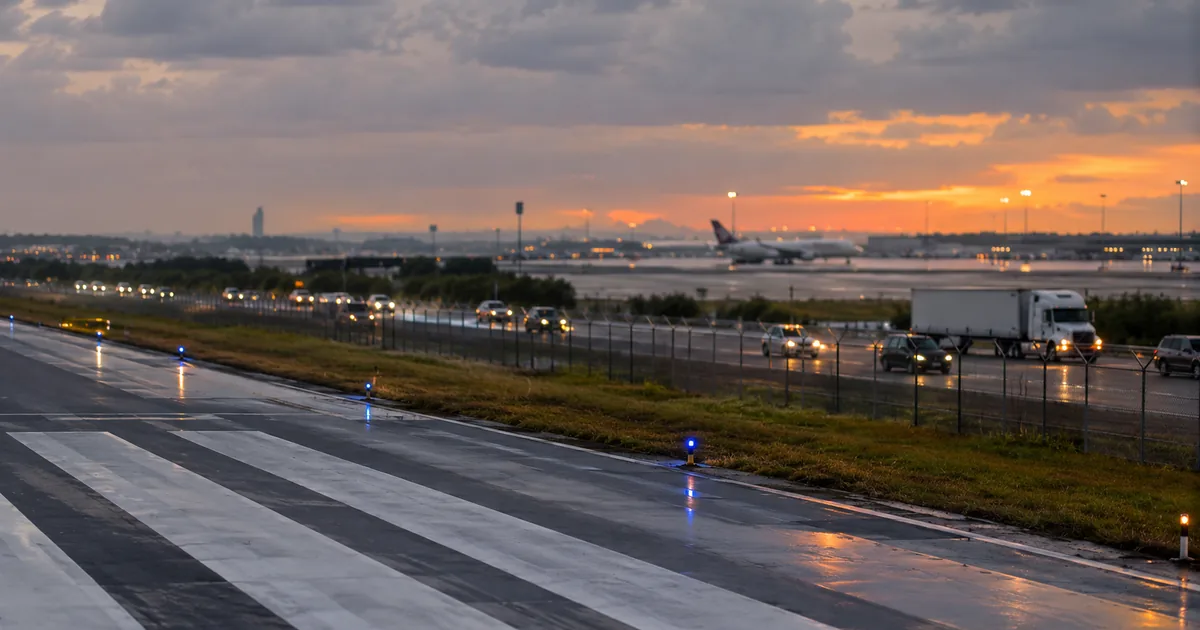
A Boeing 767 freighter was still doing roughly 130 miles an hour when it ran out of Runway 30 at Miami International Airport on Sunday afternoon, and there was nothing past the pavement built to slow it down.
Five people died, none of them on the plane. They died in vehicles, on a roadway, because a jet that should have stopped on airport property kept going until it hit them.
That last detail is the story, and it is the one almost nobody is telling. The coverage has settled on the crash itself: the black smoke over west Miami-Dade, the more than 60 fire units that answered the call, the ground stop that stranded 450-odd flights, five dead and five hospitalized with three of them critical. What is missing is the piece of infrastructure that exists precisely so an overrun stays inside the fence, and that Miami International does not have on a single one of its four runways.
The Fix Has Existed for Thirty Years
The Federal Aviation Administration calls it an Engineered Materials Arresting System. It is a bed of crushable cellular cement laid past the runway end. An aircraft that overruns sinks its tires into the material and decelerates. The agency’s own fact sheet on the technology, last updated on August 12 of this year, three and a half weeks before Sunday, explains why it was invented in the first place: many US airports were laid out before the modern runway safety area standard, and cannot physically fit the graded 1,000 feet the FAA wants beyond each runway end. The obstacles the FAA lists by name are bodies of water, railroads, populated areas and highways.
Miami International is the textbook case. It is boxed in by roads on every side. It is also, by the FAA’s own accounting, supposed to be handled: the agency says it has facilitated runway safety area improvements at more than 500 commercial airports, and that “all practicable improvements, including the use of EMAS technology, have been made at approximately 1,000 runway ends.”
Approximately 1,000 runway ends. Runway 30, at one of the country’s largest international freight gateways, was not one of them.
The FAA’s tally of what those beds have actually done is on the same page. Twenty-six overrunning aircraft stopped. Four hundred ninety-seven crew and passengers aboard them. The most recent arrestment was a Learjet 60 at Teterboro in April of this year, six people on board, walked away. Zero fatalities across the entire record.
The Honest Caveat, Which Makes the Case Stronger
Here is what an arrestor-bed advocate will not volunteer, so we will. The FAA states plainly that a standard EMAS installation is engineered to stop most aircraft overrunning at 70 knots, about 80 miles an hour. Flightradar24’s tracking data has 21 Air Flight 7598 leaving the usable runway at close to 130. A bed built to the standard spec would very likely not have brought that 767 to a full stop.
It would have taken energy out of it. That is the entire question here, and it is a physics question rather than a rhetorical one: the difference between a 767 crossing a public road at 130 miles an hour and crossing it at 60, or 40, or stopping in a field short of it, is the difference between five dead motorists and a wrecked airplane. Every one of the 26 EMAS arrestments on the FAA’s list ended with a damaged aircraft and living people. Sunday ended the other way, and the reason it did is that nothing between the end of the pavement and the traffic was designed to absorb anything at all.
We are not going to pretend to know why the aircraft did not stop on the runway. That is what the National Transportation Safety Board is in Miami to determine, and the investigators will spend a year on the approach profile, the landing gear, the braking, the touchdown point and the surface conditions. All of that matters. None of it changes the design question, which is separate and answerable today: when a landing goes wrong at Miami International, where does the airplane go?
Whose Airplane Was It, Exactly
The second thing worth correcting is a matter of nouns. Every headline this weekend called this an Amazon plane. It was not, in the sense that matters legally or operationally. The 767 was flown by 21 Air, a Greensboro carrier operating on its own FAA certificate, carrying freight for Amazon under the arrangement the industry calls ACMI: the contractor supplies the aircraft, the crew, the maintenance and the insurance, and the customer supplies the routes and the boxes. Amazon owns the network and the paint scheme. It does not hold the operating certificate, and it will not be the party the NTSB examines.
We have been here before, and the sequence is worth remembering because it is about to repeat. In February 2019 an Atlas Air 767 flying Amazon Prime Air freight went into Trinity Bay outside Houston and killed all three people aboard. That flight had departed from Miami International. The NTSB’s final report found the first officer had concealed a history of failed training from his employers and that no system existed to catch it, and the board’s recommendations landed on the contract carrier’s hiring and on the FAA’s pilot records database. Amazon’s name was in every headline for a week. It appeared nowhere in the findings.
That structure is not an accident, and it is not illegal. It is a deliberate arrangement in which the most valuable brand in the chain carries none of the certificate risk. Our position is that it should not survive this one intact. If your logo is on the tail and your logistics network sets the schedule, the flying is yours in every way a customer would understand the word, and the safety record ought to attach to you too. Amazon Air moved to a contractor fleet because it is cheaper and faster than becoming an airline. Fine. Then publish the audit results for every carrier on the network, and let people see what the model buys.
What Should Happen Next Is Small and Boring
Miami-Dade County owns the airport. It has spent the last decade on a multibillion-dollar capital program of concourses, baggage systems and terminal glass. An EMAS bed costs a few million dollars per runway end. The airport has four runways and hundreds of thousands of people living, driving and working around its perimeter, which is exactly the condition the FAA cites when it explains why the technology exists.
Runway safety failures at big American airports have stopped being rare enough to treat as freak events. This site covered two pilots killed at LaGuardia in March when a jet hit a fire truck on an active runway, and a Denver takeoff that killed a man who had climbed the perimeter fence in May. Different failures, same underlying condition: the boundary between the airfield and everyone else is thinner than the public assumes.
The NTSB will take a year. The arrestor beds do not require the report. Miami-Dade and the FAA can put Runway 30’s overrun area on the next capital cycle this month, and if they do not, somebody should have to say on the record why five deaths on a public road did not make it practicable.