
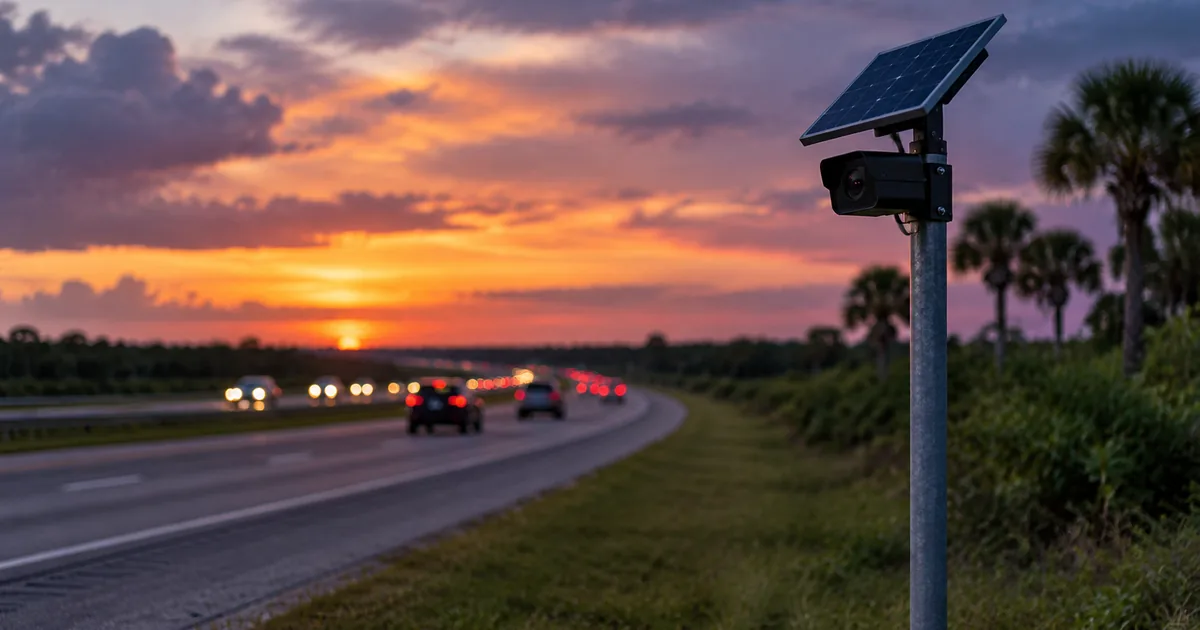
The Florida Department of Transportation revoked every permit for automated license plate readers sitting in state right-of-way on August 31 and gave agencies 30 days to take them down.
It is the loudest move any state has made against Flock Safety, and by the best available count it reaches about two percent of the cameras watching Florida drivers.
That number is the part almost nobody ran. The headlines said Florida banned license plate readers, and Governor Ron DeSantis said the technology was out of control and warned the state could turn into “some type of digital prison.” What FDOT actually did was cancel a category of encroachment permits on land it controls. Engadget put the arithmetic plainly: the rule change does not touch the 98 percent of Florida ALPRs installed on local roads and private property, because the state transportation department has no say over any of them.
What the Memo Covers, and What It Cannot
The order itself is narrow by design. WUSF reported that FDOT revoked existing approvals for license plate recognition systems in state rights-of-way, halted all future permit requests in its jurisdiction, and said it will pull down anything still standing after the deadline. The memo cited the speed of the rollout alongside “concerning reports of misuse, data privacy concerns, and surveillance schemes.”
Every word of that is a real finding. None of it applies to the camera bolted to a pole on a county road, the one in a shopping plaza parking lot, or the one a homeowners association bought for the entrance to a subdivision. Those are the installations that make up the network. NBC News framed the action as a ban on state highways specifically, which is accurate and also the whole story: the jurisdictional line is the policy.
The Cameras Were Already Coming Down, One Council Vote at a Time
Florida did not start this. When we counted the national ALPR network in August, the pattern was already a municipal one, and it has accelerated since. The advocacy group DeFlock now tallies at least 214 communities that have dropped Flock since 2021, with roughly 90 of those cancellations landing in August 2026 alone, across 23 states. California and Wisconsin lead. New York, Washington and Massachusetts are close behind.
That is the mechanism that has actually removed cameras from American streets: a city council meeting, a contract that comes up for renewal, a room full of residents. It is slow and it is unglamorous, and it has taken down more hardware than any governor’s memo.
Why the Misuse Cases Are Driving This
The backlash is not abstract privacy anxiety. It is a run of specific, documented abuses by the officers who hold the search box. ABC News reported that a Kentucky officer was arrested after allegedly using Flock to track an ex-girlfriend more than 2,000 times, and that six police department employees in Savannah, Georgia were fired in August over alleged misuse. The Institute for Justice has identified more than 100 ALPR abuse incidents, stalking and wrongful stops among them. Reporting elsewhere puts the number of officers accused of unauthorized tracking at 46 and counting.
“The biggest, most grassroots privacy backlash that I’ve ever seen in more than 20 years working on these issues.”
That is an ACLU senior policy analyst describing the reaction, and the description holds up against the tally. Flock has responded with product changes, cutting its default data retention from 30 days to seven and adding case-code requirements for law enforcement searches by the end of the year. When the company announced a similar package of safeguards in August, the ACLU welcomed the retention cut and called most of the rest superficial. Immigration enforcement is the other engine here. NPR traced cancellations back to residents who did not want their local police feeding a federal deportation dragnet, a concern that has only sharpened since.
A Permit Revocation Is Not a Law
Here is where we land. DeSantis is right about the problem and his order is not a serious answer to it. He reached for the only lever a governor can pull unilaterally, a transportation department permit file, and then told the legislature to consider restrictions on the rest. That sequencing tells you what this is. If the state genuinely believes a private company operating a searchable, warrantless, nationwide movement database is a threat to Floridians, the remedy is a statute that binds every ALPR in Florida regardless of who owns the pole it hangs on, with a warrant requirement for queries, a hard retention cap written in law rather than set by vendor policy, and an audit trail residents can actually see. Florida’s legislature meets in January. Nothing stops that bill from being filed now.
There is also a tension the state has not addressed. A large share of the local anger driving these cancellations is about ALPR data reaching federal immigration enforcement, which is a policy this administration has enthusiastically supported. You cannot campaign against a digital prison and also cheer for its most active tenant.
The 30-day clock runs out around the start of October. Two things are worth watching: whether FDOT actually sends crews to remove cameras that are still up, and whether a single bill covering local roads gets filed in Tallahassee before the session opens. If the answer to both is no, Florida will have removed a rounding error from the surveillance network and issued a press release about it.