
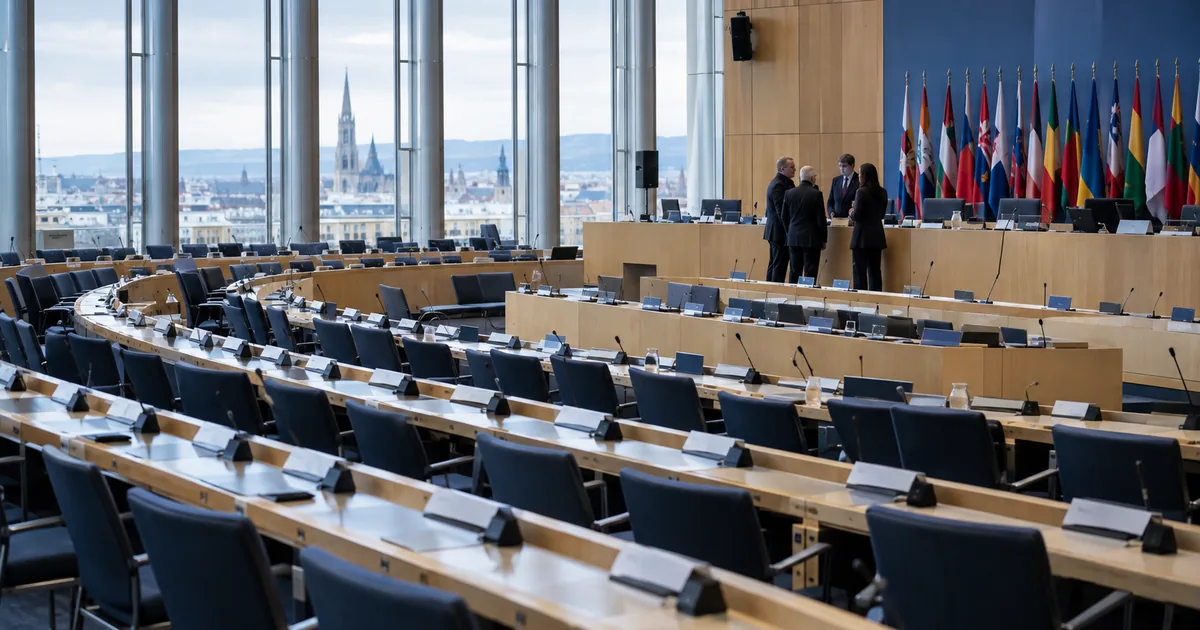
The International Atomic Energy Agency’s board of governors voted 23 to 3 on Wednesday to report Iran to the United Nations Security Council over its non-proliferation obligations, the first referral of its kind in two decades.
Nearly every account of that vote has framed it as an escalation, which is the one thing it cannot be, because the Security Council reimposed the entire pre-2015 sanctions architecture on Iran in September 2025 and did not need the IAEA’s permission to do it.
That is the piece missing from the wire copy. The referral is being written up as a door swinging open onto punishment, when the punishment arrived a year ago and changed very little. What the vote actually produces is a paper trail, and the question worth asking is why Washington and its European partners wanted one badly enough to spend a board vote on it.
What the Board Actually Voted On
The resolution was submitted by the United States, Britain, France and Germany, and Al Jazeera reported that Russia, China and Niger voted against it while eight members abstained. It calls on Iran to “urgently remedy its non-compliance” and to produce “updated verifiable declarations about the quantity and whereabouts of nuclear material,” alongside restored inspector access at all facilities. As France 24 noted, it follows a June 2025 finding that Iran was already in non-compliance, a determination the board made the day before Israel began bombing Iranian nuclear sites.
Iran’s response was immediate and unsurprising. Its ambassador in Vienna, Reza Najafi, called the resolution a political tool, and the country’s UN mission argued the situation exists “solely because of the criminal acts of aggression by the U.S. and Israeli regime.”
The Punishment Already Happened
Here is what almost no coverage of Wednesday’s vote bothered to say out loud. Britain, France and Germany triggered the snapback mechanism written into the 2015 nuclear deal on August 28, 2025, and the previously terminated UN sanctions came back into force a month later, on September 28. The Arms Control Association’s timeline puts both dates on the record, and it is worth noticing what they sit beside. The Council was scheduled to close its Iran file for good on October 18, 2025. Snapback fired three weeks ahead of that deadline and kept the file open instead.
So the Security Council that received Iran’s file on Wednesday is not a body waiting to act. It is a body that already acted, using a mechanism that deliberately bypassed the veto Russia and China are now expected to use. That is the whole reason snapback existed. Its architects understood in 2015 that a referral could be blocked and built a one-time workaround, and the E3 spent it last year.
There is not much left in the drawer. Moscow and Beijing maintain the snapback authority has since expired, while the E3 insists other provisions of the original resolution remain live, a dispute Security Council Report has documented across months of contested briefings. Wednesday’s referral lands on top of that argument without settling any of it. It cannot produce new sanctions, because the two governments holding vetoes are the same two that voted no in Vienna.
Nobody Can Count the Uranium, and That Is the Actual Emergency
The verification problem is real, urgent, and almost entirely absent from the day’s headlines.
Before the June 2025 strikes, the IAEA had verified that Iran held roughly 440 kilograms of uranium hexafluoride enriched to 60 percent, a stockpile Al Jazeera reported had grown by half in a single reporting period. That material sits close to the 90 percent that weapons require and far above the 3.67 percent the 2015 agreement allowed. Inspectors have not been able to confirm its size, composition or location since, and nuclear sites were struck again in the fighting that began on February 28. Director General Rafael Grossi has assessed that more than 400 kilograms remain somewhere inside the damaged complexes at Isfahan, Fordow and Natanz, under structures nobody has been permitted to examine.
The agency’s lack of information about these facilities is a matter of serious proliferation concern.
That is Grossi’s own framing, and he has been repeating versions of it since the strikes. Al-Monitor reported that the agency is now pressing Iran to close the gap with “utmost urgency,” with Grossi offering that restored access would carry “positive repercussions” for Tehran. Fifteen months on, the assurance that nothing has been diverted still does not exist. A referral does not produce one. Only inspectors standing inside those buildings produce one, and Wednesday’s resolution contains no mechanism to put them there.
Who Broke the Cameras
This is where the house position matters, because the governments demanding verifiable declarations are largely the governments that made verification impossible.
The IAEA lost access to Iran’s key nuclear sites because those sites were bombed, first by Israel and then by the United States. Whatever one thinks of the strikes, their direct and predictable effect was to destroy the monitoring regime that had been producing the only independent numbers anyone had. Iran’s subsequent refusal to readmit inspectors is its own choice and its own violation, and the country walked away from the diplomatic track before that, as we covered when Iran abandoned nuclear talks and threatened the Strait of Hormuz. Both things are true. But a Western coalition cannot bomb the inspection system, spend the one veto-proof sanctions lever it had, and then treat a symbolic board vote as evidence of a strategy.
What would count as a strategy is trading something Iran wants for inspector access to Isfahan and Fordow, on a defined timetable, with the referral held in reserve rather than cashed for a news cycle. That is unglamorous and it is the only move that puts eyes on 400 kilograms of near-weapons-grade material. The sanctions leverage that might have funded such a trade was already spent, and the enforcement machinery around it has been fragmenting for most of the past year.
What the Referral Is Actually For
Read as enforcement, Wednesday’s vote is close to empty. Read as record-keeping, it makes more sense: it puts a formal, dated, multilaterally endorsed finding of non-compliance into the UN system, which is the kind of document that matters later, when someone wants to justify a harder action and needs to show the peaceful channels were exhausted first.
That is not nothing. It is also not what it is being sold as, and the gap between those two readings is worth watching over the next several weeks. If the Security Council takes up the file and produces nothing, as Russia and China’s vetoes suggest it will, the interesting question becomes what the referral gets cited in support of six months from now.