
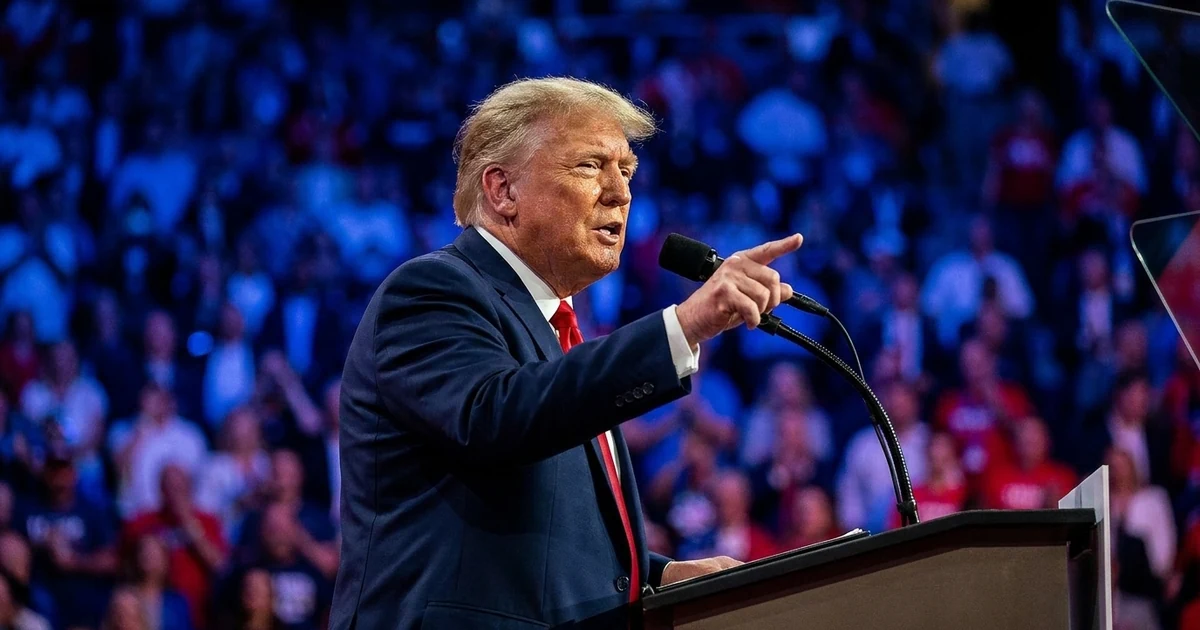
An hour into his keynote at the Republican National Committee’s midterm convention in Dallas on Wednesday night, President Donald Trump told the room that every American citizen would get a $5,000 payment, on one condition: Republicans have to hold the House and the Senate first.
He called it the Trump Dividend, said it would be funded in part by tariffs, and offered no mechanism for actually sending it.
Coverage of the promise has been extensive and almost entirely forward-looking, as though this were a new proposal being floated for the first time. It is the second one. Trump promised a tariff-funded dividend of at least $2,000 per person in November 2025, said the checks would arrive by mid-2026, and they never came. The reason they never came is the same reason this one will not: the Supreme Court struck down the tariff authority the whole idea rested on, seven months ago, and the Treasury has been writing refund checks ever since.
The Money Is Going Out, Not Coming In
On February 20, 2026, the Supreme Court ruled 6 to 3 in Learning Resources, Inc. v. Trump that the International Emergency Economic Powers Act does not give a president the power to impose tariffs. Chief Justice John Roberts wrote the opinion. The law firm Holland & Knight, in its client guidance on the decision, described a ruling that invalidated a year of collections and sent importers straight to the refund window.
The scale of that reversal is the part missing from this week’s coverage. The Penn Wharton Budget Model put roughly $164.7 billion of IEEPA tariffs on the books through January 2026 and projected up to $175 billion in refunds flowing back out. It also found IEEPA duties made up about 52% of all customs revenue at the time, which means future tariff collections fall by roughly half unless something replaces them. The Bipartisan Policy Center’s tariff tracker, built on daily Treasury statements, notes that the first refunds started going out in early May and that the reimbursement surge is visible in Customs and Border Protection’s withdrawals from the general fund.
Now hold that against the promise. CBS News put the cost of a $5,000 payment at around $1.35 trillion, based on roughly 270 million adults. Tariffs brought in something on the order of $195 billion across all of fiscal 2025, their best year on record. Even at that peak, and even if every dollar were diverted to checks and none to the government, the dividend is about seven years of gross tariff revenue. The actual revenue line is now half what it was and is running negative against refunds.
There is no arithmetic here. There is a number said out loud to a crowd.
Congress Writes the Checks, and It Already Declined Once
The other thing the president cannot do is appropriate money. CNN’s account of the night noted he did not say whether he would ask Congress to authorize the payments, which is the only route that exists.
That route has already been tried. After Trump floated direct payments in July 2025, Senator Josh Hawley introduced the American Worker Rebate Act of 2025 to send tariff-funded checks to households. It went to the Senate Finance Committee and stopped there. When Axios reported the $2,000-by-mid-2026 version of the pledge in November 2025, the bill was already stalled. By February, after the Supreme Court ruling, CNBC was quoting Bankrate analyst Stephen Kates saying the odds of the checks were “now effectively zero”.
So the record on tariff dividends now reads:
- July 2025: the idea is floated, and a bill follows.
- November 2025: $2,000 per person, promised by mid-2026.
- February 2026: the funding authority is struck down 6 to 3, and refunds begin.
- September 2026: the number goes up to $5,000, and a condition is attached.
The amount rose by 150% after the money to pay for it was taken away.
Our View: The Condition Is the Story, Not the Number
If the Republicans win, you win with us and you get $5,000.
President Donald Trump, RNC midterm convention, Dallas, September 9, 2026
Politicians promise money they cannot deliver constantly, and voters discount it. That is normal, and if this were only an unfunded promise we would file it with the rest.
It is not only that. The payment was explicitly conditioned on an election result. Not on a bill passing, not on revenue arriving, not on a second term’s agenda. On which party controls Congress in November. That framing turns a federal payment into a reward contingent on how people vote, from a president who does not control the appropriation and could not fund it if he did.
We think that is worse than an empty promise, and it should be named as what it is rather than covered as a policy proposal with missing details. The details are not missing. The mechanism does not exist. Treating “how would this be paid for” as an open question gives the pledge a seriousness it has not earned, and it fits a pattern this administration has run all year of leaning on election machinery it does not own, including firing the last Election Assistance Commission members four months before the midterms.
What should happen next is straightforward, and it does not involve the White House. If any member of Congress believes American households should receive a tariff-funded payment, there is a bill sitting in Senate Finance with a number on it. Move it, mark it up, and show the offsetting revenue. Absent that, the Trump Dividend is a campaign line with a dollar sign, and the honest question to ask anyone repeating it between now and November is not when the checks arrive. It is which appropriation they are coming out of.