
Memory is already becoming scarcer than oil for AI, and Lenovo has unexpectedly emerged as one of the main beneficiaries of this new reality. According to the latest earnings reports, the world’s largest PC manufacturer reported a 27% increase in quarterly revenue to $21.6 billion, significantly exceeding market expectations. The company’s shares jumped by 20% on the news, placing Lenovo among premarket movers as customers rushed to purchase computers ahead of another rise in memory prices.
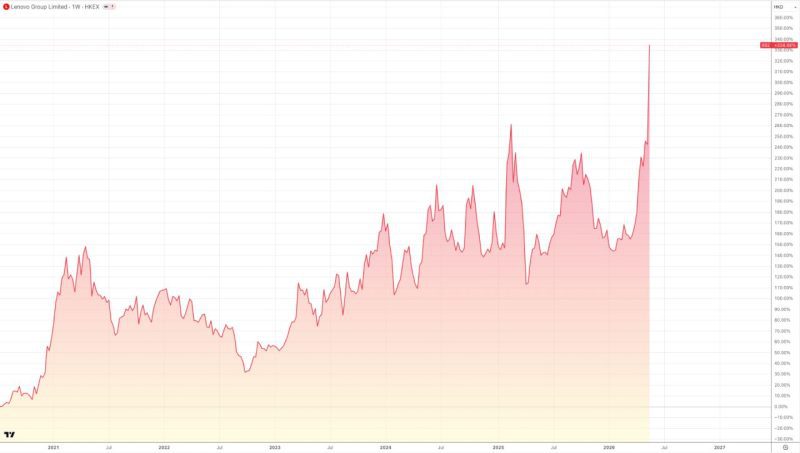
Formally, the PC market is far from booming right now. Global computer shipments in the first quarter increased by only 3.2% to 63.3 million devices. But Lenovo grew almost three times faster than the market, with the company’s shipments jumping by 9% and its share reaching 26%. In effect, Lenovo is benefiting less from a broader industry recovery than from its advantageous position within the global memory supply crisis.
The company has already openly acknowledged that device prices have been raised precisely because of rising DRAM and NAND costs. And this is just the beginning. In the first quarter, memory prices doubled compared to the previous quarter, and this year they may add up to 63% more. A paradoxical situation is now emerging in the market: the AI industry is effectively displacing consumer electronics from supply chains.
The largest AI data centers are now buying up almost all available memory. The situation is particularly difficult for high-bandwidth HBM memory for AI accelerators. The production of one such module requires about four times more crystals than for conventional consumer DRAM. While OpenAI, Microsoft, xAI, and Google continue to build giant AI clusters, memory manufacturers are forced to redistribute capacity in their favor.
For the PC market, this means the destruction of a familiar model. Previously, electronics almost always became cheaper over time. Now the opposite is happening — Microsoft, ASUS, Samsung, Lenovo, and other manufacturers are either raising prices for existing devices or launching new models at significantly higher prices. Even gaming consoles, which historically became cheaper toward the middle of their life cycle, have started becoming more expensive five years after launch.
The main problem is that the industry simply does not have enough time to expand production capacity. After the crisis of 2022-2023, memory manufacturers sharply reduced investment because the industry was operating at a loss. And already at the end of 2022, the release of ChatGPT triggered a global AI race — one that could accelerate even further amid growing speculation surrounding a potential OpenAI IPO alongside a possible Anthropic offering. Now the industry is trying to catch up with explosive demand while facing delays of several years, as the construction of a new memory factory takes three to four years.
This is where Lenovo gained a strategic advantage. The company has access not only to traditional suppliers like Samsung and SK hynix, but also to Chinese memory manufacturers, including CXMT. For Beijing, the development of domestic memory production has long been a matter of technological sovereignty, so local manufacturers are now actively expanding capacity. Lenovo, as one of the largest Chinese OEM manufacturers, directly benefits from this. In addition, the scale of the business gives Lenovo additional weight in negotiations with component suppliers. While smaller manufacturers are forced to either cut supplies or sharply raise prices, Lenovo can better balance margins and volumes.
A second major growth driver — servers for AI infrastructure — is becoming especially important. Lenovo’s core division increased revenue by 37%, and the order book reached $21 billion. In fact, the company is monetizing both sides of the AI boom simultaneously. It first sells servers to data centers, and then sells more expensive PCs to consumers affected by the same memory shortage.
Against this backdrop, the tablet market looks noticeably weaker. Global shipments increased by only 0.1% to 37 million devices. Here, memory is also becoming a limiting factor, but manufacturers prefer allocating available components to more profitable categories: laptops and smartphones. As a result, the tablet market is supported mainly by the premium segment.
Meanwhile, there is growing discussion about a fundamental transformation of the electronics market. Previously, memory deficiency was viewed as a cyclical problem, but now it increasingly resembles a long-term restructuring of the industry to meet the needs of artificial intelligence. Even optimistic estimates suggest that meaningful easing is unlikely before the end of 2027, with full normalization expected only closer to 2030.
And while AI companies continue to consume computing power and memory with appetites comparable to those of energy corporations of the last century, manufacturers like Lenovo are suddenly becoming central players in a new scarcity economy, where securing access to memory is becoming almost as important as the ability to sell computers themselves.