
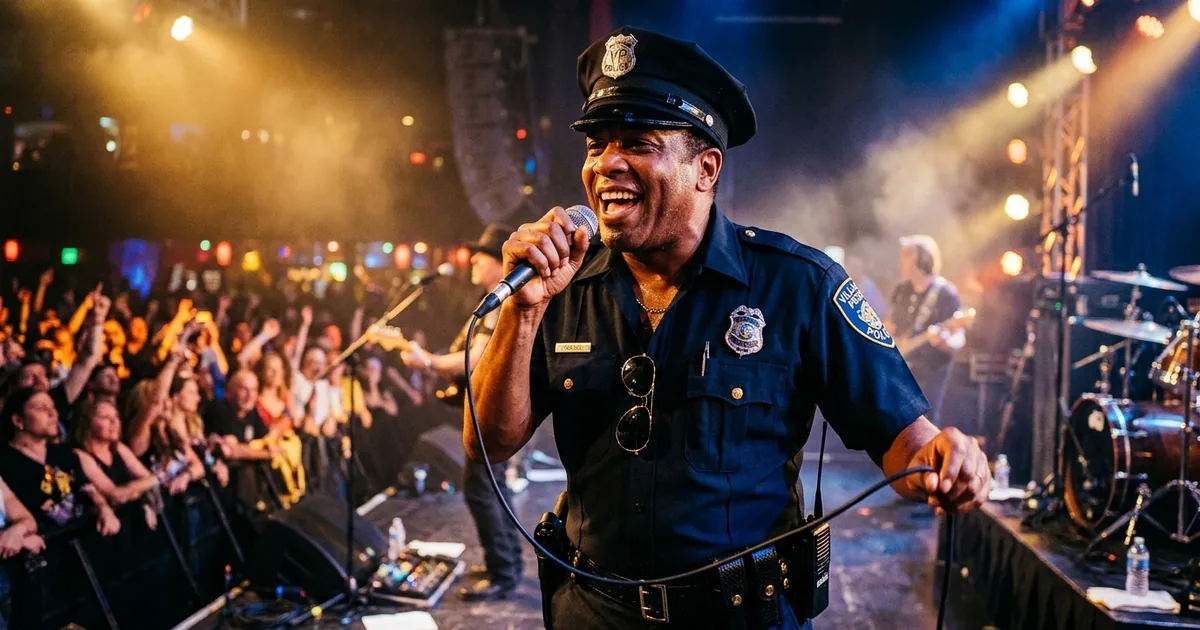
Victor Willis, the founding lead singer of the Village People who co-wrote some of the most recognizable songs in pop history, died on Monday, June 30. He was 74 years old, one day short of his 75th birthday. His wife confirmed he passed after a short but aggressive illness, though the family has not disclosed a specific cause of death.
Willis was not merely the frontman of a novelty act. He was the creative engine behind a catalog that embedded itself into the fabric of American culture so thoroughly that “YMCA” plays at virtually every sporting event, wedding reception, and political rally in the country, whether or not the people doing the arm choreography have any idea who wrote it.
The Voice That Built a Cultural Monument
Born July 1, 1951, in San Francisco, Willis grew up singing gospel in his father’s Baptist church before training as an actor and dancer in New York. He joined the Negro Ensemble Company and landed a role in the original 1975 Broadway production of “The Wiz” before music producer Jacques Morali recruited him as the lead vocalist and songwriting partner for a new concept group built around American archetypes.
What Willis and Morali built was something genuinely unprecedented. The Village People turned hyper-masculine American iconography into joyful, inclusive dance music that crossed every demographic line imaginable. Willis, dressed as a cop, co-wrote and sang lead on “YMCA,” “Macho Man,” “In the Navy,” and “Go West,” NBC News reported. “YMCA” alone has sold more than 12 million copies worldwide and remains one of the best-selling singles ever pressed.
The songs worked on multiple levels simultaneously. They were massive dance-floor hits. They carried layered meaning for LGBTQ+ communities that embraced them as anthems. And they were pop-culture juggernauts that transcended any single audience. That versatility was not an accident; it was Willis writing lyrics broad enough to hold all of those readings at once.
A Legal Battle That Rewrote the Ownership Rules
Willis left the Village People in 1979 at the height of their fame, a departure that kicked off decades of legal disputes over royalties and creative credit. The central question was one that continues to define the music industry: who owns the work?
In 2012, Willis won a landmark copyright reclamation case under the Copyright Act’s termination provision, reclaiming his share of the publishing rights to 33 songs he co-wrote with Morali. Variety reported that the victory made Willis one of the first major artists to successfully use the termination clause to reclaim ownership of iconic catalog material. The precedent mattered far beyond his own royalty checks; it demonstrated that the provision Congress wrote to protect artists from exploitative early-career deals could actually function as intended.
Willis returned to performing with the Village People in 2017, this time as both lead singer and controlling rights holder. That combination of creative authorship and legal ownership gave him a position most legacy artists never achieve.
Why the Loss Registers Beyond Nostalgia
It is easy to reduce the Village People to a punchline, a costume act frozen in a 1970s time capsule. That reading misses everything Willis actually accomplished. He co-wrote a catalog that generates tens of millions in annual licensing revenue across sports broadcasting, advertising, film, and live events. “YMCA” alone appeared at both the 2024 Republican and Democratic national conventions, a rare cultural artifact that both parties claimed without irony.
The deeper legacy is in the publishing battle. Willis fought for artist ownership when the music industry’s standard operating model was to lock songwriters into contracts that stripped them of long-term value. His successful copyright termination case helped establish the legal pathway that Taylor Swift, Paul McCartney, and other artists have since used or advocated for in their own catalog disputes. Willis did not just write the songs. He proved that the people who write the songs can eventually own them, too.
The music world lost another generation-defining voice earlier this year when Peabo Bryson died in June. Willis’s death at 74, from an illness his family has chosen to keep private, closes another chapter of an era when pop songwriting could produce genuine cultural infrastructure, songs so ubiquitous they stopped being music and became ritual.
What remains is the catalog, the legal precedent, and the unanswered question of whether the current streaming-era music industry, where songwriters earn fractions of a cent per play, will ever produce anything with the same staying power.