
The decision by CME Group and Silicon Data to create computing-power futures may become one of the most important infrastructural developments in the current stage of the artificial intelligence industry. While Nasdaq futures reflect expectations for technology-heavy growth stocks, including AI-related names, computing-power futures would track a more fundamental input: the cost of the infrastructure on which AI companies increasingly depend. In effect, for the first time, the market is beginning to formalize computing resources as an independent financial asset, comparable in function to oil, electricity, or industrial metals. If the project receives regulatory approval, it would mark the transition of AI infrastructure from a category of technology services into a full-fledged class of tradable resources with its own system of hedging, pricing, and derivatives.
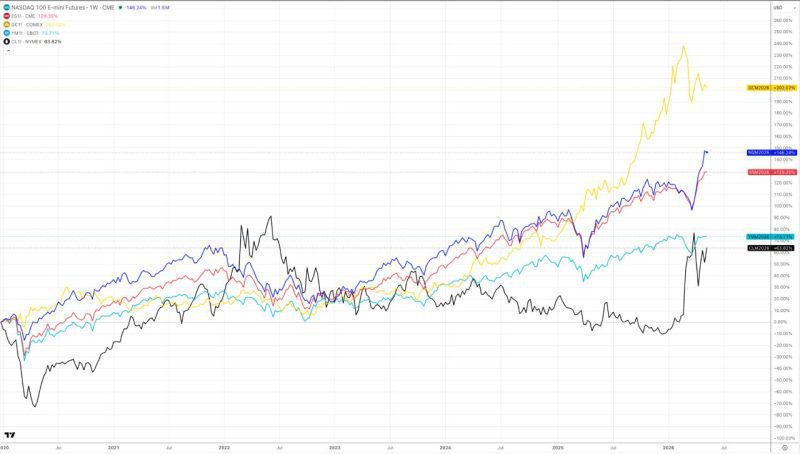
The very emergence of such futures reflects the scale of the imbalance that has formed around computing power. Over the past two years, the AI boom has turned access to GPU infrastructure into one of the key factors of competitiveness for technology companies. Limited supply forces AI developers to either overpay for computing-resource rentals or limit the scaling of their own models. As a result, the cost of computing is becoming as strategically important as the cost of raw materials is for traditional industry.
Until now, this market has remained relatively opaque. GPU rental prices were determined through private agreements between cloud providers, data centers, and AI companies, and the computing power itself lacked a standardized pricing mechanism. The Silicon Data H100 index, which tracks the hourly cost of renting graphics accelerators, represents one the first attempts to create a single market benchmark for computing resources. Thus, AI infrastructure is gradually acquiring the features of a classic commodity market, where the cost of a basic resource becomes an object of speculation, risk management, and long-term planning.
Against this backdrop, it is especially significant that growth across the related production ecosystem is accelerating at the same time. Revenue in the semiconductor manufacturing materials market grew to $73.2 billion last year, with the fastest growth rates demonstrated by segments directly related to high-performance computing and advanced chip-packaging methods. This highlights that the shortage of computing resources has long affected not only GPU manufacturers, but the entire supply chain, from silicon wafers to lithography and packaging.
The growing demand for advanced chip-manufacturing and packaging technologies is particularly important. AI workloads require increasingly dense component integration and higher memory bandwidth, which automatically intensifies the industry’s dependence on the most capital-intensive and technologically complex production processes. As a result, the cost of computing begins to be determined not only by the price of accelerators themselves, but also by the state of the global semiconductor manufacturing infrastructure.
The geography of the market further highlights the concentration of this new infrastructure cycle. Taiwan remains the largest consumption center for chip-manufacturing materials, China is showing the most aggressive growth rates, and South Korea retains a critical role due to its dominance in the memory segment. Against this backdrop, North America is gradually strengthening its position as a center of AI model development and computing power consumption, but remains dependent on the Asian manufacturing base. This configuration creates an additional level of market risk, since any instability in supply chains can directly affect the cost of computing and, as a result, the economics of AI companies, including some of the market’s top stock gainers.
Under these conditions, the futures market becomes an attempt to adapt the financial system to a new reality in which computing power becomes a limited infrastructure resource. For AI developers, this creates the opportunity to lock in GPU rentals costs in advance and reduce the risks of price spikes. For investors and traders, this is a new speculative segment that is directly linked to the growth rate of the AI industry. For cloud providers and data centers, it offers a mechanism for more transparent pricing and infrastructure-load management.
Taken together, these factors demonstrate how AI is gradually forming a full-fledged resource economy around itself. If, at an early stage, the market attention was mainly focused on models and software solutions, the focus is now shifting to infrastructure and its cost. Computing power is becoming not just a technological tool, but a basic economic asset whose availability will increasingly shape the future dynamics of the entire industry.
That is why the emergence of GPU futures goes far beyond another financial product. It reflects the transition of the AI industry to a new stage of maturity, in which the market begins to perceive computing as a strategic raw material of the digital economy — one characterized by scarcity, volatility, and a struggle for control over infrastructure, much like traditional commodity markets.