
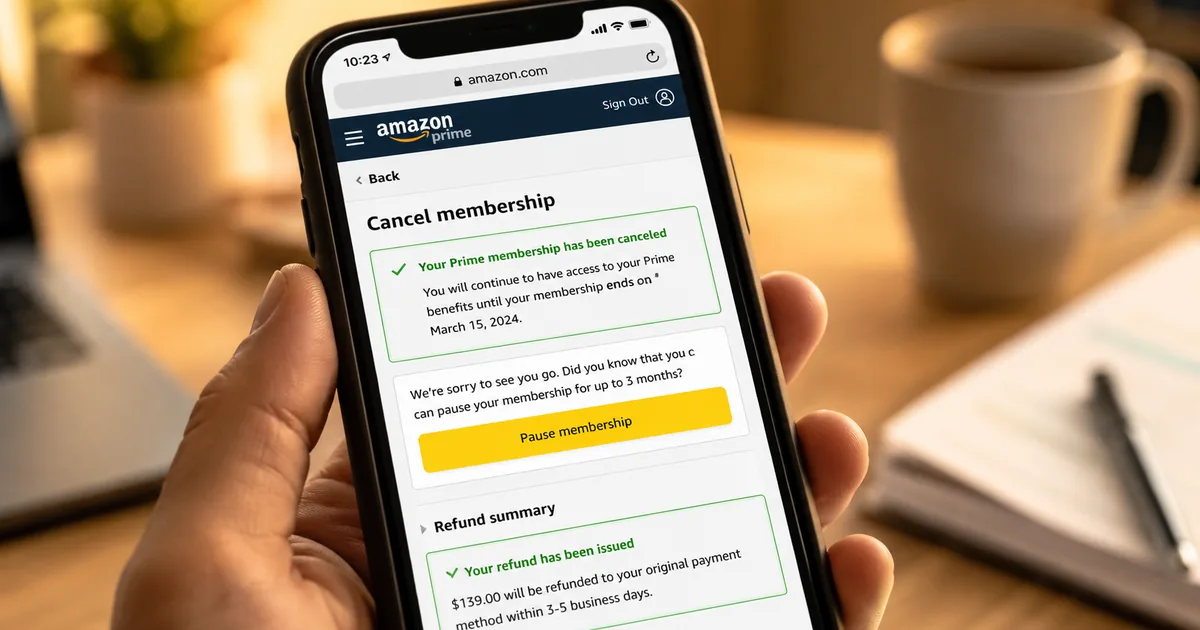
If you have ever been an Amazon Prime member, today is the last day to file a claim in the company’s $2.5 billion FTC settlement, and the clock runs out at midnight. The settlement resolves allegations that Amazon used deceptive design patterns to trick customers into signing up for Prime and then made cancellation deliberately difficult.
What Amazon Actually Did
The Federal Trade Commission alleged that Amazon enrolled millions of customers in Prime memberships through what regulators called “dark patterns,” interface designs that nudged users into subscriptions they did not explicitly choose. The complaint, filed in 2023, described a cancellation process so convoluted that Amazon internally nicknamed the project to simplify it “Iliad,” after the famously long Homer epic.
Amazon agreed to the settlement in September 2025 without admitting wrongdoing: a $1 billion civil penalty paid to the government plus $1.5 billion set aside for consumer refunds. That consumer refund pool is what is closing today.
Who Qualifies and How Much You Get
Eligible claimants are U.S. Amazon Prime customers who signed up through what the FTC calls a “challenged enrollment flow,” essentially anyone who was subscribed to Prime in a way they did not clearly authorize or who struggled to cancel. Automatic refunds went out to some eligible customers in November and December 2025. Starting in January 2026, Amazon began sending claim notices by mail or email to customers who did not receive an automatic payment.
The maximum individual refund is $51, which is roughly one month of the current Prime annual membership prorated. Not life-changing money, but for a company that built a $200 billion subscription business partly on the friction of cancellation, the principle matters more than the check.
How to File Before Midnight
If you received a claim notice from Amazon (check your email and physical mail), follow the instructions on the form. You can choose to receive payment by check, PayPal, or Venmo. The claim portal is at the URL provided in your notice. If you need help, Amazon has set up a dedicated support line at admin@SubscriptionMembershipSettlement.com.
One important detail: you do not need your claim notice to file. CBS News reported that eligible customers can visit Amazon’s settlement page directly if they have lost their notice, though the process requires verifying your identity and Prime membership history.
Why This Settlement Matters Beyond the Money
The Amazon Prime case was the FTC’s most significant action against subscription dark patterns, and it landed during a broader regulatory crackdown on what the commission calls “negative option” marketing: the practice of enrolling consumers in recurring charges that are easy to start and hard to stop. The FTC finalized its “click-to-cancel” rule in 2024, requiring companies to make cancellation as simple as sign-up.
Amazon’s settlement became the proof-of-concept for enforcement. The $2.5 billion price tag sent a signal that dark-pattern revenue is not free money; it is a liability that compounds. Every streaming service, gym chain, and SaaS company running a similar retention-through-friction playbook watched this case land and recalculated.
The Bigger Pattern
Amazon is not the only tech giant paying for subscription design choices. The broader push against manipulative enrollment practices has touched companies across industries, from dating apps to meal kit services. But Amazon’s case was the largest by dollar amount and the most visible by customer reach.
If you were ever a Prime member and received a claim notice you ignored, today is the last day to act on it. After midnight, the unclaimed portion of that $1.5 billion refund pool closes, and Amazon keeps it. Fifty-one dollars is not going to change your life. But making a trillion-dollar company pay for designing its cancellation button to be deliberately hard to find is the kind of consumer accountability that only works if people actually file the claim.