
The $11.57 billion acquisition of Globalstar was more than just an expansion deal for Amazon — it was part of a broader investment strategy where satellite communications, cloud computing, and AI infrastructure converge into a single ecosystem. As the major stock heatmap player prepares to launch its own satellite internet service, it is strengthening its position in competition with SpaceX’s Starlink, which already has thousands of satellites in orbit and a multi-million-user base.
The acquisition provides Amazon with immediate access to Globalstar’s existing orbital infrastructure and customer base, accelerating the deployment of its own constellation, which aims for approximately 3,200 satellites by 2029. For the market, this is a signal that competition in the low-orbit internet segment is entering a new phase. Previously, leadership was virtually uncontested, but now large technology corporations are ready to close the gap through capital rather than time.
At the same time, the satellite area is only one component of a massive investment program. Amazon CEO Andy Jassy stated that the company is ready to invest about $200 billion in 2026, primarily toward AI infrastructure. This includes data center construction, network infrastructure development, and proprietary chip production — a segment that has already exceeded $20 billion and continues to show exponential growth. In fact, Amazon is repeating the strategy that it previously used in the cloud segment: sacrificing short-term profits for long-term dominance.
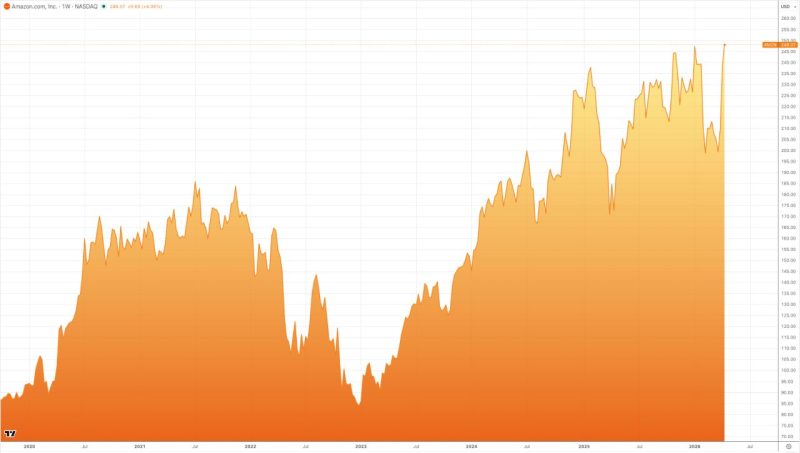
However, it is precisely the scale of these investments that is becoming a source of tension for investors. The company’s shares have been declining since the beginning of the year, as the market grows less tolerant of long investment cycles without quick returns. Despite the fact that revenue from AI services has already reached $15 billion, the key question remains when capital expenditures will finally transform into sustainable cash flow.
An additional layer of risk involves infrastructural and regulatory constraints. The large-scale expansion of the data center is driving a massive surge in electricity consumption, questioning Amazon’s ability to meet its climate goals. Pressure from investors is increasing as they demand greater transparency regarding the carbon footprint and sustainability of the growth model. Amazon, in turn, insists that it already provides sufficient disclosure. It has further reinforced its commitment to carbon-free power with a $500 million investment in X-energy, a leader in advanced small modular reactors. This partnership aims to provide a scalable energy alternative for massive data centers, lowering long-term costs while drastically reducing their carbon footprint. With X-energy now preparing for a public market debut amid an improving investment climate and rising major U.S. indices like the S&P 500 and Dow Jones, the deal and the disclosure debate combined underscore the growing weight of ESG factors in evaluating capital-intensive AI projects.
The acquisition of Globalstar looks like a logical step in a vertical integration strategy. Amazon aims to control not only the computing infrastructure on Earth, but also data transmission channels in space, forming an alternative to existing solutions. By combining satellite communications, cloud services, and an AI platform, Amazon is building a fully closed technological ecosystem.
Financially, this represents a transition to a model where growth is driven by advanced investments and infrastructure scaling, rather than the optimization of current margins. Historically, this approach has proved successful for Amazon, but the current cycle is characterized by significantly higher capital intensity and greater dependence on external factors — from energy costs to the pace of AI adoption.
As a result, the market is facing a classic dilemma. On the one hand, Amazon is demonstrating its willingness to invest in areas that could shape the multibillion-dollar markets of the future. On the other hand, the scale of these investments is increasing concerns about the payback and the sustainability of the business model. The company’s ability to convert this infrastructure leadership into cash flow will ultimately determine not only the dynamics of its shares, but also the balance of power in the global technology market.