
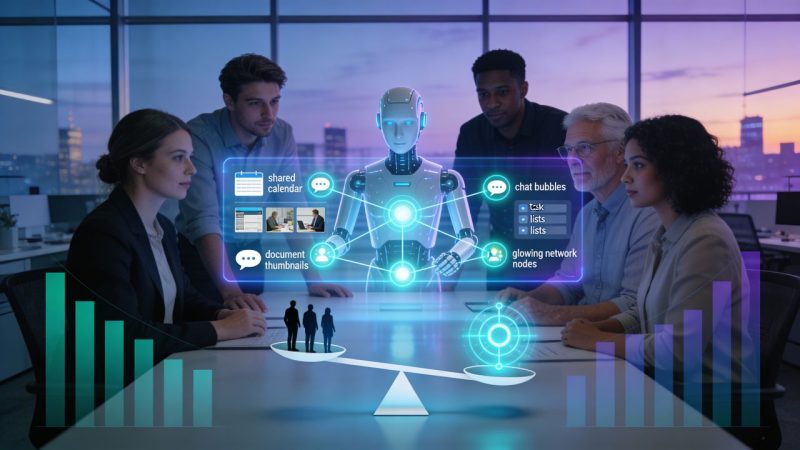
Anthropic just launched what might be its most consequential product since Claude itself, and the implications extend far beyond organizing your messy downloads folder.
Claude Cowork, which debuted January 12 as a research preview for Max subscribers, represents something the AI industry has been promising and threatening for years: an autonomous digital agent that doesn’t just chat with you, it does your work. The tool grants Claude direct access to your local file system, letting it read, edit, create, and organize files without you manually copying and pasting content into a chat window. Point it at a folder of scattered receipts, and it produces an expense spreadsheet. Give it access to your chaotic downloads, and it reorganizes everything with sensible naming conventions.
The product emerged from an observation that should concern anyone whose job involves “glue work,” the tedious connective tissue of modern knowledge work: Anthropic noticed users were already bending Claude Code, its developer-focused command line tool, to handle non-coding tasks. People were treating a programming assistant like a general-purpose administrative aide. So Anthropic built exactly that.
From Chatbot to Coworker
The shift from “assistant” to “coworker” isn’t just marketing wordplay. Anthropic explicitly designed Cowork to feel less like a back-and-forth conversation and more like delegating tasks to a colleague. Users can queue multiple assignments, walk away, and return to find work completed. The AI makes plans, executes them in parallel, checks its own output, and asks for clarification when it hits roadblocks.
Built on the same Claude Agent SDK that powers Claude Code, Cowork can navigate desktop applications, work across different software tools, and even browse the web through the Claude in Chrome extension. Anthropic demonstrated the tool scanning a cluttered folder, identifying receipts and project notes, then automatically generating structured reports and spreadsheets while the user was away from their desk.
Perhaps the most telling detail about Cowork’s capabilities: Anthropic’s team reportedly built the entire feature in approximately a week and a half using Claude Code itself. The recursion is dizzying. AI tools are now competent enough to build better AI tools.
The Job Market Question Nobody Wants to Answer
Here’s where it gets uncomfortable. While Anthropic positions Claude as a “coworker,” an agent capable of doing the work of an entry-level analyst or administrative assistant will inevitably force companies to reevaluate whether they need as many of those roles. This isn’t speculation. According to a Resume.org survey, nearly three in ten companies have already replaced jobs with AI, and by the end of 2026, 37% expect to have done so.
The data points keep accumulating. Salesforce CEO Marc Benioff stated publicly that the company reduced its customer support headcount from 9,000 to 5,000 thanks to agentic AI. Entry-level hiring at the 15 biggest tech firms fell 25% from 2023 to 2024. Economists at McKinsey project that agents could automate 70% of office workflows by 2030.
Investors are explicit about what’s coming. In a recent TechCrunch survey, multiple enterprise VCs predicted AI would significantly impact the workforce in 2026, even though the survey didn’t specifically ask about it. “2026 will be the year of agents as software expands from making humans more productive to automating work itself, delivering on the human-labor displacement value proposition in some areas,” said Yoav Mendel of Foundation Capital.
The Competitive Arms Race
Cowork arrives amid what industry analysts are calling the “Agent Wars” of 2026. Anthropic is now competing directly with Microsoft’s Copilot ecosystem, OpenAI’s Operator system, and Google’s Project Mariner. Each company is racing to become the default operating layer between humans and their digital tools.
Anthropic’s strategy is differentiation through flexibility. While Microsoft’s Copilot is deeply integrated into Office 365 and Google’s agents are tied to its ecosystem, Cowork can work across any application on a user’s desktop regardless of who made it. This “agnostic agent” approach appeals to power users who don’t want to be locked into a single software stack.
Fortune noted that Cowork’s launch has sparked concern among startup founders about the competitive threat posed by major AI labs bundling agent capabilities into their core products. Dozens of AI startups have raised funding to solve the exact problems Cowork now addresses: file organization, document generation, data extraction. When the foundation model provider starts shipping these features as standard, the startups building on top become increasingly vulnerable.
The Risks Are Real
Anthropic, to its credit, isn’t pretending Cowork is ready for prime time. The company labeled it a research preview and published explicit warnings about its limitations. Prompt injection attacks remain an unsolved problem. Giving an AI access to your file system creates new attack surfaces for potential data breaches. Vague instructions can lead to destructive outcomes, including unexpected file deletions.
The company implemented “Deletion Protection” requiring explicit user approval before permanently removing files, and it recommends limiting browser access to trusted sites. Users are explicitly held responsible for all actions Claude takes while using Cowork, including content created, transactions made, and data accessed.
These aren’t hypothetical concerns. They’re the kind of risks that technical users of Claude Code already understood. The question is whether mainstream users adopting Cowork will have the same foresight.
What Comes Next
Cowork is currently available only to Claude Max subscribers ($100 to $200 per month) on macOS, though it recently expanded to Pro subscribers. Anthropic has indicated plans for Windows support, cross-device sync, and enhanced connectors for Google services.
The broader implication is harder to contain. Once you’ve experienced an AI that organizes your files, drafts your reports, and processes your expenses while you’re away from your desk, returning to doing that work manually feels like deliberately choosing inefficiency. That’s the adoption curve Anthropic is betting on.
Whether that’s a productivity revolution or a displacement event depends entirely on which side of the automation line you’re standing on. For knowledge workers whose jobs consist primarily of moving information between applications, reformatting documents, and organizing digital chaos, Cowork isn’t a coworker. It’s a replacement that works faster, costs less, and never takes vacation.
The AI industry has spent years promising that these tools would handle the tedious work so humans could focus on higher-value activities. Cowork is the first product that makes that promise feel uncomfortably specific. The glue work is getting automated. The question is what happens to the people who used to do it.
If you’re interested in other AI Bots that can change how you work and that are trending right now, check out Clawdbot (not affiliated with Anthropic) check it out here.