
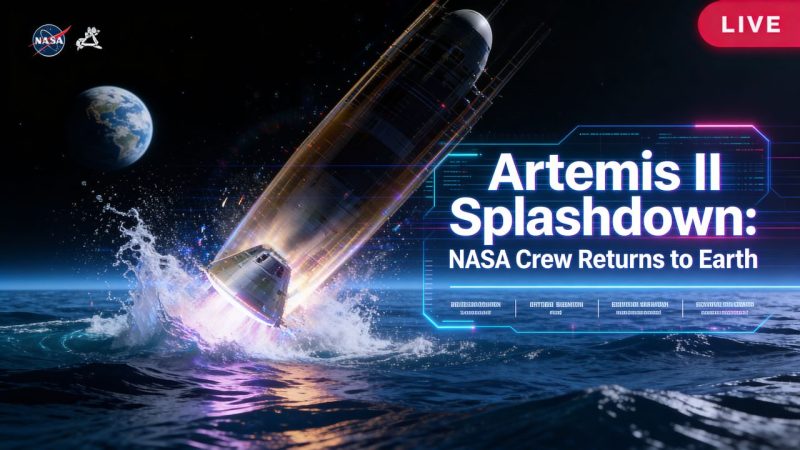
NASA’s Artemis II splashdown happens tonight, and if you’ve been following the mission drama, you know this isn’t just another routine return to Earth. Four astronauts and one Canadian space specialist are about to end a nine-day voyage that took them farther from home than any human has traveled in more than five decades, and they’re doing it in a spacecraft with a known engineering flaw that nobody has quite solved yet.
When The Artemis II Return Happens
Tonight at 8:07 p.m. EDT (5:07 p.m. PDT), Commander Reid Wiseman, pilot Victor Glover, mission specialist Christina Koch, and Canadian Space Agency mission specialist Jeremy Hansen will splash down off the coast of San Diego. Netflix is streaming the Artemis II live coverage if you want to watch. The recovery team is ready with helicopters standing by to haul the crew out of the Pacific and deliver them to the USS John P. Murtha. Within hours, they’ll be back in controlled spaces, undergoing the medical evaluations that come with returning from the most ambitious human spaceflight mission since the Apollo program.
This timing matters. The Artemis II splashdown represents something that feels increasingly rare in American space exploration: a moment where ambition meets execution, where the agency actually follows through. The crew lifted off from Kennedy Space Center on April 1, ten days ago. In those ten days, they did something that will be discussed in astronaut training programs and aerospace engineering schools for decades.
The Record That Silenced Apollo Skeptics
On April 6, the Artemis II crew reached 248,655 miles from Earth. Let that number sit for a moment. It surpassed Apollo 13’s record distance, a mark set in 1970. You have to understand what this means culturally, not just scientifically. Apollo 13 was a catastrophe transformed into triumph, a mission that failed to land but became the most famous moonshot in history because of how the crew and mission control handled the crisis. For Artemis II to exceed that distance without drama, without explosions, without improvised filters, speaks to how far we’ve come in spacecraft design and mission planning. It also speaks to how NASA has quietly built a deep competency bench after years of relying on contractors and commercial partners.
The crew tested instruments, systems, procedures, and performance in deep space. They weren’t just riding along, waving and taking photos. Every hour of the mission fed data back to engineers who spent years designing the Artemis program to succeed where multiple iterations of the Constellation program failed. These tests matter because they’re the bridge between simulation and reality, the place where theory meets vacuum.
The Heat Shield Problem NASA Won’t Ignore
Here’s where things get uncomfortable, and why the Artemis II splashdown tonight carries a tension that casual observers might miss. There’s a known design flaw in the Orion capsule’s heat shield. NASA hasn’t hidden this fact, but they haven’t made a national spectacle of it either. The agency is the kind of institution that acknowledges engineering problems while simultaneously projecting confidence that the problems won’t derail the mission. It’s a delicate balance, and it’s the balance that all spacefaring nations have to strike.
The Orion capsule will lose communication with mission control during reentry. That’s normal for this type of spacecraft design. The plasma envelope that protects the heat shield blocks all radio signals for about four minutes. During that window, mission control can only watch the clock. The crew can only trust that the engineers understood the physics, that the tests meant something, that the redundancies in the system actually provide redundancy. It’s the kind of silence that makes engineers drink more coffee than is probably advisable.
The heat shield flaw is real, documented, and being monitored. NASA has contingency plans. But you can’t design away every risk in spaceflight. At some point, the crew has to get in the capsule and the rocket has to fire and the heat has to dissipate. That’s where we are tonight. Four extremely well-trained people are about to experience the most thermally violent four minutes of their mission.
What Comes After The Artemis II Splashdown
Assuming splashdown proceeds on schedule, the immediate timeline is: helicopters will recover the crew from the recovery zone. They’ll be transported to the USS John P. Murtha, where medical personnel will conduct post-mission evaluations. These aren’t casual check-ups. They’re comprehensive assessments of how the human body responded to microgravity, radiation exposure, and the physiological stresses of deep space travel. The crew will be studied with the same intensity that NASA studied the early Mercury and Gemini astronauts.
From the ship, they’ll eventually travel to NASA’s Johnson Space Center in Houston. Debriefings will begin. Engineers will extract every detail about how systems performed, how the crew responded to procedures, where training matched reality and where it didn’t. This data will inform Artemis III, the actual lunar landing mission that remains several years away. Every splashdown teaches something. Artemis II splashdown will teach plenty.
The Artemis II Mission Represents Something Bigger
The Artemis II return to Earth tonight isn’t just about bringing four people home safely. It’s about validating an enormous bet that NASA and the aerospace industry made on the Artemis program when everything was theoretical and Congress was skeptical about budget allocations. It’s about proving that after years of cost overruns, technical delays, and redesigns, the system works. It’s about demonstrating that Americans can still do big, complicated things in space.
The Artemis II splashdown will happen, the crew will splash down into the Pacific, the helicopters will arrive, and the mission will transition from active exploration to analysis and preparation for the next phase. Tonight, we find out if all those tests and simulations and sleepless nights in mission control meant what everyone hoped they meant. We find out if engineering confidence is justified. We find out if the heat shield holds.
Watch tonight if you can. The Artemis II live stream begins well before the actual splashdown window. You’ll see something that doesn’t happen very often anymore: a moment when American space exploration delivers exactly what it promised, on the schedule it committed to, bringing home four extraordinary people who represent something even bigger than national achievement. That’s worth paying attention to.