
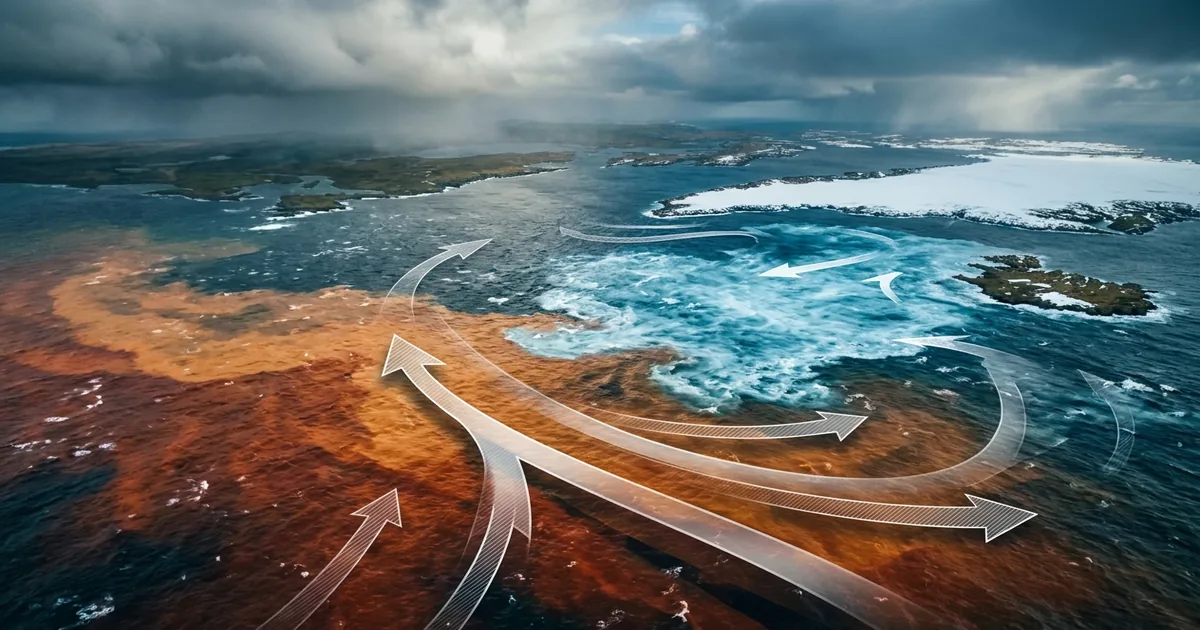
A mysterious patch of unusually cold water in the North Atlantic has been expanding for years, and new research suggests it is not a fluke. Scientists writing in New Scientist have linked the so-called “cold blob” to a measurable slowdown in the Atlantic Meridional Overturning Circulation, the massive ocean conveyor belt that regulates weather patterns across the Northern Hemisphere.
The implications are not abstract. They are happening now.
What the AMOC Does and Why It Matters
The Atlantic Meridional Overturning Circulation works like a planetary heat pump. Warm surface water flows northward from the tropics, releases heat into the atmosphere over northern Europe and the eastern seaboard of North America, then sinks as it cools and flows back south along the ocean floor. This cycle has run for millennia, and its stability underpins the relatively mild climate that northern Europe and much of the eastern United States have come to depend on.
Direct measurements from sensor arrays deployed across the Atlantic show the AMOC’s strength has dropped by roughly 10 to 20 percent since the mid-2000s, according to CNN’s reporting on the latest research. That translates to hundreds of millions of gallons of water per second that are no longer flowing northward. The cold blob, a region south of Iceland and Greenland where surface temperatures have bucked the global warming trend and actually cooled, is one of the most visible symptoms.
The Numbers Are Getting Worse
Recent modeling work has refined the projections significantly. When researchers incorporated observational data to constrain their climate models, the results were grimmer than previous estimates. The AMOC could slow by 51 percent by 2100 under a medium-emissions scenario, a weakening 60 percent stronger than the average prediction from unconstrained models.
That is not a distant theoretical risk. A half-strength AMOC would mean fundamentally different weather patterns across the Atlantic basin. Northern Europe could see significantly colder winters even as global average temperatures continue climbing. Rainfall patterns across West Africa and the Amazon would shift. Sea levels along the U.S. East Coast would rise faster than the global average because the current’s flow helps pull water away from the coastline.
The research community has moved from asking whether the AMOC is weakening to debating how fast and how far the decline will go. Yale Environment 360’s analysis of the trend lays out a scenario in which the current does not fully collapse but degrades enough to produce cascading impacts on agriculture, fisheries, and extreme weather frequency across two continents.
Why the ‘Collapse’ Framing Misses the Point
The AMOC debate has often been framed around the dramatic possibility of total collapse, the scenario that inspired the Hollywood treatment in “The Day After Tomorrow.” That framing is counterproductive. Total collapse remains a low-probability outcome within this century, and leading with it gives policymakers an excuse to dismiss the entire concern as alarmist.
The real danger is the more mundane but equally consequential scenario of a gradually weakening current that reshapes regional climates over decades. A 50 percent slowdown does not produce a sudden ice age. It produces a slow accumulation of disruptions: crop failures in regions that relied on predictable rainfall, accelerated property value shifts in coastal areas already under pressure from climate change, and more volatile weather extremes as the temperature gradient across the Atlantic steepens.
The cold blob itself is a signal, not a crisis. But it is the kind of signal that climate scientists have been warning about for two decades. The Atlantic’s circulatory system is showing measurable strain, and the trajectory points in one direction.
What Happens Next
The uncomfortable truth is that the AMOC’s decline is already baked into the system to some degree. Even aggressive emissions reductions would not reverse the current weakening quickly because the ocean responds on timescales of decades to centuries. What emissions reductions can do is limit how far the decline goes and whether it approaches the thresholds where nonlinear feedbacks could accelerate the process beyond what models currently project.
For now, the cold blob keeps growing, the sensor arrays keep recording a weaker flow, and the gap between what the models predicted and what the ocean is actually doing keeps narrowing in the wrong direction.