
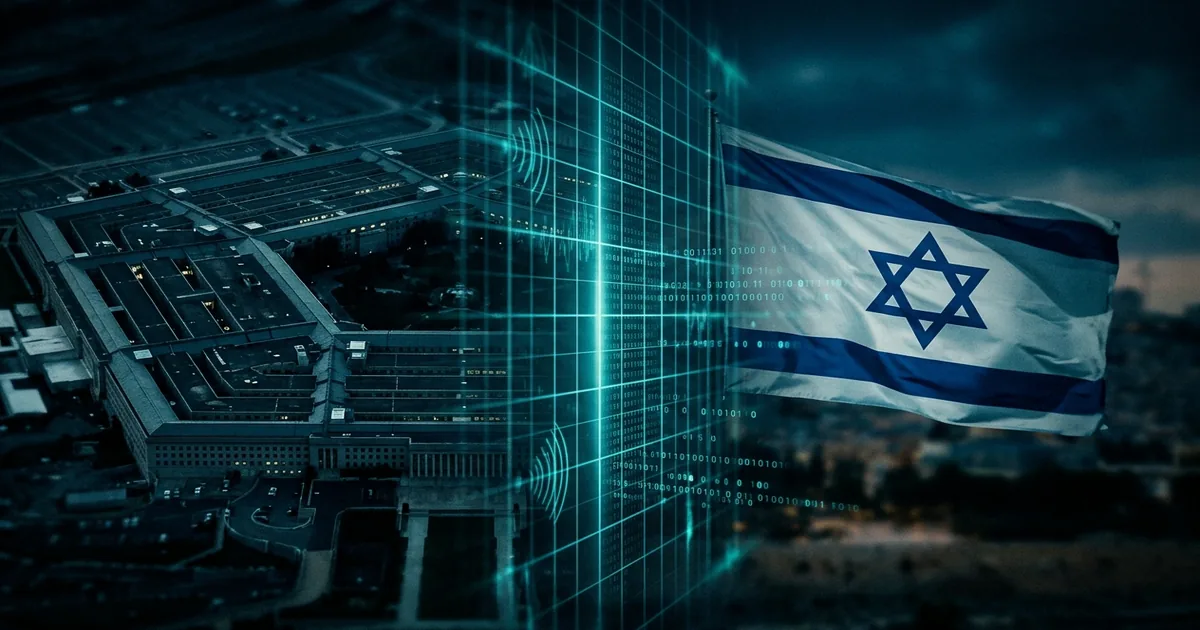
The Pentagon’s Defense Intelligence Agency has raised its counterintelligence threat assessment for Israel to “critical,” the highest possible level, according to NBC News reporting citing two current and one former U.S. official.
The designation reflects growing alarm inside the defense establishment that one of America’s closest allies has been aggressively surveilling senior U.S. officials to gain insight into the Trump administration’s internal deliberations on the Iran conflict.
What the ‘Critical’ Designation Actually Means
Allies spy on each other constantly, and nobody in the intelligence community pretends otherwise. But the DIA’s decision to raise Israel’s threat level to critical signals something qualitatively different: a judgment that Israeli human intelligence and technical collection capabilities directed at the United States have crossed a threshold that demands operational countermeasures.
The practical fallout is already visible. U.S. officials traveling to Israel now carry burner phones. Hotel arrangements have gotten more cautious. The Pentagon has effectively told its workforce to treat interactions with Israeli counterparts the way they’d treat meetings with representatives of a hostile intelligence service.
None of this is subtle, and none of it is normal between allies.
The Iran War Is Driving the Wedge
The timing is not coincidental. The U.S. and Israel have been on divergent tracks since the February 2026 joint strikes on Iran evolved into a broader conflict. Washington has been pursuing diplomatic channels to de-escalate, while Jerusalem has pushed for a more aggressive posture on Iranian nuclear and military infrastructure.
Israel’s intelligence apparatus, according to the assessment, is particularly focused on understanding what the Trump administration is privately willing to concede in negotiations with Tehran. That is not the kind of information allies typically try to extract through clandestine means. It is the kind of intelligence that shapes whether a war ends or expands.
The dynamic mirrors a pattern that predates this conflict. Israel has a documented history of aggressive intelligence collection against the United States, from the Jonathan Pollard case in the 1980s to more recent episodes involving surveillance technology. What makes the current moment different is the scale and the stakes: the U.S. is actively fighting a war alongside Israel while simultaneously suspecting Israel of spying on the very officials directing that war.
The White House Pushed Back Hard
The response from official channels was swift and categorical. A White House spokesperson called the NBC report “entirely false,” attributing it to sources without knowledge of the situation. Israel’s embassy in Washington similarly denied that Israel spies on the United States.
These denials are standard diplomatic protocol, and they are worth exactly as much as every previous denial of allied espionage: very little. The DIA assessment is an internal Pentagon document, not a press release. It exists because career intelligence professionals determined the threat warranted the highest classification, regardless of what diplomats say publicly.
What matters more than the denials is what has not happened. There has been no reported disruption to day-to-day intelligence sharing between the two countries, and the U.S.-Israel military coordination on the Iran conflict remains operationally intact. The critical designation is a defensive posture, not a diplomatic rupture. At least not yet.
Why This Story Has Institutional Weight
The U.S. spy flights over Cuba earlier this year demonstrated how intelligence posture shifts can signal deeper strategic recalibrations. The Israel espionage upgrade carries a similar institutional weight: it is the Pentagon telling its own people that the alliance’s intelligence boundaries have changed.
For the broader U.S.-Israel relationship, the critical designation raises a question that Washington has spent decades avoiding. At what point does an ally’s intelligence collection against you become incompatible with the trust required to share your most sensitive capabilities? The five-decade norm has been to absorb Israeli espionage as a manageable irritant. The DIA’s assessment suggests the Pentagon, at minimum, no longer considers it manageable.
The answer may depend on whether the Iran conflict moves toward a negotiated resolution or continued escalation. If diplomacy succeeds, the espionage tensions may recede into the familiar pattern of allied friction. If the war expands, the intelligence wedge could become one of several fractures in a relationship that has never been tested quite like this.