
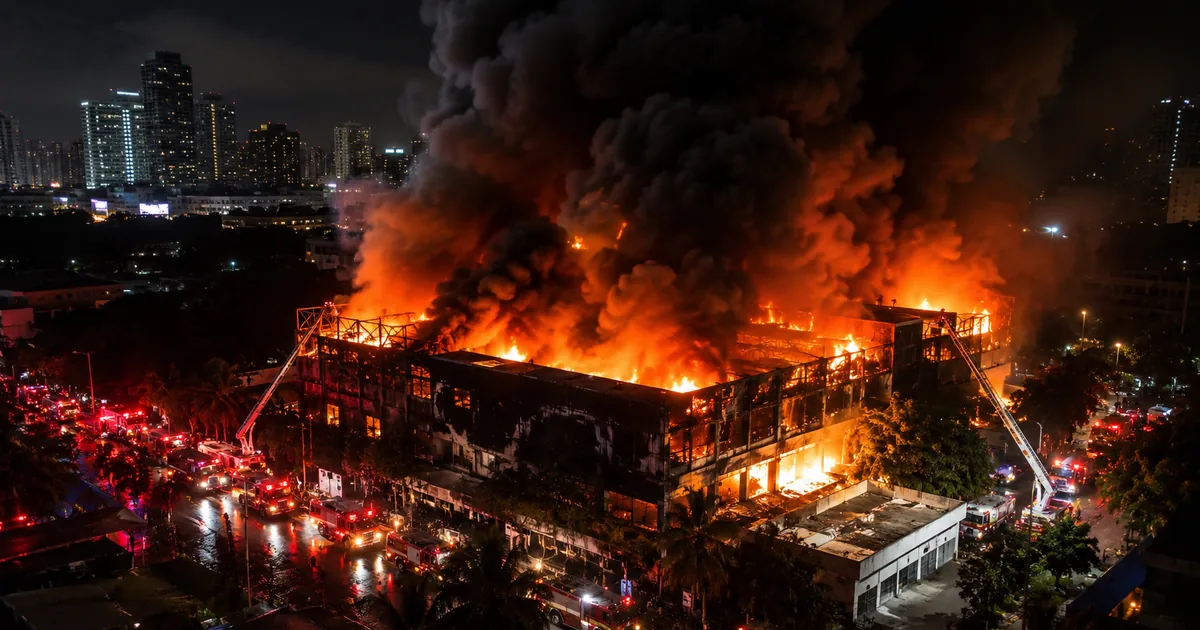
A fire tore through one of Bangkok’s most popular nightlife venues overnight, killing at least 27 people and injuring dozens more in one of Thailand’s deadliest entertainment-venue disasters in nearly two decades.
The blaze at the Na Ladprao pub in the Chatuchak district exposed, once again, the lethal gap between Thailand’s fire-safety codes and the reality of how its nightlife venues actually operate.
What Happened at Na Ladprao
The fire broke out around midnight local time on Sunday, according to the Associated Press, at the Na Ladprao pub, a sprawling venue in northern Bangkok’s Chatuchak district known as one of the area’s most popular gathering spots. A musician performing at the venue told reporters he saw smoke billowing from a circuit breaker near the stage moments before the power cut out, followed by an explosion that sent thick black smoke pouring through the interior.
That smoke is what turned a fire into a mass-casualty event. Thai Prime Minister Anutin Charnvirakul, who arrived at the scene and confirmed the death toll, told reporters that the smoke “quickly filled the place” after the initial blast. Many of the 27 victims were found in restrooms at the back of the pub, where they had become trapped while trying to escape the choking smoke and flames. Firefighters brought the blaze under control in roughly 30 to 35 minutes, but by then the interior was gutted, with charred tables and chairs visible in the aftermath.
A Pattern Thailand Has Not Broken
The Na Ladprao fire is not an isolated tragedy. It fits a recurring pattern of deadly nightlife fires in Thailand that stretches back decades, each one prompting promises of tighter enforcement that fail to prevent the next disaster.
The most notorious precedent is the 2009 Santika nightclub fire on New Year’s Eve in Bangkok, which killed 66 people when pyrotechnics ignited the ceiling. That disaster led to a round of safety reviews, inspections, and political pledges. Then in 2022, a fire at a pub in Sattahip killed 14 people, again raising questions about overcrowding, blocked exits, and lax code enforcement at entertainment venues. Just two days ago, a factory fire in Jinjiang, China killed 28 workers, another reminder that fatal fires in commercial venues across Asia remain stubbornly common.
The structural problem is straightforward: Thailand’s fire-safety regulations exist on paper but are unevenly enforced, particularly at entertainment venues that operate in regulatory gray zones between restaurant, bar, and concert-hall classifications. Inspections are sporadic. Exit requirements are routinely ignored or built around during renovations. When a venue’s single-point-of-failure electrical system goes down, the smoke does the rest.
Why the Restroom Death Toll Is the Tell
The detail that many victims were found dead in the restrooms is not incidental. It is the forensic signature of a venue where the emergency egress plan failed completely. In a properly designed and maintained entertainment venue, restrooms are not where people die. They die there when the main exits are blocked, unmarked, or unreachable through smoke, and the only doors people can find in the dark lead to dead-end rooms.
This pattern has repeated across fire disasters globally, from the 2003 Station nightclub fire in Rhode Island (100 dead, many trapped in a bottleneck corridor) to the 2013 Kiss nightclub fire in Brazil (242 dead, victims piled at a locked exit). The common thread is never the fire itself. It is always the gap between the venue’s theoretical capacity and its actual escape infrastructure.
The Investigation Ahead
Thai authorities have not yet confirmed the cause of the fire, though the musician’s account of a circuit breaker failure near the stage points toward an electrical fault as the likely trigger. BBC News first reported the death toll as authorities were still working to identify victims. PM Anutin’s presence at the scene signals the political gravity of the event, but the real test will be whether the investigation produces enforceable changes to venue inspection and licensing, or another cycle of temporary scrutiny followed by drift.
The death toll could still rise. Several of the injured were taken to hospitals in serious condition, and officials have not released a full accounting of everyone inside the venue when the fire started.
For now, 27 families are dealing with the consequences of a night out at a popular pub that turned into a death trap, in a country where the same sentence has been written too many times before.