
In a world where speed and accuracy define operational success, traditional document scanning workflows often struggle to keep up. Manual sorting, batch separation, and post-scan corrections consume time and introduce errors. Barcode reading offers a smarter alternative, streamlining document processing while improving accuracy and scalability.
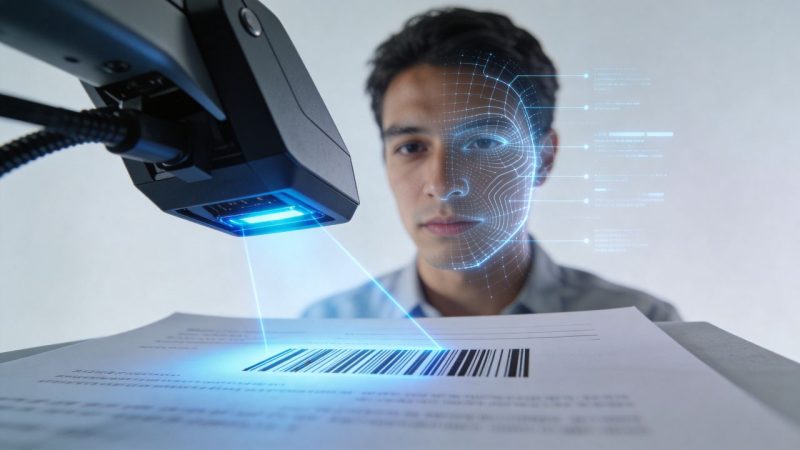
This guide explains what barcode reading is, why it matters in document scanning, how it supports modern identity verification, and how barcode scanning software works behind the scenes.
What Is Barcode Reading?
Barcode reading is the process of scanning and decoding information embedded in barcodes. Barcodes are visual, machine-readable patterns designed to store structured data in a compact format. They fall into two main categories:
- 1D (linear) barcodes, such as UPC or Code 128, which use parallel lines of varying widths
- 2D (matrix) barcodes, such as QR codes and Data Matrix, which use grids of squares or dots
Barcode reading software captures the barcode image, detects its structure, and converts the encoded data into a digital format that can be processed by backend systems. This enables fast, consistent, and highly accurate data extraction without relying on manual input.
Why Use Barcodes in Document Scanning?
Barcodes significantly simplify and accelerate document scanning workflows.
Traditional document processing often requires scanning documents in separate batches, followed by manual file naming and sorting. This approach becomes inefficient when working with high-volume or high-speed scanners, where human intervention quickly turns into a bottleneck.
By contrast, barcode-based document scanning allows multiple document batches to be processed in a single pass. Barcodes act as separators and identifiers, enabling automatic file naming, indexing, and routing based on the encoded data. As a result, organizations benefit from:
- Reduced manual handling and human error
- Faster processing of large document volumes
- Consistent document organization and traceability
Barcodes also outperform OCR in low-quality or low-resolution scans. While OCR accuracy depends heavily on image clarity and font quality, barcodes encode data in a way that remains readable even under suboptimal scanning conditions. This minimizes the need for manual validation and reprocessing.
The Latest Trends in Using Barcodes for Identity Verification
Barcodes are no longer limited to inventory management or document indexing. They are increasingly embedded in identity verification workflows, driven by digital transformation and mobile-first services.
Key trends include:
Mobile-First Verification
Smartphones can now scan and process QR codes and other 2D barcodes with high accuracy. This makes barcode-based identity verification more accessible for remote onboarding, travel, healthcare, and financial services.
Enhanced Security Mechanisms
Modern barcode standards support encryption, digital signatures, and error correction. These features help protect encoded identity data from tampering and ensure reliable decoding even if the barcode is partially damaged.
Multi-Factor Authentication
Barcodes are often combined with biometrics, document verification, or database checks. This layered approach strengthens identity verification by reducing reliance on a single data source.
Real-Time Validation
Advances in barcode scanning and backend connectivity enable real-time verification of identity data. This allows organizations to detect fraud faster and make immediate access or onboarding decisions.
How Barcode Scanning Software Works in Identity Verification
Barcode scanning software plays a central role in transforming raw images into trusted identity data. The process typically includes several stages.
Barcode Detection
The software first locates the barcode within an image or scanned document. Image processing algorithms analyze contrast, edges, and geometric patterns to identify the barcode area, even when the image is rotated, poorly lit, or captured at an angle.
Barcode Reading and Decoding
Once detected, the barcode is decoded based on its symbology. Linear barcodes are interpreted by analyzing line widths and spacing, while 2D barcodes are decoded using grid-based algorithms. The visual pattern is converted into structured digital data.
Barcode Data Parsing
After decoding, the extracted data is parsed according to predefined formats and rules. This may include document numbers, personal identifiers, or transaction references. Accurate parsing ensures that the data is correctly integrated into identity verification systems and downstream workflows.
Conclusion
Barcode reading has become a foundational technology for efficient document management and secure identity verification. By enabling fast, accurate, and automated data capture, barcodes reduce operational friction while supporting modern security requirements.
With ongoing advancements in mobile scanning, security features, and real-time verification, barcode technology continues to expand its role across industries. Whether the goal is to optimize document scanning or strengthen identity verification processes, barcode-based solutions offer a reliable and scalable approach.
For a smooth setup and seamless integration, contact our experts to configure your scanning workflow using the demo version of SimpleIndex.