
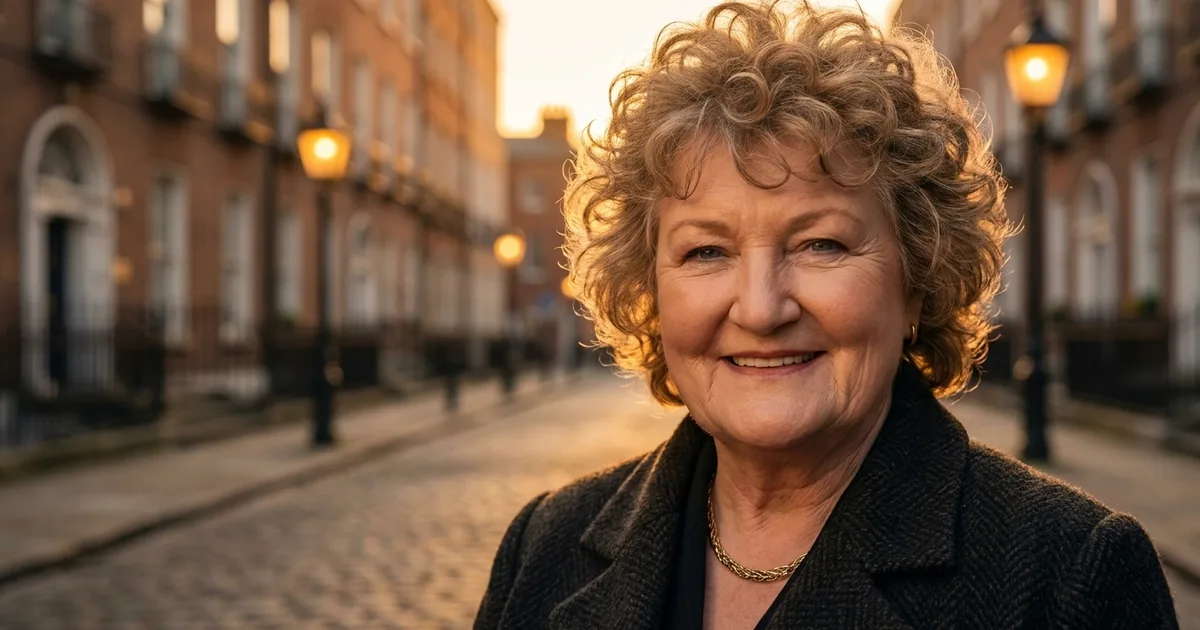
Brenda Fricker, the Irish actress who became the first woman from Ireland to win an Academy Award when she took home the Best Supporting Actress Oscar for her role as Christy Brown’s mother in My Left Foot, has died at the age of 81.
Her agent, Phil Belfield, confirmed her death on Thursday.
A Career That Spanned Six Decades
Fricker’s range was extraordinary. She could break your heart as the fiercely devoted Mrs. Brown opposite Daniel Day-Lewis in Jim Sheridan’s 1989 masterpiece, then make an entire generation of kids laugh as the Pigeon Lady in Home Alone 2: Lost in New York three years later. That kind of range is rare in any era of filmmaking, and it is what made her one of Ireland’s most enduring screen presences across a career that stretched from the 1960s through the 2010s.
Born in Dublin on February 17, 1945, Fricker trained at the Brendan Smith Academy of Acting before cutting her teeth in Irish theater and early television work. Her breakthrough came not on film but on the small screen: she was cast as Staff Nurse Megan Roach in the first season of BBC’s Casualty when the medical drama launched in 1986, a role she would return to over more than two decades and 70 episodes.
The Oscar That Made History
The role that changed everything came in 1989. Director Jim Sheridan cast Fricker as the mother of Christy Brown, the Dublin artist born with cerebral palsy who could only write and paint with his left foot. Day-Lewis famously stayed in character throughout the shoot, requiring crew members to feed him and carry him around the set. Fricker matched his intensity with a quieter, more devastating performance: a woman holding a working-class family together with almost no resources and absolute stubbornness.
The Irish Times reported that when Fricker won the Oscar at the 62nd Academy Awards in March 1990, she became the first Irish-born actress to take home the award. It was a milestone that mattered beyond the individual honor, because it signaled to a new generation of Irish actors and filmmakers that the Academy was paying attention to stories from outside the Anglo-American mainstream.
From the Oscars to the Pigeon Lady
What Fricker did next surprised people. Rather than chasing prestige roles, she took on the Pigeon Lady in Chris Columbus’s Home Alone 2: Lost in New York in 1992, a character who could easily have been a throwaway comic bit. Fricker made her something more: a lonely, misunderstood woman in Central Park whose friendship with Macaulay Culkin’s Kevin McCallister became the emotional anchor of the film. It remains one of the most-quoted holiday films in American pop culture, and Fricker’s performance is a large part of why.
Her filmography through the 1990s and 2000s was varied and deliberate. She appeared in Jim Sheridan’s The Field alongside Richard Harris in 1990, in Joel Schumacher’s A Time to Kill in 1996, and in two films with deep Irish resonance: Veronica Guerin in 2003, where she played the mother of the murdered Dublin journalist, and Inside I’m Dancing in 2004. She reunited with the world of prestige period drama in Albert Nobbs alongside Glenn Close in 2011.
Health Struggles and a City’s Recognition
In more recent years, Fricker had spoken candidly about her health challenges. She described herself as having a “dreadful death” in interviews, with characteristic dark humor that never tipped into self-pity. Dublin City Council had announced plans to award her the Freedom of Dublin in recognition of her exceptional contribution to Irish arts and culture.
Fricker’s death comes during a period in which the entertainment world has lost several towering figures in quick succession. Sam Neill, the New Zealand-born star of Jurassic Park, died last week at 78, and MJ Shannon, the matriarch behind the Kardashian empire, died earlier this week at 91.
What She Left Behind
The structural reason Brenda Fricker matters to film history is not just the Oscar. It is what she proved about the relationship between prestige and accessibility. She demonstrated that an actress could win the highest honor the industry offers and then immediately choose a role in a family comedy, not because she had to, but because she saw something real in it. That refusal to be boxed in by the industry’s own hierarchies is the thread that runs through her entire career.
She won an Oscar, she fed pigeons with Macaulay Culkin, and she did both with the same commitment. That is the legacy.