
Sam Neill, the New Zealand actor whose quiet authority and wry intelligence made him one of the most recognizable faces in global cinema, died on Sunday in Sydney, Australia.
He was 78. His family confirmed the death in a statement, calling the loss “sudden and unexpected.”
Neill had fought a five-year battle with angioimmunoblastic T-cell lymphoma, a rare and aggressive blood cancer, and announced in April 2026 that he was cancer-free. His family emphasized that cancer was not the cause of his death.
The Role That Changed Everything
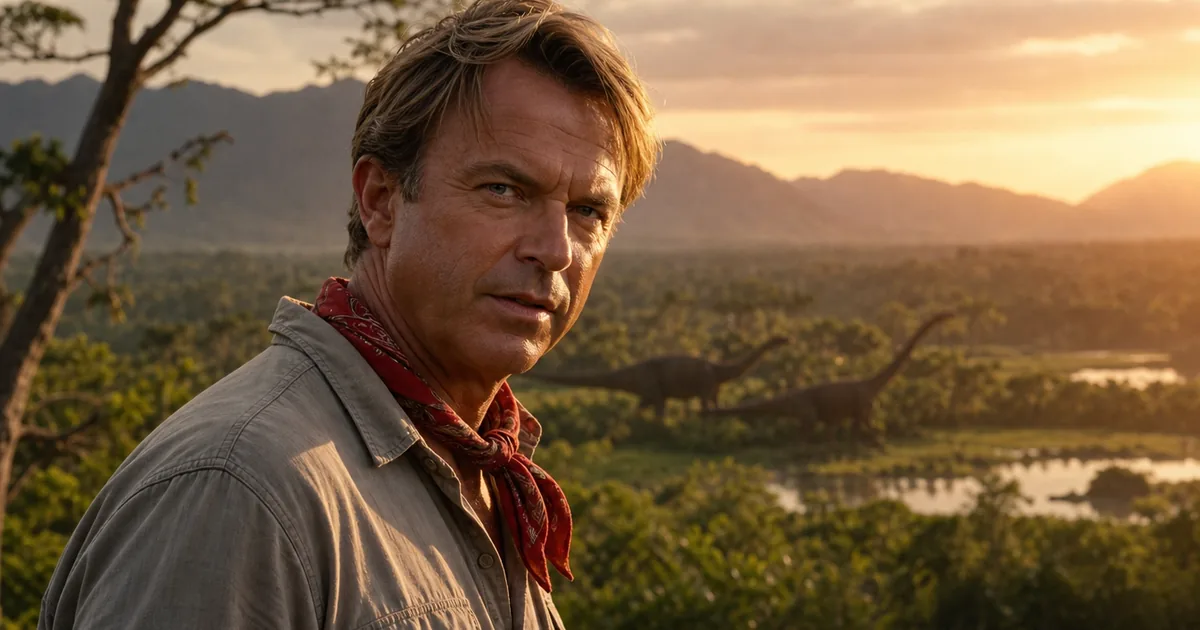
Neill’s career spanned more than four decades and more than 90 films, but one role redefined his trajectory. When Steven Spielberg cast him as Dr. Alan Grant in 1993’s Jurassic Park, Neill became the calm, authoritative center of what would become one of the highest-grossing franchises in film history. He returned to the role in Jurassic Park III (2001) and again in Jurassic World Dominion (2022), closing a 29-year arc with the character that made him a household name.
What set Neill apart from the standard blockbuster lead was his refusal to play Grant as an action hero. The paleontologist was cautious, cerebral, visibly frightened when he needed to be. It was the performance of an actor who understood that the dinosaurs were the spectacle and the human response to them was the story.
A Career Built on Range, Not Volume
Before Spielberg came calling, Neill had already built a formidable body of work. His turn opposite Nicole Kidman in Phillip Noyce’s Dead Calm (1989) established him as an actor who could carry a thriller through tension and restraint rather than physical dominance. A year later, he played a Soviet submarine captain in The Hunt for Red October alongside Sean Connery.
But it was Jane Campion’s The Piano (1993), released the same year as Jurassic Park, that showed Neill’s full range. His portrayal of the possessive settler Alistair Stewart in colonial New Zealand earned critical acclaim and a Palme d’Or for the film at Cannes. CNN reported that Neill considered The Piano among his most important work, despite it being overshadowed commercially by the Spielberg blockbuster that opened weeks apart.
In later years, Neill brought menacing precision to Major Chester Campbell in the first two seasons of Peaky Blinders, played Odin in Thor: Love and Thunder, and continued working in New Zealand cinema, a commitment to his adopted country’s film industry that never wavered even as Hollywood kept offering bigger paychecks.
“He Remained Cancer Free”
Neill went public with his cancer diagnosis in his 2023 memoir, Did I Ever Tell You This?, a book he wrote partly because he was not sure he would survive to tell the stories any other way. The memoir was characteristically self-deprecating, funny, and honest about the terror of aggressive chemotherapy.
His recovery appeared to be a genuine medical success. NPR reported that Neill’s family stressed the distinction in their statement: “The loss was sudden and unexpected but blessed by the fact that Sam remained cancer free.” The family did not disclose a specific cause of death but said he was surrounded by loved ones at St Vincent’s Private Hospital in Sydney.
A Kiwi Who Never Left
Neill was born Nigel John Dermot Neill in Omagh, Northern Ireland, in 1947, but his family moved to New Zealand when he was a child, and he considered himself a New Zealander for the rest of his life. He was knighted as a Knight Companion of the New Zealand Order of Merit in 2022 for services to film, a recognition that placed him alongside his country’s most celebrated cultural figures.
Australian Prime Minister Anthony Albanese was among the first world leaders to pay tribute. “He earned a special place in Australian hearts,” Albanese said. “Wry and dry, thoughtful and laconic, Sam fought illness with the same dignity, humour and conviction that gave strength to his every performance.”
The tributes from Neill’s peers in the entertainment world have been striking for their consistency: colleagues describe a man who was generous on set, funny off it, and entirely without the ego that typically accompanies a career at his level. In a year that has already claimed several beloved entertainers, including Bonnie Tyler and Victor Willis, Neill’s death lands with particular force because it was supposed to be the good-news chapter, the one where the cancer survivor got to enjoy his recovery.
What He Leaves Behind
Neill’s final projects include several films in post-production, and his vineyard, Two Paddocks, in Central Otago, New Zealand, which he ran as both a serious winemaking operation and an expression of his deep attachment to the New Zealand landscape.
The structural tragedy of Neill’s death is in the timing. A man who wrote a memoir partly as a farewell, who fought a rare cancer with public grace, who announced his recovery to genuine global relief, died suddenly three months later from something else entirely. The cancer did not kill him. Something no one saw coming did.
That is a story even Spielberg could not have scripted.