
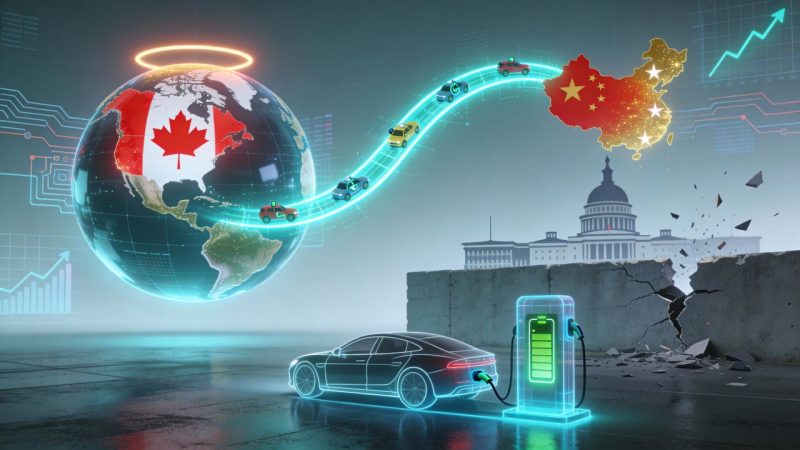
Donald Trump wanted to make Canada the 51st state. Instead, he just pushed America’s closest ally into the arms of its biggest rival.
Prime Minister Mark Carney returned from Beijing last Friday with something no Canadian leader has achieved in nearly a decade: a functional relationship with China. The “new strategic partnership” he announced alongside President Xi Jinping represents the most significant realignment in Canadian foreign policy since World War II, and it happened because Trump’s tariff chaos made the alternative unthinkable.
The numbers tell the story. Canada will now allow 49,000 Chinese electric vehicles into the country at a 6.1% tariff rate, down from the 100% levy Ottawa slapped on in 2024 when it was still playing nice with Washington. In exchange, China agreed to slash tariffs on Canadian canola seed from a punishing 84% to 15% by March 1, reopening a $4 billion market that Beijing had effectively closed to retaliate against the EV restrictions.
The Art of the (Other) Deal
Carney became the first Canadian prime minister to visit Beijing since 2017, walking into the Great Hall of the People to meet Xi just days after Trump renewed his musings about absorbing Canada into the United States through “economic force.” The timing was not accidental.
“In terms of the way our relationship has progressed in recent months with China, it is more predictable, and you see results coming from that,” Carney told reporters when asked the obvious question: Is China now a more reliable partner than the United States? He didn’t say yes. He didn’t have to.
The deal extends far beyond cars and cooking oil. Canada and China pledged to restart high-level economic dialogue, cooperate on oil, gas, and clean energy development, and establish regular ministerial meetings on energy policy. Carney announced that Canada plans to produce 50 million tonnes of LNG annually by 2030, all destined for Asian markets. Xi committed to visa-free travel for Canadians visiting China.
For Canadian farmers who have been watching their canola rot while China’s retaliatory tariffs made export impossible, the deal unlocks nearly $3 billion in orders. Lobster fishers, crab harvesters, and pea farmers will all see Chinese tariffs lifted by March.
Washington’s Mixed Signals
The White House response was characteristically incoherent. Trump himself seemed unbothered, telling reporters, “That’s what he should be doing. It’s a good thing for him to sign a trade deal. If you can get a deal with China, you should do that.”
His cabinet had different ideas. Transportation Secretary Sean Duffy, touring a Ford factory in Ohio while Carney was shaking hands with Xi, predicted Canada would “live to regret the day they partner with China.” Trade Representative Jamieson Greer warned that Chinese vehicles wouldn’t be welcome in the American market regardless of what Canada does, citing cybersecurity rules that would make compliance difficult for Chinese automakers.
The disconnect reveals an administration that wanted to bully Canada into submission without considering that Ottawa might have other options. About 75% of Canada’s manufactured goods currently flow to the United States. China accounts for just 4%. But when your dominant trading partner starts talking about annexation and slapping tariffs on your goods, even a 4% alternative starts looking attractive.
The Auto Industry Freakout
Ontario Premier Doug Ford, whose province hosts most of Canada’s auto manufacturing, reacted with predictable fury. “The federal government is inviting a flood of cheap made-in-China electric vehicles without any real guarantee of equal or immediate investments in Canada’s economy, auto sector or supply chain,” he wrote on X.
Ford has a point, but not the one he thinks he’s making. The 49,000 vehicles Canada agreed to accept represent roughly the same volume China was shipping before the 2024 tariff war began. It’s a return to status quo, not an invasion. Half of those imports must be priced under $35,000 by 2030, which would actually give Canadian consumers access to affordable EVs that the North American market has conspicuously failed to produce.
The Canadian Vehicle Manufacturers’ Association and its American counterpart issued a joint statement warning about China gaining a “foothold” in North America. Brian Kingston, president of the Canadian group, called engagement with China “extremely risky” given the need to secure renewal of the trilateral trade agreement with the US and Mexico this year.
But that argument assumes the United States is a reliable partner worth making sacrifices for. After a year of Trump’s tariff threats, sovereignty jokes, and general economic hostility, Canadian politicians and business leaders are starting to question that assumption.
The Bigger Picture
“It’s a huge declaration of realignment in Canada’s economic relations,” Edward Alden, a trade expert at the Council on Foreign Relations, told the Associated Press. “The economic threat from the United States is now perceived by Canadians as far bigger than the economic threat from China. So this is a big deal.”
The relationship between Canada and China was toxic just a few years ago. In 2018, Canada arrested Huawei executive Meng Wanzhou at Washington’s request, and Beijing retaliated by imprisoning two Canadian citizens on espionage charges that everyone understood were fabricated. During the April debate that preceded his election, Carney named China as Canada’s biggest security threat.
Now he’s calling the partnership “historic” and talking about “new global realities.” Xi is calling it a “new type of strategic partnership.” Both men know what changed: the American president decided to treat a sovereign ally like a hostile acquisition target.
Carney even discussed Greenland with Xi, telling reporters he “found much alignment of views” on the Danish territory that Trump has repeatedly threatened to seize. The message to Washington couldn’t be clearer: if you want to act like an imperial power, don’t be surprised when your neighbors start hedging their bets.
What Comes Next
Analysts caution against reading too much into the Beijing visit. Canada remains deeply embedded in American security and intelligence frameworks, and no single trade deal changes that overnight. “Canada is a core U.S. ally,” noted Sun Chenghao, a fellow at Tsinghua University. “It is therefore very unlikely to realign strategically away from Washington.”
But strategic realignment and economic diversification are different things. Canada can remain part of NATO and Five Eyes while simultaneously reducing its dependence on American markets. That’s exactly what Carney is doing, and Trump’s erratic trade policy gave him the political cover to do it.
The USMCA review looms later this year, and the Canada-China deal complicates those negotiations considerably. Michigan Governor Gretchen Whitmer put it bluntly: “When we fight our neighbors, however, China wins.”
Trump spent the last year trying to strong-arm Canada into submission. He got a functioning China partnership instead. Sometimes the art of the deal is knowing when you’ve made a terrible one.