
“So gray as to whose place this is… and which standards to follow.”
An Alligator Alcatraz facility official, to federal inspectors in January 2026
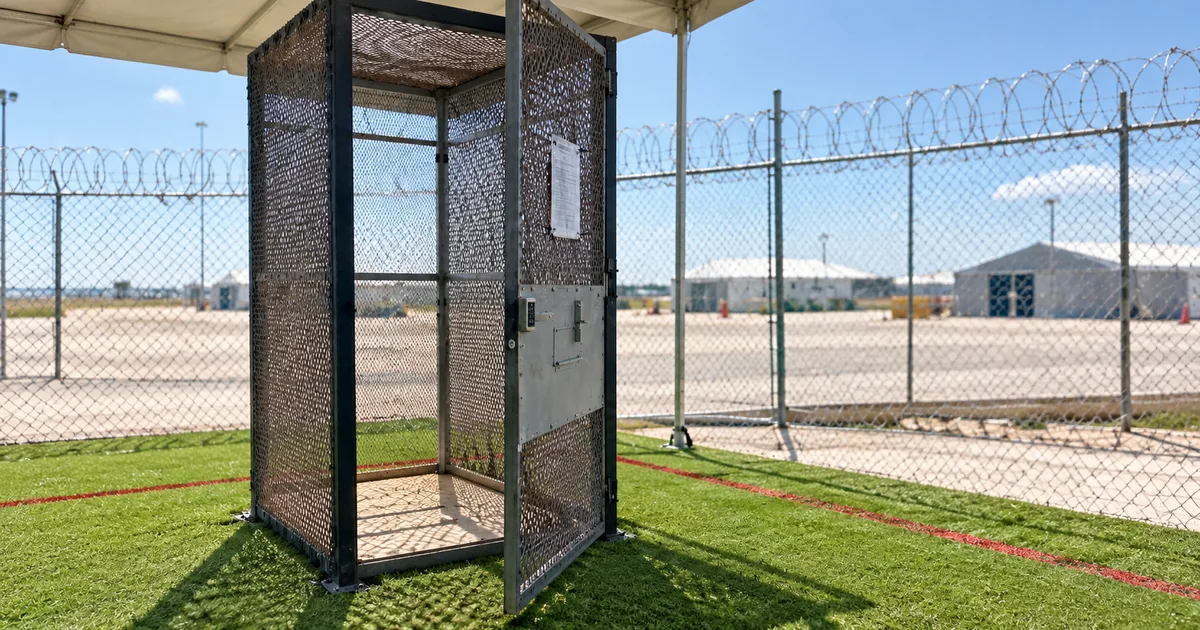
The Department of Homeland Security’s own inspector general has now confirmed what former detainees told Amnesty International last year: Florida’s detention camp in the Everglades put people inside metal enclosures with roughly 18 square feet of floor, 79 of them between July 2025 and January 2026. The cages are the headline, but the inspector general’s report released Monday is really a document about an alibi, because when DHS was asked to fix what its inspectors found, it answered that the camp was never its job.
Two details deserve more weight than they got on day one. The reassuring numbers, “several minutes to nearly 2 hours” and an average stay just under an hour, come from the camp’s own records, and the inspectors say plainly that they could not confirm or refute what officials told them. And DHS’s claim that Florida alone was in charge sits a few pages from a footnote in which both governments told federal judges something very different.
What the Inspectors Could Not Verify
The inspection itself was modest. A team from the Office of Inspector General arrived unannounced on January 21, spent one day on a limited-scope review, and interviewed eight detainees.
They found at least two enclosures standing in the outdoor recreation areas. Staff put them at 4 feet 3 inches on each side and 7 feet 9 inches tall. That is less than half the 37 square feet ICE guidelines require for a single cell, as NBC News, which first reported the findings, pointed out. It is also less than a third of the 8-by-7-foot cells in the camp’s own special management unit, where detainees were held in segregation, including as punishment. The calming area, in other words, was about three times smaller than the camp’s segregation cells.
Staff called the enclosures “calming areas” for detainees to “de-escalate and have time alone.” They said detainees asked to use them and were never locked in. The inspectors noted, dryly, that they observed locking mechanisms on the doors. A sign posted beside the cages, under the heading “Respect, Care and Dignity,” described a place for detainees to “reflect on their behavior choices, manage their emotions, reduce stress, and practice self-directed behavior.” It promised water “upon request.”
Then there is the detainee who spent 26 minutes inside one. The report does not name that person or say where they came from. The camp’s paperwork gives a single reason for the stay: “Failed to comply with a lawful command.” That one entry is the inspectors’ evidence that the enclosures “may have been used as a disciplinary tool,” and it is as close as a 33-page federal report gets to the person inside the cage. ICE officials, asked separately, were less coy. They told inspectors the enclosures were used for disciplinary issues, crisis intervention, housing changes and conflicts between detainees, and that people were handcuffed on the way in but not while inside.
Former detainees describe something harsher. The people Amnesty interviewed for its December 2025 report on the camp and Krome called it “the box” and said they were shackled hand and foot for hours in the sun with hardly any water. Amnesty concluded that using it as punishment “constitutes torture.” In March, Senators Jon Ossoff and Dick Durbin wrote to DHS citing those accounts.
The inspector general did not settle that dispute. It said it was “unable to independently confirm or refute” ICE’s version, because none of the eight detainees it spoke to reported experiencing those conditions. So when you read that nobody was held past the two-hour limit, understand the source: the camp’s own log. By that log, a new detainee went into a cage about once every 56 hours for six months.
DHS Says It Was Florida’s Camp. The Footnotes Say Otherwise.
The report made 10 recommendations to ICE. Number five was blunt: “immediately discontinue the use of the small metal enclosures to hold detainees for any reason or amount of time.” DHS’s formal response, the inspector general wrote, “did not address” any of them.
Instead, the department argued that Florida held people at the camp under Section 287(g) of the Immigration and Nationality Act, that DHS had no contract for the site, and that the state therefore ran day-to-day operations. On that reading, the cages were Tallahassee’s problem.
The watchdog spent its closing pages dismantling that. Every detainee at the camp was an ICE detainee. The handbook each of them received at intake described the site as “a detention facility of the United States Immigration and Customs Enforcement.” ICE posters hung on the walls, ICE personnel worked on site, and the 287(g) agreements ICE signed with nine Florida agencies say the work is “supervised and directed by ICE.” The inspectors could not even get through the gate without an ICE escort.
The footnote is where it gets awkward. In August 2025, an ICE official told a federal judge in the Everglades environmental case that ICE had been touring the camp to ensure it met ICE detention standards. In October, according to the report’s summary of a filing in a detainee lawsuit, Florida told another federal court that ICE decides which detainees are offered to the state and can summon any of them back at any time. When the question was whether the camp could keep operating, both governments described ICE’s hand on it. When the question became who answers for the cages, the hand disappeared.
The money followed the same pattern. In April, the Eleventh Circuit let the camp skip federal environmental review on the grounds that it was state-run, and Chief Judge William Pryor wrote, as The Invading Sea reported, that “until Homeland Security officials decide to fund the facility, no final agency action occurs.” FEMA had already obligated $608.4 million to Florida’s emergency management division for the camp in September 2025. On May 15, 2026, about three weeks after that ruling, it paid out $58.3 million. Back in January, a facility official had asked the inspectors whether they knew when the money would arrive.
That is the mechanism, and it explains the pull quote at the top of this piece. Alligator Alcatraz was federal when it needed ICE’s detainees and FEMA’s money, and it was Florida’s whenever a judge or an inspector asked who was responsible. Even ICE’s own records listed the camp’s contractually required detention standards as “N/A.” The staff could not say which rulebook they followed, and the official who called it “so gray” said that confusion was why detainees had no commissary, no in-person family visits and nothing to do in their units.
The Recommendations Were Closed Without an Answer, and Deportation Depot Is Still Open
Florida shut the camp on June 15. Governor Ron DeSantis said it “was always meant to be only temporary,” and PBS reported that about 21,000 deportations ran through it. The inspector general’s report arrived nearly three months later, delayed, it says, by a lapse in its funding from February 14 to April 30, the same budget fight behind the 42-day DHS shutdown. Because the camp no longer existed, the watchdog closed all 10 recommendations administratively. Not one was accepted, rejected or answered.
Florida’s response to all of this was to wish the cages were smaller. “While it adheres to all federal standards for criminal confinement, we’d make it even smaller if we could,” DeSantis communications director Alex Lanfranconi said in a statement reported by CNN, after calling the people inside “violent criminal aliens.” DeSantis said he had not read the report, then insisted the goal “was not to apply those standards but to exceed those standards.” An 18-square-foot cage does exceed the standards, in the sense that no standard anyone could find contemplates one.
Here is where we land. DHS’s response is not a legal position. It is a way of guaranteeing that nobody ever has to accept or reject recommendation five, and it should not be allowed to work twice. The Baker Correctional Institution in Sanderson, which Florida calls Deportation Depot, is also state-operated. It held 1,028 detainees as of August 27. ICE’s own documentation lists its required standards as “N/A,” exactly as it did for the Everglades camp, and ICE’s Office of Detention Oversight has not inspected it and has no inspection scheduled for fiscal 2026 or fiscal 2027.
The fix is not complicated. ICE should inspect Baker now, not at some point after fiscal 2027. DHS should apply all 10 recommendations to Baker before a second report arrives too late to matter. And Congress should attach written ICE standards and inspection access to every dollar of FEMA detention grant money, because the inspector general found that whatever DHS says about day-to-day control, it retains authority over how that federal funding is used. That is the one lever the department cannot claim it lacks.
Somewhere in Baker’s records, if anyone is keeping them, there will be another detainee who failed to comply with a lawful command. Nobody has written down which standard decides what happens next, and nobody from ICE is scheduled to check.