
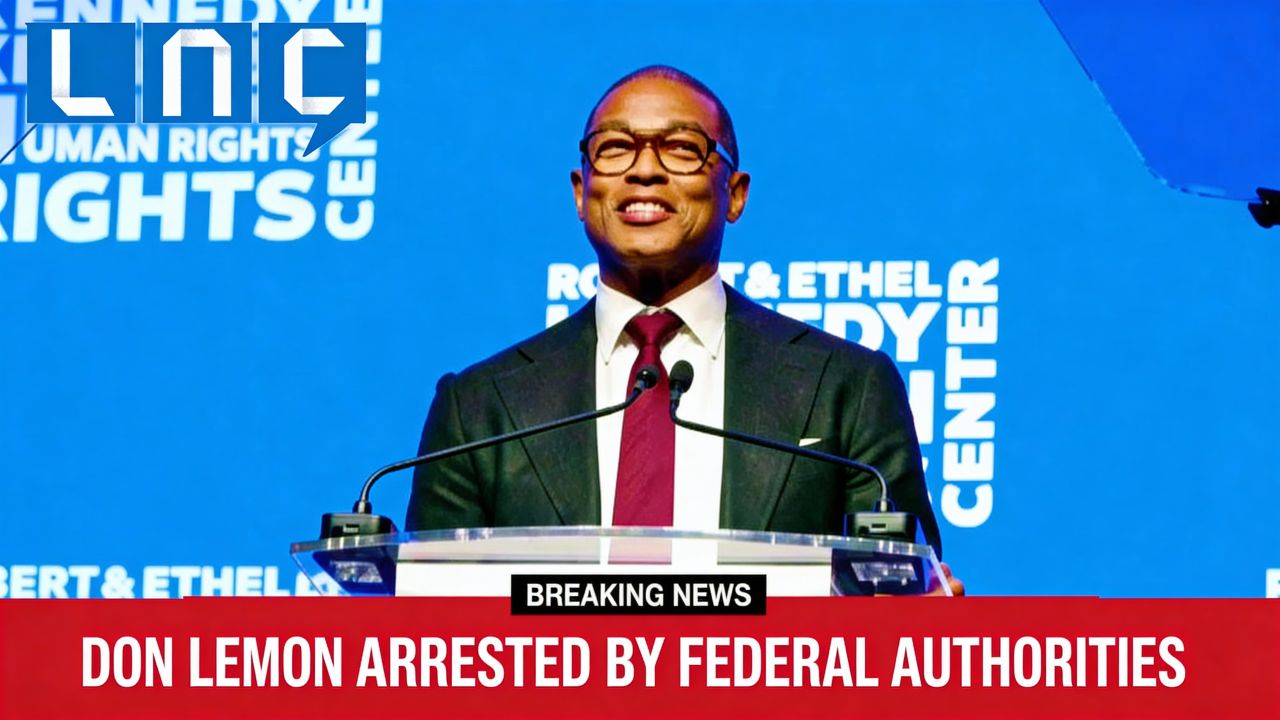
Former CNN anchor Don Lemon was arrested by federal agents Thursday night in Los Angeles while covering the Grammy Awards, marking a dramatic escalation in the administration’s pursuit of the journalist over his coverage of an anti-ICE protest at a Minnesota church earlier this month.
FBI and Homeland Security Investigations agents took Lemon into custody after a grand jury was empaneled Wednesday, according to multiple sources with direct knowledge of the arrest who spoke to CBS News. The specific charges Lemon faces have not been officially announced, but they stem from his presence at a January 18 protest at Cities Church in St. Paul, where demonstrators disrupted Sunday worship services.
Attorney Calls Arrest “Unprecedented Attack on the First Amendment”
Lemon’s attorney, Abbe Lowell, released a blistering statement on the former anchor’s Instagram account shortly after the arrest.
“Instead of investigating the federal agents who killed two peaceful Minnesota protesters, the Trump Justice Department is devoting its time, attention and resources to this arrest, and that is the real indictment of wrongdoing in this case,” Lowell wrote.
“This unprecedented attack on the First Amendment and transparent attempt to distract attention from the many crises facing this administration will not stand. Don will fight these charges vigorously and thoroughly in court.”
What Happened at Cities Church
The arrest traces back to January 18, when approximately 30 to 40 protesters affiliated with the Racial Justice Network and Black Lives Matter Minnesota entered Cities Church during Sunday morning worship. The demonstrators were protesting a pastor they alleged was David Easterwood, the acting field office director for ICE in Minnesota.
Protesters chanted “ICE out” and “Justice for Renee Good,” referencing a Minneapolis woman fatally shot by an ICE agent on January 7. The protest disrupted services, with congregants and their families leaving the building.
Lemon, who has operated as an independent journalist on YouTube since leaving CNN, livestreamed the protest and interviewed both protesters and Pastor Jonathan Parnell. In his livestream, Lemon compared the demonstration to the civil rights movement and defended the protesters’ First Amendment rights to assemble.
“This is the beginning of what’s going to happen here,” Lemon said during his coverage. “When you violate people’s due process, when you pull people off the street, you start dragging them and hurting them and not abiding by the Constitution, people get upset and angry.”
DOJ’s Pursuit of Lemon Hit Multiple Roadblocks
The Justice Department’s path to arresting Lemon was anything but smooth. Attorney General Pam Bondi and Assistant Attorney General for Civil Rights Harmeet Dhillon made prosecuting those involved in the church protest a top priority, with Dhillon publicly putting Lemon “on notice” on social media shortly after the incident.
On January 22, federal prosecutors presented criminal complaints against Lemon and four others to U.S. Magistrate Judge Douglas Micko. The former federal public defender refused to sign the arrest warrant for Lemon, finding no probable cause.
The DOJ then took the extraordinary step of asking the 8th Circuit Court of Appeals to compel the lower court to sign the warrants. In a filing, Chief Judge Patrick Schiltz wrote that the request was “unheard of in our district.”
The appeals court ultimately declined to force the lower court’s hand, though one of the three judges said he found probable cause existed to justify arrests. The ruling left the DOJ with two options: improve its affidavits and try again with a magistrate, or take the case to a grand jury.
They chose the grand jury route, which was empaneled Wednesday. One day later, Lemon was in custody.
Three Others Already Charged
Three people have already been arrested and charged in connection with the church protest: civil rights attorney Nekima Levy Armstrong, St. Paul School Board member Chauntyll Louisa Allen, and William Kelly. All three face charges of conspiring to interfere with constitutionally protected rights under the Ku Klux Klan Act.
Prosecutors also sought to charge them under the Freedom of Access to Clinic Entrances (FACE) Act, which prohibits interference not just with abortion clinics but also places of worship. Magistrate Judge Micko rejected that charge, writing “No Probable Cause” in the margin of the arrest warrants.
First Amendment Showdown
The Lemon arrest sets up what could become a landmark First Amendment case. The central question: Was Lemon acting as a journalist covering a newsworthy event, or was he a participant in what the DOJ characterizes as unlawful interference with religious worship?
University of Minnesota media law professor Jane Kirtley told Minnesota Public Radio that charging Lemon would be difficult to square with the Supreme Court’s 2010 decision in Holder v. Humanitarian Law Project, which held that reporting and expressing ideas cannot be considered “material support” for illegal activity.
“The question would be whether there is actually evidence that Don Lemon was doing anything other than just reporting on the activities that day at the church,” Kirtley said.
The DOJ appears to be arguing exactly that. In their pursuit of charges, prosecutors have alleged Lemon had advance knowledge of the protest and entered the church with demonstrators, making him a participant rather than an observer.
Tensions in Minnesota
The arrest comes amid escalating tensions between the Trump administration and Minnesota officials over federal immigration enforcement. Two people have been fatally shot by federal agents in the Minneapolis-St. Paul area this month, sparking daily protests and clashes.
The Pentagon announced last week that 1,500 soldiers were being put on standby to potentially deploy to Minneapolis to support ICE operations. Grand jury subpoenas have been issued to Minnesota Governor Tim Walz as part of federal investigations.
Minnesota Attorney General Keith Ellison has publicly disputed the DOJ’s legal theories, telling Lemon in an interview that neither he nor the protesters violated the FACE Act.
What Comes Next
Lemon is expected to make an initial court appearance in the coming days. With high-powered attorney Abbe Lowell, who has represented clients including Hunter Biden and Jared Kushner, mounting his defense, this case is poised to become a major battleground over press freedom and the limits of protest.
The DOJ has not yet commented on the specific charges Lemon faces. Whether a jury will ultimately agree that a journalist covering a protest crossed the line into criminal participation remains to be seen.
What’s clear is that the Trump administration has made its intentions known. As Dhillon said after the appeals court ruling, “Stay tuned.”
This is a developing story and will be updated as more information becomes available.