
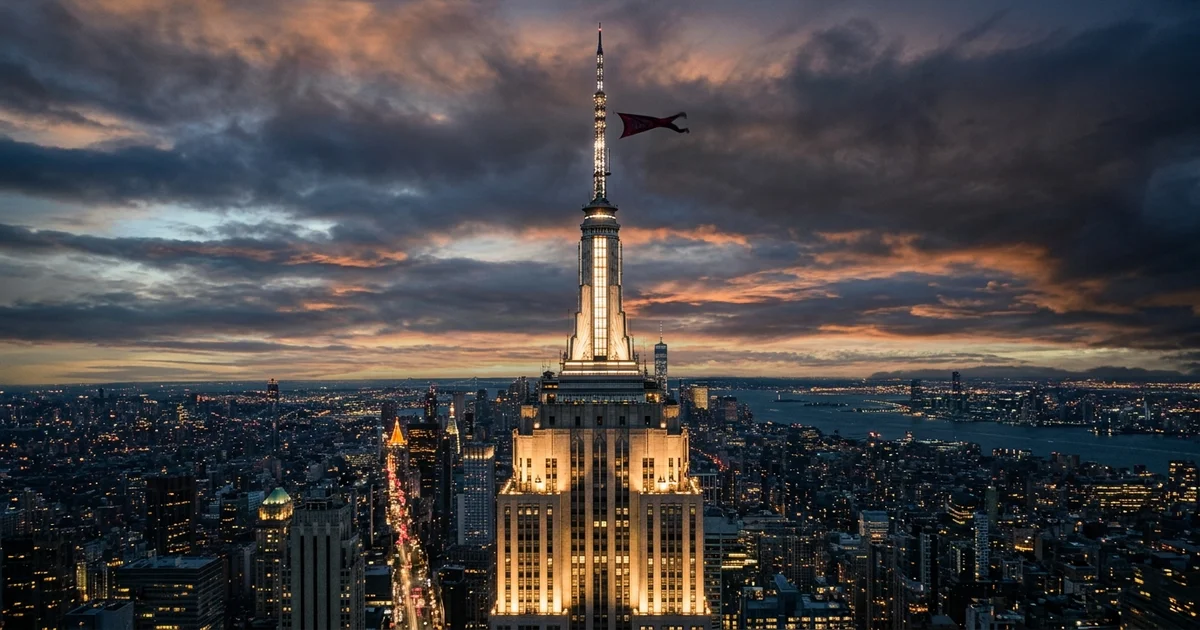
Angelina Nikolau and Ivan Kuznetsov climbed to the top of the Empire State Building on July 1, unfurled a banner reading “When the power of love beats the love of power, the world knows peace” from roughly 1,500 feet up, and then Kuznetsov dropped to one knee and proposed. An NBC helicopter circled overhead catching the whole thing on camera. It was romantic, reckless, and immediately illegal.
The Stunt Itself
The logistics of what Nikolau and Kuznetsov pulled off are worth considering before the inevitable debate about whether it was stupid or cool (it was both). The Empire State Building is one of the most recognizable structures on Earth and, you would assume, one of the most secured. It has been the target of security assessments and upgrades for decades. Two people in activewear should not be able to reach an exterior point 1,500 feet above Midtown Manhattan.
And yet. Both Nikolau and Kuznetsov are social media influencers with extensive histories of free-climbing skyscrapers and pulling off exactly this kind of high-altitude stunt in cities around the world. This is what they do. They find the gaps in building security, exploit them, document everything, and post it. As CNN’s follow-up investigation reported, Kuznetsov’s explanation was disarmingly simple: “Security always has a blindspot.”
That quote is going to give a lot of building managers a very bad week.
The Charges Are Serious
Whatever your feelings about the romance of it all, New York prosecutors are treating this as a crime, not a content moment. Both Nikolau and Kuznetsov were charged with felony burglary, reckless endangerment, and criminal mischief, plus additional misdemeanor counts. They were released under court supervision after arraignment.
Felony burglary is the charge that carries real weight here. In New York, entering a building unlawfully with intent to commit a crime inside qualifies, and prosecutors appear to be arguing that the trespassing itself, combined with the property access and the banner deployment, meets that threshold. Reckless endangerment, meanwhile, covers the risk to people below. A dropped phone from 1,500 feet is a projectile. A falling person is a catastrophe.
The mismatch between the visual (two people in love kissing above the skyline) and the legal reality (multiple felony charges, potential prison time) is the entire tension of this story.
The Influencer Economy’s Outer Edge
Nikolau and Kuznetsov are not amateurs who got lucky. They are part of a specific subculture of extreme urban climbing that has been growing on social media for over a decade. The genre, sometimes called “rooftopping,” has produced viral moments, brand deals, and, inevitably, deaths. In 2017, Chinese rooftopper Wu Yongning fell to his death during a filmed stunt. Others have followed.
The economics are straightforward and grim. The more dangerous the stunt, the more views it generates. The more views, the more sponsorship money flows in. Platforms algorithmically reward content that triggers visceral reactions, and there is nothing more visceral than watching someone stand on the edge of a skyscraper with no safety equipment. The incentive structure does not care whether the person survives. It only cares whether the content performs.
What Nikolau and Kuznetsov added to the formula was narrative. A proposal is a story. Stories get press coverage that pure stunts do not. NBC’s initial report led with the romance angle because romance is more shareable than trespassing. The framing was practically gift-wrapped for the couple’s social media strategy.
What This Says About Security
The Empire State Building is not some poorly guarded warehouse. It is a major tourist attraction that processes thousands of visitors daily, with security checkpoints, cameras, and restricted-access areas. The fact that two known free-climbers were able to bypass all of it and reach the exterior of the upper structure raises questions that go beyond this particular stunt.
If two influencers with Instagram accounts can find the blindspot, who else can? That is not a hypothetical. It is the question that building security professionals, city officials, and anyone responsible for protecting high-profile structures in New York will be asking this week. The answer, based on the available evidence, is uncomfortable: the blindspot exists because no security system is designed for people willing to risk death for content.
The Proposal as Content Strategy
Strip away the altitude and the felony charges, and what happened on July 1 was a content play executed with military precision. The banner was pre-made. The NBC helicopter was not a coincidence; aerial media coverage was part of the calculation. The proposal itself was timed for maximum visual impact. Every element was designed to produce a moment that would travel across platforms.
It worked. The video has been viewed millions of times. The story has been covered by every major outlet. Nikolau and Kuznetsov are, by every metric that the influencer economy values, having the best week of their careers. They are also facing felony charges. Both things are true simultaneously, and the fact that neither cancels the other out tells you everything about the city where this happened and the era we are living in.
Where This Goes Next
The legal proceedings will play out over months. The content will live forever. The security review at the Empire State Building is probably already underway. And somewhere, right now, another influencer is looking at a skyline and doing the math on what it would take to top this.
That is the part of the story nobody wants to say out loud. Prosecution does not deter people who view arrest as a plot point in their personal brand narrative. The risk is the product. The charges are the sequel. And the algorithm will reward the next person who goes higher, stays longer, or falls further.
The kiss was nice, though.