
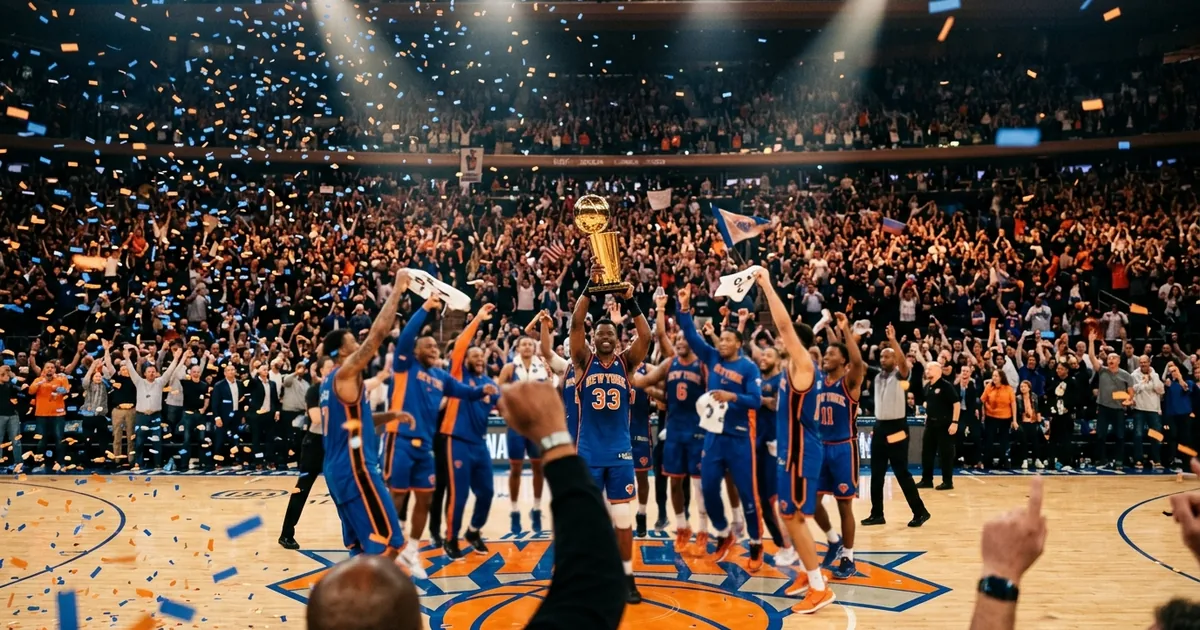
The New York Knicks are NBA champions for the first time since 1973, beating the San Antonio Spurs 94-90 in Game 5 on Saturday night to close out the Finals four games to one. Jalen Brunson scored a franchise Finals-record 45 points in the clincher and took the Bill Russell Trophy as Finals MVP, ending the longest active title drought in the league and finally handing the NBA’s richest, most scrutinized franchise the one prize all that money had never bought.
Fifty-Three Years, Finally Over
It is hard to overstate how long this city waited. The Knicks last raised a banner when Richard Nixon sat in the White House and Walt Frazier ran the offense. Every team since has been measured against that 1973 group and come up short, often spectacularly, through decades of front-office dysfunction, coaching churn, and an ownership reputation that curdled into a national punchline. Saturday night ended it in the most fitting way imaginable: a four-point grind at the Garden, in front of a crowd that had spent half a century rehearsing this exact release.
The path there bordered on the absurd. The Knicks rallied from a double-digit deficit in all four of their Finals wins, a run the league itself called historically clutch, with every game in the series still inside five points in the final five minutes. The turning point was Game 4, when San Antonio blew a 29-point lead and lost 107-106, the worst collapse in Finals history as ESPN documented it. That meltdown put New York up 3-1 and broke the Spurs in a way the box score only hints at.
A Title Built in the Trade Market, Not the Draft
Here is where the story gets interesting, because the 2026 Knicks are a case study in how a big-market team wins in the modern NBA. They did not bottom out and draft a generational savior. They bought and traded for a finished contender. Brunson arrived as a free agent from Dallas in 2022 and became the cornerstone the Mavericks inexplicably let walk. Around him, team president Leon Rose spent the currency big-market teams wield and small-market teams hoard: draft picks, and a lot of them.
Karl-Anthony Towns came over from Minnesota. Mikal Bridges cost a haul of first-rounders that drew open eye-rolls at the time. OG Anunoby was pried out of Toronto, and Josh Hart, once buried on the bench, turned into the connective glue every champion seems to need. None of it was cheap, and the wager was explicit: win before the bill comes due. That bet now looks like genius, which is how these bets always look once they hit. The same approach has hollowed out other rosters, and the Knicks themselves spent years as the cautionary tale. What changed was less the strategy than the execution, and a front office that finally stopped tripping over itself.
The Mike Brown Gamble Pays Off
The quieter turning point was on the sideline. Mike Brown replaced Tom Thibodeau, inherited a roster already engineered to win, and steered it through a season he later described as needing “a little chaos.” Brown loosened the heavy-minutes, ride-the-starters approach that defined the previous regime, trusting his bench in spots Thibodeau rarely would. Swapping coaches on a team this close to a title is the kind of decision that gets executives fired when it backfires. It did not backfire. The Knicks arrived in June with fresher legs than they had in years, and it showed in those fourth-quarter comebacks.
For all the structural analysis, the watching mattered too. This was a series that turned every late possession into appointment television, the kind of nightly drama that has reshaped how live sports coverage holds an audience and reminded a lot of lapsed fans why they cared in the first place.
The Spurs Lost the Series but May Own the Future
Then there is San Antonio, the more thought-provoking half of this Finals. The Spurs are everything the Knicks are not: small-market, draft-built, and years ahead of schedule. Victor Wembanyama, in only his third season, dragged them to their first Finals since 2014, won Western Conference Finals MVP and beat the Oklahoma City Thunder in seven games to get there. He finished third in MVP voting and the Spurs won 62 games. They lost the 2026 title. They may well own the next decade of them.
That contrast is the real lesson of these Finals. Two opposite theories of team-building met at the summit. The veteran, win-now, mortgage-the-picks model took the trophy this year, and it took everything the Knicks had to do it. The patient, draft-and-develop model walked away with the best player on the floor and a war chest of future assets. New York won the present. San Antonio is positioned to win the future, especially with the league’s hardening salary rules and their punishing second apron, which tend to reward the team that is young and cheap over the one that is old and expensive.
So the banner goes up at the Garden, 53 years late and fully earned. The harder question starts the moment the parade ends: can the Knicks run it back before this veteran core ages and the bill arrives, while a 22-year-old in San Antonio spends the summer deciding he is done losing Junes?