
A congressional maneuver sets the stage for long-awaited public release of Jeffrey Epstein’s government files.
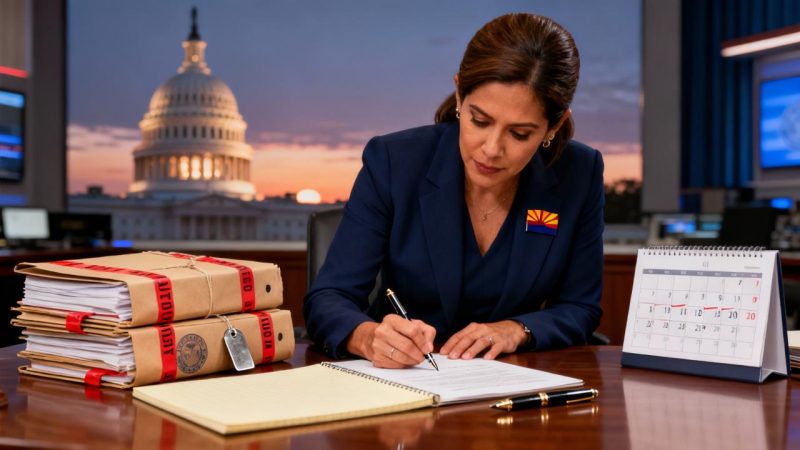
Rep. Adelita Grijalva of Arizona has officially delivered the decisive 218th signature on the House discharge petition compelling a vote to release every remaining government file tied to Jeffrey Epstein.
Her signature crosses the constitutional majority threshold needed to force the measure onto the legislative calendar, beginning a mandatory seven‑legislative‑day countdown before it reaches the House floor.
The move, confirmed Wednesday by House officials, ends weeks of procedural brinkmanship that saw Grijalva’s swearing‑in delayed for nearly two months—an extraordinary hold‑up Democrats said was engineered by Speaker Mike Johnson to block her from signing. Once the waiting period expires, Johnson must permit a floor vote under House rules, meaning a showdown over one of Washington’s most politically radioactive subjects is now unavoidable.
The petition, authored by Reps. Thomas Massie (R‑Ky.) and Ro Khanna (D‑Calif.), demands the Department of Justice publicly release its full Epstein case files, redacting only victims’ names. The bipartisan effort grew out of frustration over ongoing secrecy surrounding the late financier’s network of political and business allies and what many perceive as a government cover‑up.
According to CNN and The 19th, Grijalva’s arrival triggers a clock that could see a vote by early December, depending on the House schedule. Even if it passes the chamber, the measure faces steep odds in the Republican‑controlled Senate and the personal opposition of President Donald Trump, whose own ties to Epstein have resurfaced following last week’s release of emails linking him to Epstein’s trafficking operation.
Renewed Scrutiny After Email Revelations
The timing of Grijalva’s action is politically explosive. Just days before her swearing‑in, Democrats on the House Oversight Committee published a cache of Epstein’s private emails in which the disgraced financier claimed Trump “knew about the girls” and “spent hours at my house” in the company of a trafficking victim. Trump has denied the allegations and called the effort to release further records a “hoax.”
For many in Washington, those denials only underscored why full disclosure has become such a flashpoint. Epstein’s death in federal custody six years ago left unanswered questions about who enabled his decades‑long trafficking network. Successive leaks and partial document dumps have laid bare fragments of the story: a Justice Department plea deal so lenient it defies belief, a black book of contacts linking royalty, CEOs, academics, and political elites, and lingering suspicions of systemic protection.
The newly released messages, and now the petition milestone, have revived a debate about government accountability that stretches far beyond Epstein’s crimes. “This is about restoring public trust,” said Rep. Khanna, arguing that transparency is “the only antidote to conspiracy and impunity.”
Behind the Power Struggle
Grijalva’s path to that one decisive signature became a parable of obstruction and persistence. Elected in a September special election to replace her late father, Raúl Grijalva, she spent nearly seven weeks waiting to be sworn in as speaker Johnson kept the House out of session during the government shutdown. Johnson claimed procedural rules prevented her swearing‑in; Democrats called it political hostage‑taking.
Her eventual oath, described by The Guardian as “ending a seven‑week standoff,” drew applause on the House floor and instantly changed the balance of power. The same afternoon, she confirmed her intention and added her name to the petition—transforming what had been a symbolic campaign into a binding legislative process.
Under the rarely used discharge rule, 218 signatures compel the Speaker to schedule the underlying legislation for debate once a set of procedural “ripening” days passes. Only a handful of discharge petitions have ever succeeded in modern congressional history, often signaling a rebellion against leadership control of the floor.
What Happens Next
Once the waiting period expires, House leadership has two legislative days to act. If the measure reaches the floor, it would trigger debate on compelling the Department of Justice to publish all Epstein‑related case files, investigative correspondence, and communications with high‑profile figures. A floor vote could come as early as the first week of December if Johnson honors the timetable.
Even passage would only represent the first battle. The Republican‑controlled Senate could stall or kill the bill outright, and any final law would require Trump’s signature—an unlikely scenario as his administration continues to characterize the movement as partisan theater. Still, the House vote would publicly record where every lawmaker stands on one of the most sensitive transparency issues in decades.
Advocates for Epstein’s victims have hailed Grijalva’s signature as “the moment the cover finally cracks.” “We have waited years for this,” said attorney Lisa Bloom, who represents several survivors. “The system that enabled Epstein’s exploitation has hidden behind bureaucracy long enough. Let it all come out.”
Transparency vs. Power
This moment is about more than the content of the files. It’s a collision between two principles: the public’s right to know and the establishment’s instinct to protect itself. The Epstein saga has become a shorthand for elite impunity, the idea that the powerful occupy a parallel legal universe.
Grijalva’s move, though procedural, carries moral weight. It reasserts Congress’s ability to compel disclosure even when the executive branch resists. For lawmakers battered by years of cynicism over corruption and privilege, this vote—if and when it happens—may be their clearest test yet.
Seven legislative days from now, the House must decide whether sunlight is still the best disinfectant—or whether power, once again, prefers the dark.