
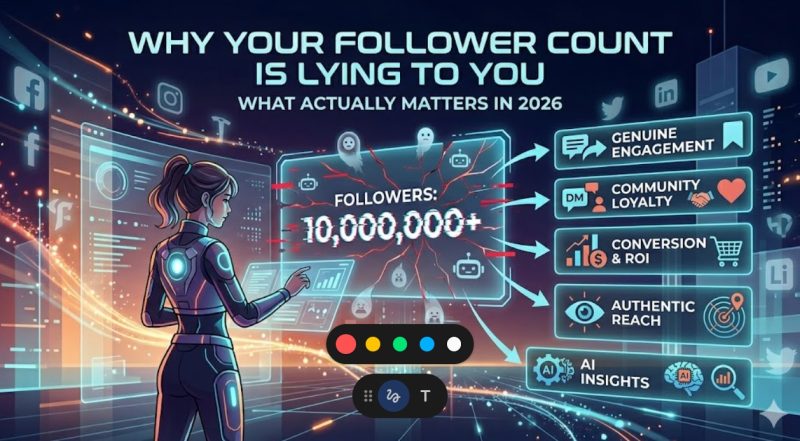
For years, the social media playbook was simple: grow the number, win the game. Brands chased follower milestones like trophies. Influencers inflated counts with follow-for-follow schemes and bot farms. The assumption was baked into every marketing deck on the planet: more followers equals more influence.
That assumption is now demonstrably wrong, and 2026 is the year the industry finally stopped pretending otherwise.
The Follower Count Illusion Is Over
Every major social platform now distributes content based on engagement signals, not follower count. A post from an account with 500 followers can reach millions if the algorithm detects genuine interest: watch time, shares, saves, comments that go deeper than a fire emoji. Meanwhile, accounts with six-figure followings routinely see their content buried because nobody actually cares enough to interact with it.
The data backs this up. TikTok’s engagement rate sits at 3.7% heading into 2026, up 49% year over year. Instagram’s hovers around 0.48%, essentially flat. But here’s the telling detail: comments per post fell 24% on TikTok and 16% on Instagram, while shares surged 45% on TikTok alone. People aren’t reacting passively anymore. They’re curating, forwarding, and saving content that actually provides value, and scrolling past everything that doesn’t.
This is a fundamental rewiring of how social platforms decide what gets seen. And it means the old metric, raw follower count, tells you almost nothing about actual reach or influence.
Ghost Followers Are Dragging You Down
Here’s the part most social media managers don’t want to talk about: a bloated follower list actively hurts your performance. Algorithms measure how your existing audience responds to new content. If half your followers are bots, inactive accounts, or people who followed you three years ago during a giveaway and haven’t engaged since, your engagement rate craters. The platform interprets that silence as a signal that your content isn’t worth distributing.
Think of it this way. You’d rather have 5,000 followers who open every post, share it with friends, and buy what you’re selling than 50,000 followers who forgot you existed. The first audience builds a business. The second one just looks good in a pitch deck that nobody believes anymore.
This is why regular audience auditing has become essential. Tools like an unfollowers tracker let you see exactly who has dropped off, which accounts have gone inactive, and where the dead weight is hiding. It’s not vanity management. It’s algorithmic hygiene, and in 2026, it directly impacts whether your content gets seen at all.
Community Is The New Currency
The smartest brands in 2026 aren’t optimizing for follower growth. They’re optimizing for community depth. Threads surpassed X (formerly Twitter) in daily active users earlier this year, hitting 141.5 million compared to X’s 125 million. Substack is exploding as a hybrid social platform. Discord servers, broadcast channels, and niche communities on Reddit are where the real conversations happen.
The pattern is clear: people are migrating away from public broadcast feeds and toward smaller spaces where they feel seen, heard, and connected to others who share their interests. For brands, this means the value proposition has flipped entirely. It’s not about reaching the most people. It’s about reaching the right people, consistently, in spaces where trust is already established.
More brands are now hiring dedicated community managers, investing in social listening infrastructure, and building programs that reward their most engaged members rather than chasing new ones. The shift is structural, not cosmetic.
Social Search Changes Everything
There’s another dimension to the follower obsolescence story that doesn’t get enough attention: social search. Over 60% of product discovery now happens on social platforms, and among Gen Z, 41% turn to social media before Google when researching something new.
This means your content needs to be discoverable, not just by your followers, but by anyone searching for relevant terms on TikTok, Instagram, YouTube, or Pinterest. Searchable captions, keyword-rich hooks, and content structured around questions people actually ask now matter more than follower count ever did.
A well-optimized video from a 2,000-follower account answering a specific question can outperform a generic post from a verified account with millions of followers. The platforms are rewarding relevance and utility over celebrity. That’s the ballgame in 2026.
What Actually Moves The Needle Now
If follower count is no longer the metric that matters, what is? The answer depends on your goals, but the strongest signals in 2026 fall into a few categories.
Shares and saves indicate that people found your content valuable enough to return to later or pass along to someone else. These are the strongest algorithmic signals on virtually every platform. DM conversations and comment depth show genuine community engagement. Retention rate (how long people watch your videos) determines distribution more than any other single factor on short-form platforms. And conversion metrics, whether that’s link clicks, discount code usage, or direct purchases through social commerce, tell you whether your audience is actually doing something after seeing your content.
None of these require a massive follower base. All of them require content that’s genuinely useful, consistently delivered, and tailored to an audience you understand deeply.
The Audit Nobody Wants To Do (But Everyone Should)
Here’s the uncomfortable truth: most social media accounts are carrying significant dead weight. Inactive followers, bot accounts, and disengaged audiences accumulated over years of growth-at-all-costs strategy. Cleaning house feels counterintuitive because the number goes down. But the performance goes up, often dramatically.
Start by identifying who’s actually engaging. Look at your share-to-impression ratio. Monitor which content formats drive saves versus passive likes. Track unfollows alongside follows to understand when and why people leave. The accounts doing this work consistently are the ones winning algorithmic distribution in 2026.
The social media landscape has changed more in the last 18 months than it did in the previous five years. Platforms are smarter. Audiences are pickier. And the old vanity metrics that once defined success now actively mislead anyone still paying attention to them.
The accounts winning in 2026 aren’t the biggest. They’re the most trusted, the most useful, and the most deeply connected to the communities they serve. If your strategy still starts with “grow followers,” it’s time for a new strategy.