
For most of modern history, serious philosophical inquiry was filtered through institutions—universities, journals, and a relatively small circle of recognised thinkers. That system gave philosophy rigour, but it also limited participation. If you weren’t trained, published, or affiliated, you were largely an observer.
That model still exists—but it’s no longer dominant.
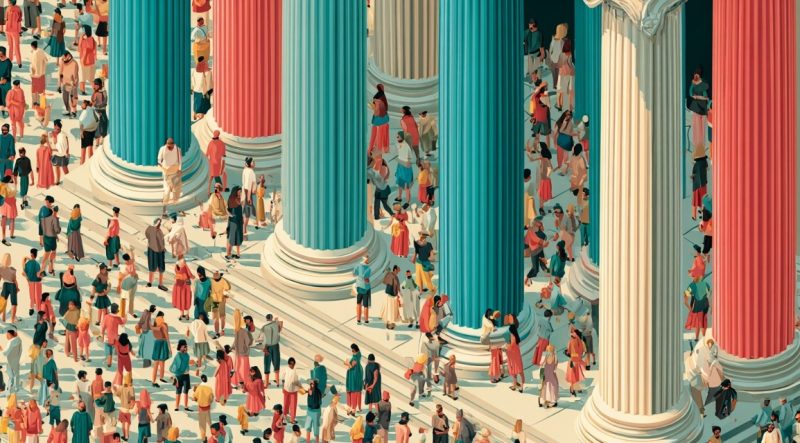
Today, philosophical discussion is happening in a far more open, decentralised environment. Platforms like Reddit and Quora have effectively removed the gatekeepers, allowing anyone to engage with questions that were once considered the domain of specialists. Research from the Pew Research Center has shown how online platforms are reshaping public discourse, creating new spaces for collective inquiry outside traditional institutions.
What distinguishes this shift isn’t just accessibility. It’s the way ideas are now tested in public. Arguments are no longer refined in isolation before being presented—they’re developed in real time, through discussion, disagreement, and iteration. Communities like the subreddits r/Philosophy and r/AskPhilosophy show how these exchanges can range from introductory questions to highly technical debates.
You can see this clearly in threads examining large, almost unfashionable questions—like whether humanity can fundamentally change its trajectory. Discussions around who could realistically fix the world and what that would actually require don’t stay abstract for long. Contributors quickly move beyond politics into questions about human behaviour itself: why people act destructively, why cooperation breaks down, and whether those patterns can be explained rather than simply managed.
From there, the conversation often broadens. Related threads explore whether we need to fix the world at its root rather than just manage crises, suggesting that surface-level solutions—policy, regulation, economic reform—may be addressing symptoms rather than causes.
Some discussions push even further back, asking more foundational questions. In threads centred on why humans keep circling the same psychological and moral dilemmas, contributors begin grappling with the possibility that recurring global problems might reflect something unresolved in human nature itself.
What’s striking is how these conversations evolve. They don’t follow the linear structure of academic papers. Instead, they branch. One idea leads to another, then splits into multiple interpretations, each refined through feedback. It’s messy—but it’s also dynamic.
In some ways, this decentralised model reflects the spirit of thinkers like Daniel Dennett, who argued that consciousness and human behaviour should be understood through multiple interacting perspectives, or Thomas Nagel, who challenged reductionist explanations of the mind. Both recognised that big questions resist simple, closed frameworks. Media theorists such as Clay Shirky have also argued that digital networks fundamentally change how knowledge is produced and shared.
Quora plays a complementary role in this ecosystem. While Reddit excels at generating discussion, Quora allows ideas to be consolidated into longer, more structured responses. Spaces like a Fix The World-focused Quora space function almost like evolving essays—refined over time as contributors revisit and expand on earlier answers.
The combination of these platforms creates something new. Instead of a single authoritative voice, you get a distributed process of inquiry: discussion, synthesis, revision, and redistribution.
Of course, this doesn’t replace traditional philosophy. Institutions still matter. The Stanford Encyclopedia of Philosophy remains one of the most rigorous and trusted sources for philosophical definitions and debates.
But what’s changed is the relationship between experts and the public. Philosophy is no longer something that trickles down—it’s something that circulates.
This has consequences. On the positive side, it allows more people to engage with meaningful questions. It breaks down intellectual silos and encourages interdisciplinary thinking. On the negative side, it introduces noise, inconsistency, and varying levels of rigour.
Still, the direction of travel is clear.
Philosophy has escaped the ivory tower—not by abandoning depth, but by redistributing it. And in doing so, it has become something closer to what it may have originally been: a shared, ongoing attempt to understand ourselves and the world we’ve created.