
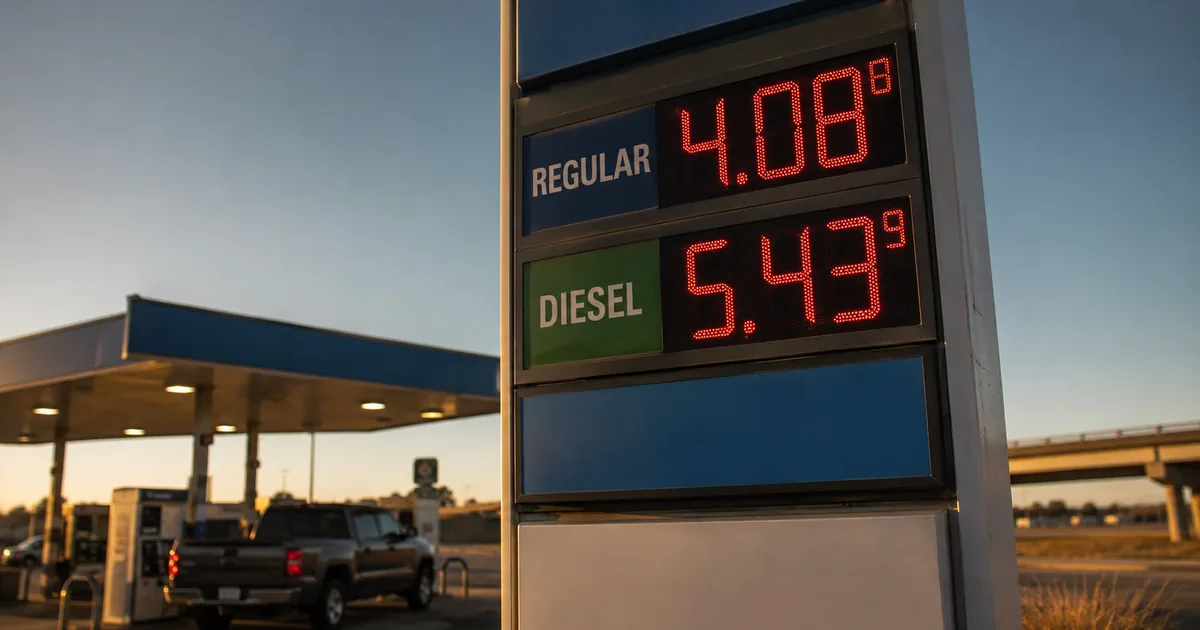
The national average for regular gasoline hit $4.08 on Friday, a price no mid-August in American history has ever produced, with diesel sitting at $5.43.
That number is the bill for a war the United States chose to start in February, and the emergency tools Washington normally reaches for in a fuel shock have already been drained.
The Record Is the Least Interesting Part
Patrick De Haan, GasBuddy’s head of petroleum analysis, put the milestone plainly this week: the national average has never been above $4 a gallon after August 12 in any previous year. Yahoo Finance reported that the closest any year came was 2022, at roughly $3.98 on this date. AAA’s tracker shows regular at $4.078 and diesel at $5.427, against $3.16 and $3.72 a year ago.
The direction matters more than the record. A month ago the average was $3.86. Prices are climbing into late summer, when they are supposed to be falling, and they sit about 36 percent above where they stood before the first American missiles hit Iranian targets on February 28. When the average crossed $4 in July, most coverage framed it as a threshold being breached. Three weeks later, $4 is the floor.
You Are Not Paying for Crude
Here is the part almost nobody covering today’s record has bothered to explain: the price on the sign has come unmoored from the price of oil. Gasoline is up roughly 98 percent this year while West Texas Intermediate crude is up about 44 percent, according to a Forbes analysis of refining margins published in July. The 3-2-1 crack spread, the industry’s shorthand for what a refiner earns turning three barrels of crude into two of gasoline and one of diesel, blew past $70 in late July. At that point the refining step was worth nearly as much as the barrel going into it.
That is not a crude shortage. That is a refining shortage, and the two have completely different cures.
Three separate blows landed on global refining at once. Iran’s closure of the Strait of Hormuz, which the Revolutionary Guards say will hold until Washington lifts sanctions and pays war damages, pulled both crude and finished fuel out of the market. Ukrainian drones have pushed Russian crude-processing rates to their lowest in two decades, a campaign that reached a refinery in Nizhnekamsk last week. And American refining capacity was already smaller than it had been two years ago, before any of this started.
That last piece is domestic, permanent, and nobody’s emergency:
- LyondellBasell shut its 263,776 barrel-per-day Houston refinery in March 2025.
- Phillips 66 ended operations at its 138,700 barrel-per-day Los Angeles plant in October 2025.
- Valero’s 145,000 barrel-per-day Benicia refinery in California came off the federal count this spring.
US operable distillation capacity stood at 18.2 million barrels per calendar day on January 1, down about 1 percent in a single year, by the Energy Information Administration’s count. You cannot drill your way out of that. A refinery takes years and billions of dollars, and no board approves one into a market everyone expects to be smaller by 2040.
The $12.6 Billion Quarter
Someone is capturing the gap between mid-priced crude and record fuel, and it is not the person holding the nozzle. Marathon Petroleum, Phillips 66 and Valero Energy earned a combined $12.6 billion in the second quarter, their best showing since Russia invaded Ukraine, Reuters reported this week. The same three companies sent $6.3 billion back to shareholders through dividends and buybacks, the largest quarterly return in more than two years, against $2.6 billion in the same quarter last year. A TD Cowen analyst expects Valero and Marathon alone to repurchase roughly a fifth of their market value between now and the end of next year.
Phillips 66 spelled out the mechanism in its own filing with the SEC: realized refining margins more than doubled in three months, from $10.11 a barrel to $24.08, lifting quarterly profit to $3.85 billion from $207 million.
None of that is illegal, and none of it means refiners started the war. It does mean the scarcity has a beneficiary, and that beneficiary is spending the windfall on share repurchases rather than on the capacity that would end the scarcity. Rational for a chief executive. Terrible for a country paying $5.43 for diesel, the fuel that moves every grocery shipment in America.
The Reserve Was Always a Crude Reserve
In March, as Hormuz closed, the administration ordered the release of 172 million barrels from the Strategic Petroleum Reserve, the largest drawdown ever authorized. Five months later the reserve holds 298.7 million barrels, its lowest level since January 1983, and it is headed for roughly 243 million once the release finishes.
The pump price set a record anyway. That is the whole argument in one sentence, and it is worth sitting with. Every barrel in the SPR is crude, which means every barrel needs a refinery before it becomes something a car can burn. Pushing crude into a market whose bottleneck is refining does one thing reliably: it softens the price of the input while the output stays scarce, which widens the crack spread. The emergency reserve, deployed at historic scale, worked in practice as a subsidy to refining margins. We argued in June that the oil market’s real constraint was never the strait itself, and the receipts are now sitting on the earnings statements.
What the President Is Offering Instead
The response from the White House has been a rotating set of demands aimed at everyone except the constraint. In late June the president publicly ordered oil companies and retailers to get to $2.25 a gallon, a number with no relationship to the cost of making the product. On August 7 he told reporters prices would fall as soon as the war ends, which he expected “pretty soon,” with no timeline attached. Tehran, which controls the strait, has attached conditions of its own to that ending.
And in May, with the average at $4.53, he offered the line that will outlive the rest of them:
This is peanuts. I appreciate everybody putting up with it for a little while. But I don’t even think about it.
Voters do think about it, and the polling is unusually direct about the mechanism. The Marquette Law School Poll, fielded July 22 to 29, found approval ticking up to 40 percent during the brief lull when pump prices eased, with no more than 30 percent approving of his handling of the cost of living. Poll director Charles Franklin named the driver without hedging: the biggest pinch was gas prices. That lull is over. The midterms are in November.
The Relief Everyone Is Counting On May Not Show Up
The standard assumption is that this fixes itself in September. Summer driving ends, refiners switch to cheaper winter-blend gasoline, and the average slides 20 or 30 cents without anyone lifting a finger.
That assumption collides with the calendar. Refiners cut runs for scheduled maintenance every autumn, and the EIA expects crude inputs to fall below 16 million barrels a day in October, thinning product output exactly as the cushion thins. Distillate inventories are already about 12 percent under their five-year average, and federal forecasters expect stocks of gasoline, diesel and jet fuel to end the year at their lowest since 2000.
So the question is not whether gas comes down after Labor Day. It is what the price does during the first genuinely cold week in the Northeast, with the reserve at a 43-year low, three American refineries permanently dark, and the waterway that would resolve any of it still held by a government the United States is at war with.