
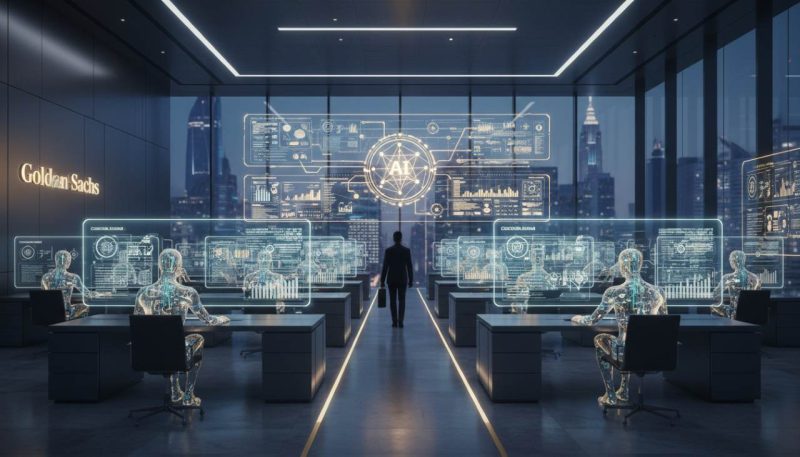
Goldman Sachs isn’t just experimenting with AI anymore. The investment banking giant has spent the last six months embedding engineers from Anthropic directly inside the firm to build autonomous AI agents that will handle work currently done by thousands of people in accounting, compliance, and client onboarding. The bank’s chief information officer, Marco Argenti, confirmed the partnership exclusively to CNBC on Thursday, describing the AI systems as “digital co-workers” for roles that are “scaled, complex and very process intensive.”
This is not a pilot program. Goldman is already preparing to launch these agents “soon,” according to Argenti, though he declined to provide a specific timeline. The initial focus is on two areas: accounting for trades and transactions, and client vetting and onboarding. Both functions require parsing massive volumes of documents, applying complex rules, and making judgment calls. Both currently employ significant numbers of professionals at Goldman and across Wall Street.
The timing is pointed. Goldman CEO David Solomon announced in October that the bank was embarking on a multi-year reorganization around generative AI, explicitly stating the firm would “constrain headcount growth” as the technology rolled out. Translation: the people Goldman would have hired in the past to handle volume growth? AI will do that work instead.
From Coding to Everything Else
Goldman’s journey with Anthropic began with Devin, an autonomous AI coding assistant that is now broadly deployed across the bank’s engineering teams. That success prompted a bigger question. “Claude is really good at coding,” Argenti told CNBC. “Is that because coding is kind of special, or is it about the model’s ability to reason through complex problems, step by step, applying logic?”
The answer turned out to be the latter. When Goldman tested Anthropic’s Claude model on accounting and compliance work, the results surprised executives. These are domains that require synthesizing large amounts of structured and unstructured data, applying regulatory frameworks, and making nuanced decisions. Claude handled it. Now Goldman’s view is that “there are these other areas of the firm where we could expect the same level of automation and the same level of results that we’re seeing on the coding side,” Argenti said.
The bank is already eyeing additional use cases, including employee surveillance and the creation of investment banking pitchbooks. That last one is particularly notable: pitchbooks are the presentation decks bankers create to pitch deals to clients, and they’ve traditionally been created by junior bankers working late nights. If AI can generate those, the implications for entry-level headcount are obvious.
No Job Cuts (Yet), But Third Parties Are at Risk
Argenti was careful to say that expecting near-term job losses for Goldman employees would be “premature.” But he left the door wide open for replacing third-party contractors and vendors who currently handle overflow work in compliance and accounting. “It’s always a tradeoff,” Argenti said.
That’s banking speak for “we’re not firing our people immediately, but we’re definitely not renewing contracts with outside firms.” For the consulting shops, legal process outsourcers, and compliance vendors who depend on Goldman’s business, this is an extinction-level event in slow motion. Goldman doesn’t need to fire anyone if it simply stops growing headcount while AI handles the increased workload that growth would have required.
The financial implications are massive. Goldman spends billions annually on operations and technology, with significant portions going to back-office personnel and third-party providers. Industry analysts estimate that automating even a fraction of compliance and accounting workflows could save hundreds of millions annually, and that’s before considering the speed advantages and reduced error rates that AI systems can deliver when operating 24/7.
The SaaS Apocalypse Context
Goldman’s announcement comes at a remarkable moment for Anthropic and the broader AI industry. Just this week, recent updates to Anthropic’s Claude Cowork productivity suite triggered a historic selloff in software stocks, with nearly $1 trillion in market value erased across software, financial services, and professional services companies. Thomson Reuters plunged 20% over five days, LegalZoom dropped 19%, and the S&P 500 Software & Services Index fell 20% from its October peak.
The panic centers on a fundamental question: if AI can do the work that specialized software was built to support, why pay for the software at all? Claude Cowork’s new plugins for legal work, financial analysis, marketing automation, and compliance are designed to replace entire categories of SaaS tools that companies currently subscribe to. The market is pricing in a world where enterprises use a single AI agent instead of dozens of specialized software products.
Goldman’s partnership with Anthropic validates that fear. One of the world’s most sophisticated financial institutions isn’t just using AI to supplement existing software. It’s building AI systems to replace entire workflows and the people who perform them. The bank isn’t alone in this bet. JPMorgan Chase, Morgan Stanley, Bank of America, and Citigroup have all been investing heavily in AI capabilities, and Goldman’s move will likely accelerate similar partnerships across the industry.
What This Means for Workers
For the tens of thousands of professionals currently working in accounting, compliance, and back-office operations at Goldman and across Wall Street, the partnership is a stark signal. The AI revolution isn’t theoretical anymore. It’s operational, it’s being built by the smartest engineers money can hire, and it’s coming for jobs that were supposed to be safe because they required judgment, context, and regulatory expertise.
Anthropic CEO Dario Amodei has been explicit about the disruption ahead. He predicted last year that AI could displace half of all entry-level white-collar jobs within the next five years, pointing specifically to losses in tech, law, consulting, and finance. With Goldman now actively building these systems and other banks certain to follow, Amodei’s timeline doesn’t seem like hyperbole.
The competitive pressure alone will force rapid adoption. If Goldman can process trade reconciliations 10 times faster than its rivals with a fraction of the headcount, other banks have no choice but to match that capability or lose business. The same dynamic will play out in legal services, accounting firms, and any industry where back-office operations are a significant cost center.
The Template for Corporate America
What makes Goldman’s move particularly consequential is that accounting and compliance functions exist in virtually every large corporation. If this partnership proves successful, it won’t stay confined to Wall Street. Pharmaceutical companies, energy firms, manufacturers, retailers, and technology companies all have similar back-office operations that could be automated using the same playbook Goldman and Anthropic are writing.
The embedded engineer model that Goldman is using is also telling. Anthropic didn’t just sell Goldman a software license. Engineers from the AI lab are sitting inside Goldman’s offices, co-developing systems alongside the bank’s technology teams. That’s a services model, not a product model, and it suggests that successful AI deployment in highly regulated industries will require deep customization and ongoing collaboration.
For Anthropic, this validates a strategy of pursuing large enterprise customers willing to pay premium prices for customized AI deployments. The San Francisco-based startup, co-founded by former OpenAI executives Dario and Daniela Amodei, has been aggressively chasing corporate contracts as it seeks to justify a valuation that has soared into the tens of billions. Goldman’s endorsement of Claude for mission-critical banking operations is the kind of reference that opens doors across Fortune 500 boardrooms.
The Real Stakes
Strip away the technology hype and here’s what’s actually happening: One of the world’s most powerful financial institutions is betting billions that AI can do the work of thousands of highly educated professionals in specialized fields. That bet isn’t based on speculation. It’s based on six months of testing with embedded engineers and measurable results that surprised even Goldman’s technology leadership.
The unglamorous back office is where the operational leverage lives. Goldman doesn’t make money from compliance officers and trade accountants. It makes money from traders and bankers. If AI can handle the essential but non-revenue-generating work at a fraction of the cost and time, the business model transforms. Other banks will be forced to follow or become uncompetitive. And once the template is proven in finance, it will spread to every industry with similar cost structures.
For workers, the implications are clear: the skills that were supposed to provide job security because they required domain expertise and judgment are being automated faster than most people expected. The question isn’t whether this is happening. Goldman just confirmed it is. The question is how quickly it spreads, and whether the displaced workers can transition to roles that AI can’t easily replicate. Right now, no one has a good answer to that second question.