
Walk down the supplement aisle in Boots, or scroll Amazon’s UK protein category for ten minutes, and you will see the word “grass-fed” stamped on tubs that cost roughly twice what the conventional alternatives charge. The bag art usually involves rolling green hills. The implication is straightforward: this is the better protein, and you should already know that.
But better in what way? Better for whom? And does paying the premium actually deliver something a conventional whey powder cannot?
Those are the questions almost no one in the supplements business wants to answer with any precision, because the marketing is more profitable when it stays vague. So let’s be precise. After looking at the published research, the processing reality, and the labels themselves, the honest answer is more interesting than either side of the argument typically admits.
WHAT GRASS-FED ACTUALLY MEANS (AND WHY THE COWS MATTER)
Grass-fed whey protein like Naked Whey comes from cows that spend their lives doing what cows are biologically designed to do, which is graze on pasture. Conventional whey, the stuff that fills most of the global protein powder market, comes from cows kept in confinement operations and fed a heavy diet of corn, grain, and soy.
That distinction matters at the source even if it does not always survive into the powder. Pasture-raised cows produce milk with a different fatty acid profile. A 2018 meta-analysis published in Food Science and Nutrition found that milk from grass-fed cows contains substantially higher concentrations of omega-3 fatty acids and conjugated linoleic acid (CLA), with a much more favorable omega-6 to omega-3 ratio (closer to 2:1, versus the 6:1 typical of grain-fed dairy).
The animal welfare argument is real too. Grass-fed operations, particularly in the UK, Ireland, and New Zealand, tend to involve smaller farms, free-roaming herds, and a reduced reliance on synthetic growth hormones like rBGH and rBST. (Both are banned in the UK and EU regardless, but the same cannot be said for the imported conventional whey ingredients that often end up in protein powders sold globally.)
So far, so good for the grass-fed pitch. Then comes the part the marketing leaves out.
THE OMEGA-3 STORY THAT BREAKS DOWN IN PROCESSING
Here is where the conversation needs to get honest. Most of the celebrated nutritional advantages of grass-fed dairy, the omega-3s, the CLA, the fat-soluble vitamins, live in the milkfat. They end up in butter, in cream, in full-fat yogurt and cheese.
Whey protein powder is the opposite of that. The whole point of the manufacturing process is to strip the fat out and concentrate the protein. Whey concentrate typically contains 70 to 80 percent protein by weight. Whey isolate pushes that figure above 90 percent. To get there, processors filter out almost all the fat and most of the lactose.
Which means the omega-3 and CLA advantages of grass-fed dairy mostly do not make it into the finished tub. The amino acid profile of grass-fed whey is virtually identical to the conventional version, because protein is protein. A leucine molecule from a Kerry pasture is structurally indistinguishable from a leucine molecule from a feedlot in Iowa.
If a brand is selling you grass-fed whey on the strength of its omega-3 content, the brand is, at best, being lazy with its science. At worst, it is exploiting a real research finding about whole milk and pretending the benefit survives a process specifically designed to remove it.
SO WHY PAY MORE FOR GRASS-FED WHEY PROTEIN
Because the upgrade is real. It is just located somewhere different from where the marketing tends to point.
Three things actually distinguish a quality grass-fed whey from a commodity conventional one, and none of them require believing in a CLA miracle.
First, the supply chain itself. Grass-fed certification, and the brands that take it seriously, impose meaningful traceability on where the milk comes from, how the cows were treated, and what they were fed. That alone is worth something to a buyer who cares about provenance, not just macros.
Second, the absence of growth hormones. For consumers who want their protein powder built on dairy that was not produced with rBGH or rBST anywhere in the supply chain, grass-fed sourcing from pasture-based regions like the UK, Ireland, and New Zealand is one of the cleanest guarantees available.
Third, and this is the underrated one, grass-fed branding tends to travel with cleaner ingredient lists. The same companies that pay extra for pasture-raised dairy are usually the ones that decline to bury the final product in artificial sweeteners, soy lecithin, and flavor maskers. Not always. But often enough that the correlation is worth using as a heuristic.
THE INGREDIENT LIST IS WHERE THE REAL DIFFERENTIATION LIVES
If you want to understand what is actually in a protein powder, ignore the front of the bag and read the back.
The average flavored whey product on the market today carries 15 to 25 ingredients. Look for the predictable cast: maltodextrin, sucralose, acesulfame potassium, soy lecithin, carrageenan, and a long list of “natural and artificial flavors” that get to remain unspecified under labeling regulations. Some of those additives are inert. Some of them, particularly soy lecithin extracted with hexane (a petroleum-derived solvent that remains the industry default for cheap lecithin), are reasonable to want to avoid.
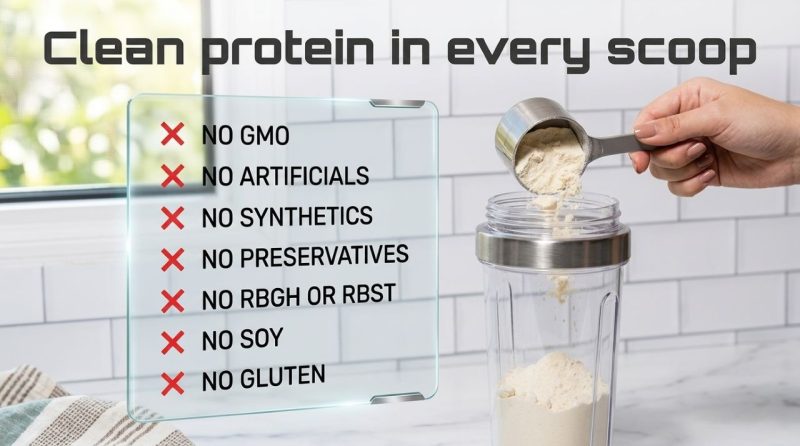
Compare that to the cleanest tier of products on the market. The unflavored version of Naked Whey’s grass-fed whey protein, for example, lists exactly one ingredient: grass-fed whey protein concentrate, sourced from cows pasture-raised on small farms in the UK, Ireland, and New Zealand. No artificial sweeteners. No soy lecithin. No gums, no maltodextrin, no flavor masking.
That is not a marketing claim. That is the entire ingredient panel.
This is the version of “grass-fed” that earns its premium. Not because of an asterisked omega-3 footnote, but because the supply chain and the formulation are both stripped down to what they actually need to be.
HOW TO CHOOSE A GRASS-FED WHEY PROTEIN WITHOUT GETTING SOLD
A few practical filters cut through most of the noise.
Read the back panel first. If the ingredient count runs past about six items, you are paying for additives, not protein. The cleanest options on the market sit in the three to six ingredient range. Single-ingredient unflavored versions exist and are usually the truest expression of what the brand actually sources.
Check the country of origin. Grass-fed labeling is not regulated identically across markets. Whey sourced from regions with serious pasture-based dairy traditions, the UK, Ireland, and New Zealand, tends to come with stricter standards baked into the supply chain than whey labeled “grass-fed” from regions where the term is largely an opt-in marketing claim.
Watch out for the sweetener stack. If a flavored grass-fed whey lists sucralose, acesulfame potassium, and soy lecithin, the grass-fed sourcing is doing real work, but the rest of the formulation is undermining the clean-label premise.
Treat the protein per serving number as table stakes, not as the differentiator. A reputable whey concentrate will deliver around 25 grams of protein per scoop. That is the floor, not the ceiling. The actual differentiation lives in the ingredients you do not see on a competitor’s label.
THE BOTTOM LINE
Grass-fed whey protein is not a magic bullet, and any brand selling it as one is overplaying its hand. The protein itself is biochemically very similar to what comes out of a conventional supply chain. The famous nutritional headlines about omega-3s and CLA largely belong to whole-fat dairy products, not to a fat-stripped powder.
But grass-fed sourcing still earns its place at the higher end of the market for reasons that have nothing to do with miracle nutrition. It signals a cleaner supply chain, an absence of growth hormones in the dairy that fed the formulation, and, most usefully, a strong correlation with shorter and more honest ingredient lists.
That last point is where shoppers should focus their attention. The real divide in the protein powder aisle in 2026 is not grass-fed versus conventional. It is short-ingredient-list versus long-ingredient-list, and the brands willing to sell single-ingredient or near single-ingredient products are doing the only thing that genuinely matters: telling you exactly what is in the tub.
If a grass-fed whey protein powder lives up to that test, the premium is doing real work. If it does not, the rolling green hills branding is doing the talking instead.