
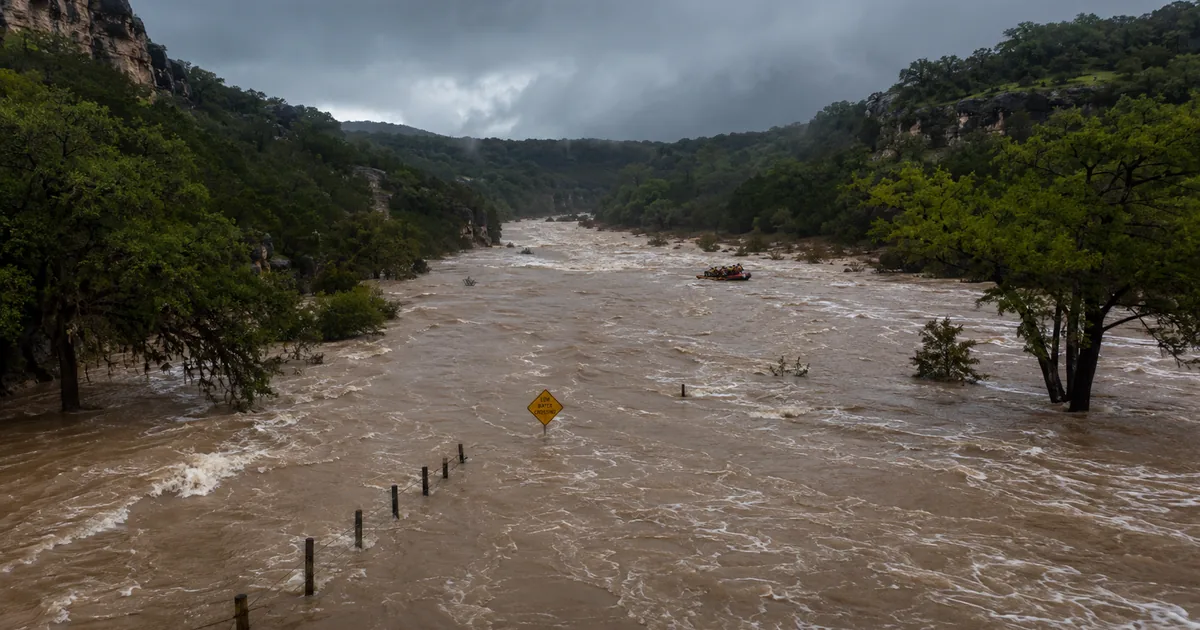
One person is dead and more than 75 have been pulled from rising water across the Texas Hill Country on Thursday, as the Guadalupe River reached 37.08 feet at Comfort and the National Weather Service issued Flash Flood Emergencies across Kerr, Uvalde, Kendall, and Blanco counties.
The same stretch of river that swept through Hill Country camps last July 4 is flooding again, and this time the water moved faster.
Rivers That Don’t Wait
Kerr County Sheriff’s Office confirmed a fatality near Center Point, between Kerrville and Comfort, on Thursday afternoon. The victim was not a camper. Gov. Greg Abbott announced that Texas Game Wardens and swift-water rescue teams had pulled more than 75 people from floodwaters, with rescues concentrated heavily in Uvalde County, where the Leona River overflowed its banks after 7 inches of rain fell overnight.
The Guadalupe River numbers are difficult to process at human scale. KUT Radio, Austin’s NPR station, reported that the river at Comfort spiked at 37.08 feet Thursday morning, exceeding last year’s catastrophic July 4 peak of 35.64 feet. One gauge outside Kerrville recorded the river rising 25 feet in a single hour. Another showed a rise of more than 34 feet in under two hours. Ten to 20 inches of rain had fallen across the broader Hill Country region over the prior two days, with 8 inches recorded in just two hours early Thursday morning.
The National Weather Service described a “large and deadly flood wave” moving down the Pedernales River, a Guadalupe tributary, and Flash Flood Emergencies were issued for parts of Kendall, Kerr, Uvalde, Blanco, and Gillespie counties. Mandatory evacuations are underway in Kerrville, Comfort, and Uvalde.
The Sirens Went Off This Time
One significant difference from last July’s disaster: the early warning infrastructure deployed in the aftermath of the Camp Mystic tragedy actually fired. More than 90 River Sentry flood warning sirens installed in Kerr County since July 4, 2025, activated before 4 a.m. Thursday morning in Kerrville and Ingram, alerting residents to high-water conditions before the worst cresting.
NPR’s reporting notes the siren towers triggered at roughly 3:32 a.m. after detecting rising water levels. Whether that window gave enough people enough time to act remains a live question. One confirmed death against last year’s far greater toll is a meaningful difference. It is also still one death, in a county that spent twelve months installing hardware designed to prevent exactly this. Infrastructure deployment and behavioral change are not the same thing. A significant portion of Hill Country residents and summer visitors still treat the rivers as a scenic amenity and have no working mental model of how fast the water becomes something else entirely.
A Region Engineered to Flood
The Hill Country’s appeal and its catastrophic flood risk share the same root cause. The region sits on the Edwards Plateau, a karstic limestone formation that does not absorb rainfall at any meaningful rate. It channels it. Narrow river canyons funnel runoff from distances of 50 miles or more into the Guadalupe, the Pedernales, and the Llano with almost no detention lag. In an engineered urban basin, that rainfall would hit impervious surfaces, storm drains, and modeled retention systems calibrated for exactly this kind of storm. In the Hill Country, the first warning that a flood wave is in motion is often the water itself.
Texas has flagged this pattern repeatedly at the policy level. In June 2026, state officials issued a disaster declaration covering 101 Texas counties after tropical-driven flash floods hit Houston and south Texas, and the Hill Country took that wave too. The legislative conversation after July 4, 2025, touched on notification requirements and risk disclosures for river-corridor businesses. What became enforceable policy versus what remained aspirational is worth examining now that a second major event has hit in 12 months.
Abbott, FEMA, and the Coming Federal Ask
Gov. Abbott confirmed the fatality and rescue numbers publicly Thursday and deployed additional Texas Game Wardens to the affected counties. A federal disaster declaration request from Texas to the White House is the expected next step, and the Hill Country track record suggests Washington will move relatively quickly. Both the Biden and Trump administrations approved prior Hill Country disaster declarations without significant delay.
But federal disaster response addresses the damage. It does not address the conditions that concentrate vulnerable people along these river corridors every summer. The Guadalupe and Medina valleys now host hundreds of campgrounds, short-term rental properties, and tubing outfitters. After July 4, 2025, that expansion did not reverse. If anything, the tragic scale of last year’s flood drew more media attention to the region, and in an attention economy, that translates into more visitors, not fewer.
The state can put sirens on the riverbanks. It is much harder to put a meaningful risk disclosure in front of a visitor who booked a riverside cabin on Airbnb for $180 a night.
What Comes Next
Flash Flood Emergencies typically recede within 24 to 36 hours, but downstream consequences persist for weeks: debris-filled roadways, contaminated water supplies, and property damage that takes months to quantify. The Guadalupe River Authority will begin formal damage assessments once water levels allow.
The broader weather system driving the flooding — a stalled low-pressure system drawing deep Gulf moisture into South Central Texas — is expected to keep producing heavy rainfall through at least Friday. The NWS has warned that some gauges could surpass the 2025 peak readings before the system clears.
The question the Hill Country will be answering over the coming months is whether this second consecutive July catastrophe constitutes a pattern that demands a structural policy response, or whether it gets absorbed into the regional identity as something that just happens sometimes, and the vacationers keep coming.
The sirens are working. That is progress. It is not a solution.