
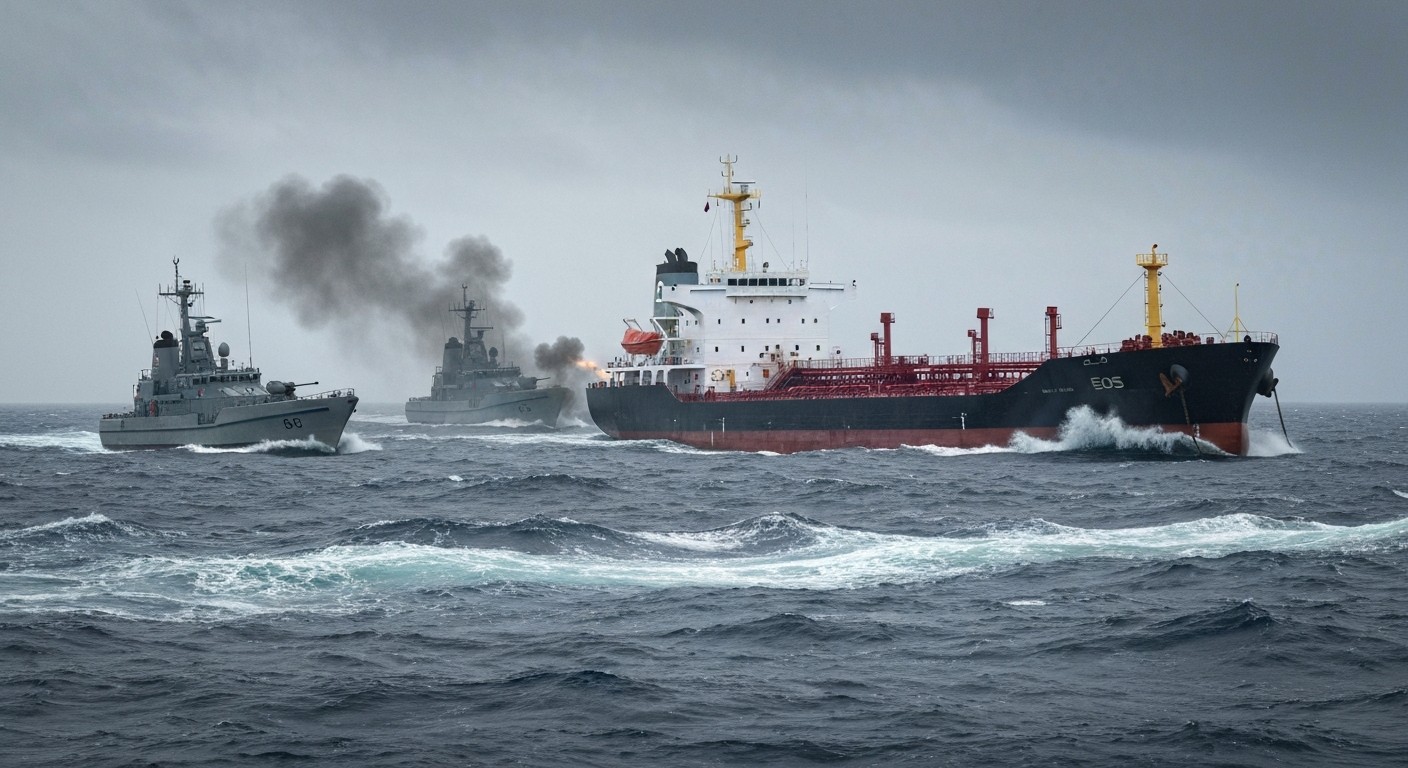
The Strait of Hormuz reopened Friday. By Saturday morning, two Islamic Revolutionary Guard Corps gunboats were firing on a tanker 20 nautical miles off the coast of Oman, and Tehran had quietly shredded its own announcement from the day before. That is the pace of this conflict now. Markets reopen, ceasefires hold, oil traders exhale, and then the IRGC puts a projectile into a merchant vessel before anyone has finished reading the headline.
WHAT THE UKMTO REPORTED
The British-run United Kingdom Maritime Trade Operations center issued warning 037-26 at 09:20 UTC Saturday. The advisory, sourced directly from the ship’s master, described two IRGC gunboats approaching a tanker without any VHF challenge and opening fire. The tanker and crew were reported safe. UKMTO did not disclose the vessel’s name or flag.
The location matters. Twenty nautical miles northeast of Oman puts the incident squarely inside the Strait’s outbound shipping lane, the same corridor Iran’s foreign minister Abbas Araghchi had described as “completely open” on Friday. Iran’s joint military command reversed that position Saturday, saying control of the waterway had returned to its previous state, which the parliament’s National Security Commission chair Ebrahim Azizi helpfully clarified means ships now require Iranian naval authorization and toll payment before transiting.
A REOPENING THAT LASTED HOURS
The sequence here is ugly. On Friday, following a US-mediated 10-day ceasefire between Israel and Lebanon, Tehran announced it was lifting restrictions on Hormuz. Oil prices dropped roughly 11% in the immediate aftermath. President Trump then posted on Truth Social that while the Strait was technically open, the US Navy’s blockade of Iranian ports would continue until nuclear negotiations wrapped up. Iran read the post as a betrayal of the deal’s spirit and walked the reopening back within hours.
By Saturday morning, at least eight tankers had managed to cross. At least that many turned around. Fox News, citing a regional intelligence official, reported the IRGC has “full control” of the waterway and it is “effectively closed at this moment.” CENTCOM, meanwhile, released photos of AH-64 Apache gunships patrolling the Strait, a not-subtle message about who runs the airspace above the water even when the water itself is contested.
INDIA CAUGHT IN THE CROSSFIRE
India, which had been on Iran’s “friendly nations” list and was still moving cargo through the Strait, got a blunt education in how quickly that status can evaporate. Two Indian-flagged merchant vessels were hit by gunfire Saturday. The Very Large Crude Carrier Sanmar Herald, according to tracking data, had already received Iranian clearance to transit before the IRGC turned on it, broke off contact, and made a run for the Gulf with its AIS transponder dark.
Delhi summoned the Iranian ambassador within hours, with Foreign Secretary Vikram Misri conveying what the Ministry of External Affairs called “deep concern” and pressing Tehran to resume passage for India-bound ships. The diplomatic embarrassment for Iran is not trivial. India has spent weeks walking a careful line, buying Russian crude, maintaining dialogue with Washington, and banking on Iranian goodwill to keep its energy imports moving. Saturday’s attacks blew a hole in that arrangement, as Al Jazeera’s reporting from Tehran framed it, with uncertainty now the defining feature of the entire waterway.
TRUMP’S WEDNESDAY DEADLINE
Trump has given Iran until Wednesday to reach a deal or, in his words, the US “may start dropping bombs again.” The Wall Street Journal reported Saturday that the US military is preparing to board Iran-linked oil tankers and seize commercial ships in international waters, a significant escalation from the current blockade posture. CENTCOM says 23 ships have already complied with orders to turn around since the blockade began.
Mojtaba Khamenei, who ascended to Supreme Leader after his father Ali Khamenei was killed in the opening salvo of Operation Epic Fury on February 28, said Saturday that the Iranian navy is ready to inflict “new bitter defeats” on enemies. First Vice President Mohammad Reza Aref added that Iran will control Hormuz “either at the negotiating table or on the battlefield.” The IRGC Navy Command’s own X account promised that “every breach of promise by America will be met with a fitting response.” That is not the language of a regime preparing to concede.
THE REAL STAKES
Roughly 20% of the world’s seaborne oil and a comparable share of its liquefied natural gas transits the Strait of Hormuz. A Dallas Fed quarterly model projects that a full-quarter closure alone would drive West Texas Intermediate to $98 per barrel and knock 2.9 percentage points off global real GDP growth in Q2 2026. Bloomberg’s reporting on oil trader sentiment suggests $170 or even $200 per barrel is no longer a fringe scenario if the closure extends deeper into the quarter.
American consumers have felt some of this already. US gasoline prices are up roughly $1.16 a gallon since the war began, with $5.00 a gallon increasingly plausible if the Strait stays closed through April. Jet fuel in North America is up 95%. European diesel shortages are expected within weeks. Qatar’s LNG exports, which are irreplaceable in the short term because there are no pipeline alternatives to ship-borne cargoes, have effectively stopped.
THE POLITICAL PROBLEM FOR WASHINGTON
Trump’s calculation here is aggressive: tighten the squeeze until Iran caves, then take credit for a reopened Strait and cheaper oil before the midterms. The problem is that the IRGC is not acting like a party ready to cave. Saturday’s gunboat attack, the reversal, the rhetoric from Mojtaba Khamenei, and Aref’s battlefield line all read as Tehran testing whether Washington will blink first.
If Trump follows through on boarding Iranian-linked tankers in international waters, he drags the US closer to a shooting war over shipping lanes that Gulf states, not the US, most urgently need open. If he backs off, he telegraphs that the blockade was always negotiable. Neither option looks clean six months before voters face midterms with $5 gas, jet fuel surcharges on every checked bag, and grocery inflation tied directly to diesel and fertilizer prices coming out of the same Gulf the IRGC just closed.
The Strait is, for now, whatever the IRGC says it is on any given morning. Everyone else, including the White House, is along for the ride.