
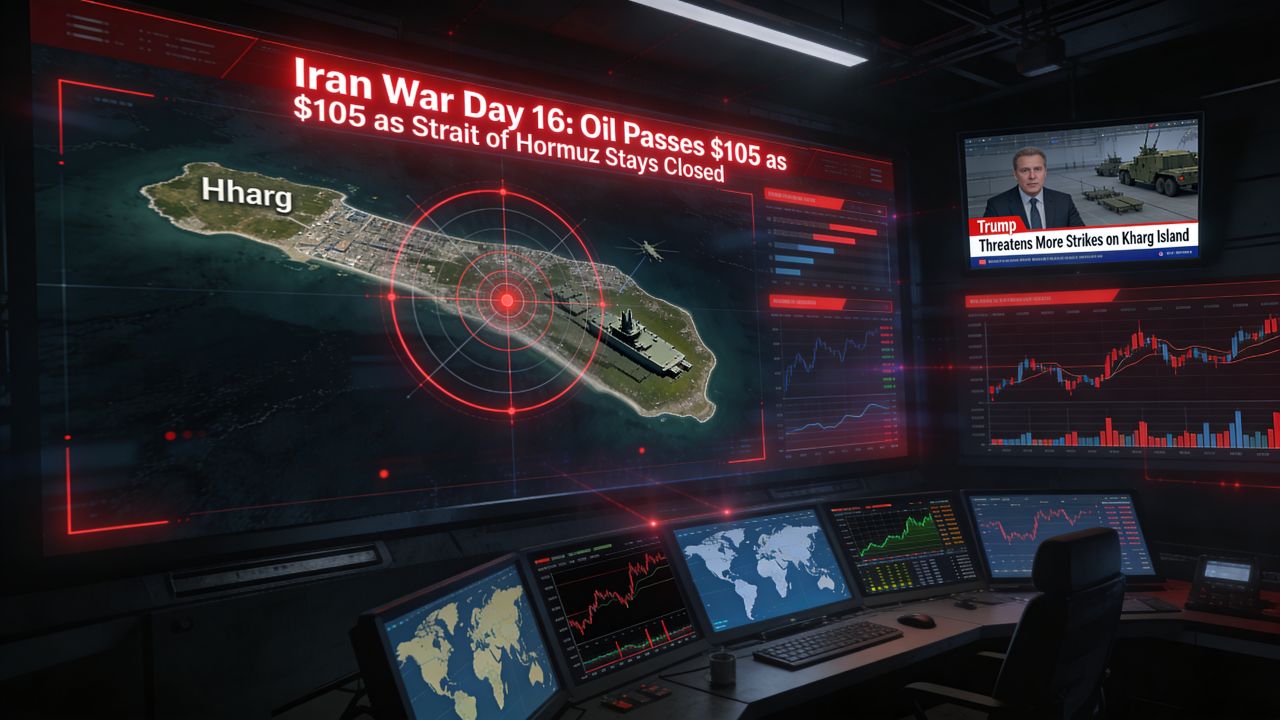
Sixteen days into a war that most of Washington still cannot fully explain to the American public, the US and Israel continued to pound Iran overnight, hitting Isfahan in strikes that killed at least 15 people.
Iran fired back with multiple missile barrages that sent sirens wailing across central Israel. And somewhere between the rubble and the retaliatory fire, the price of oil quietly crossed $105 a barrel, a number that every American household will feel at the gas pump within days.
This is what Week Three of the 2026 Iran War looks like: escalation without strategy, destruction without endgame, and an American president who told NBC News he might bomb Iran’s Kharg Island again “just for fun.”
The Strait of Hormuz Is Effectively Closed, and That Changes Everything
Before this conflict started on February 28, approximately 138 commercial vessels passed through the Strait of Hormuz every day. That number is now roughly five. One-fifth of the world’s daily oil supply moves through that narrow channel between Iran and Oman, and it has, for all practical purposes, been shut down.
The economic consequences of this are not theoretical. They are arriving. Brent crude surged past $106 before settling around $104. Gasoline futures are climbing in lockstep. Analysts at Goldman Sachs warned last week that sustained closures could push oil above $120 within a month. For American families already stretched thin by inflation, the math is brutal: every $10 increase in the price of a barrel of oil translates to roughly 25 cents more per gallon at the pump.
Trump’s response has been to call for an international naval coalition to secure the strait. That sounds decisive until you realize that most of America’s traditional maritime allies, including France, Germany, and Japan, have declined to participate. The UK has offered one frigate. The coalition of the willing, it turns out, is not particularly willing.
Trump’s “Just for Fun” Comment Reveals the Strategic Vacuum
In a phone interview with NBC News, Trump claimed that US strikes “totally demolished” much of Kharg Island, Iran’s primary oil export terminal. Then he floated hitting it again, telling the interviewer the US might strike “just for fun.” The comment was vintage Trump: brash, deliberately provocative, designed to project strength. It was also deeply revealing of a problem that has haunted this conflict from Day One.
There is no publicly articulated endgame. No set of conditions under which the bombing stops. No diplomatic framework. Israel’s military told CNN it is preparing for “at least three more weeks” of airstrikes with “thousands of targets” still on the list. Three more weeks. That would put this conflict into mid-April with no ceiling in sight.
Iran’s Foreign Minister Abbas Araghchi made Tehran’s position clear over the weekend: Iran never sought a ceasefire and is prepared for a long war. He added that the conflict could only end with guarantees against renewed attacks and compensation for damages. In other words, Iran is not looking for an off-ramp. Neither is Washington. Both sides appear to be settling into a grinding war of attrition that neither the Middle East nor the global economy can afford.
The Gulf Is Getting Dragged In Whether It Wants to Be or Not
One of the most alarming developments of the past 48 hours is the expansion of the conflict into the Gulf states. Authorities in the UAE confirmed a “drone-related incident” that sparked a fire near Dubai’s international airport. A separate drone attack hit Fujairah’s industrial zone. Neither the UAE nor any other Gulf nation is a combatant in this war, but geography does not care about neutrality.
Tehran has accused CENTCOM of using Gulf state territory as staging grounds for US operations, a claim the Pentagon has flatly denied. CENTCOM called Iran’s assertions about targeting Gulf countries “a lie.” But the drone strikes near Dubai suggest that Iran is either willing to test those boundaries or has lost precise control over the weapons it is deploying. Neither explanation is comforting.
The regional picture is darkening in other ways as well. Israeli soldiers fired on a car in the northern West Bank, killing four people including two children, according to the Palestinian Authority’s Health Ministry. Israeli operations in Lebanon have killed 826 people and displaced more than 800,000 since the conflict began. The war with Iran is not happening in isolation. It is pulling the entire region into a cascading series of crises.
What Americans Should Actually Be Watching
The daily strike counts and missile exchanges make for dramatic headlines, but the story that will define this war for most Americans is economic. Oil at $105 is a warning. Oil at $120 would be a crisis. Oil at $140, which is where some worst-case scenarios land if the Strait of Hormuz remains closed through April, would trigger a genuine recession.
Supply chains that were still recovering from the pandemic and the Red Sea shipping disruptions of 2024 are now facing a new chokepoint. Shipping insurance premiums for Gulf routes have quadrupled. Major container lines are rerouting around the Cape of Good Hope, adding two weeks to delivery times for goods moving between Asia and Europe. The ripple effects are showing up in commodity futures across the board.
And all of this is happening while the DHS government shutdown continues, the Federal Reserve faces an impossible inflation calculus, and consumer confidence sits near its lowest point since 2022. The American economy was already fragile. A sustained oil shock is exactly the kind of external blow that could push it over the edge.
The Question Nobody in Washington Wants to Answer
Sixteen days in, the question that defines this moment is deceptively simple: what does winning look like? The administration has not said. The Pentagon has not said. Israel has not said. Congress, consumed by the DHS funding fight, has barely engaged with oversight of a military operation that has now lasted longer than the initial phase of the 2003 Iraq invasion.
Without a defined objective, wars have a way of defining themselves. They expand. They metastasize. They create their own logic and momentum. We have seen this before: in Iraq, in Afghanistan, in Libya. The pattern is well-documented, the warnings are loud, and the trajectory is disturbingly familiar.
Day 16 is not the end of anything. If the people running this war cannot articulate what success means, it may not even be the beginning of the middle.