
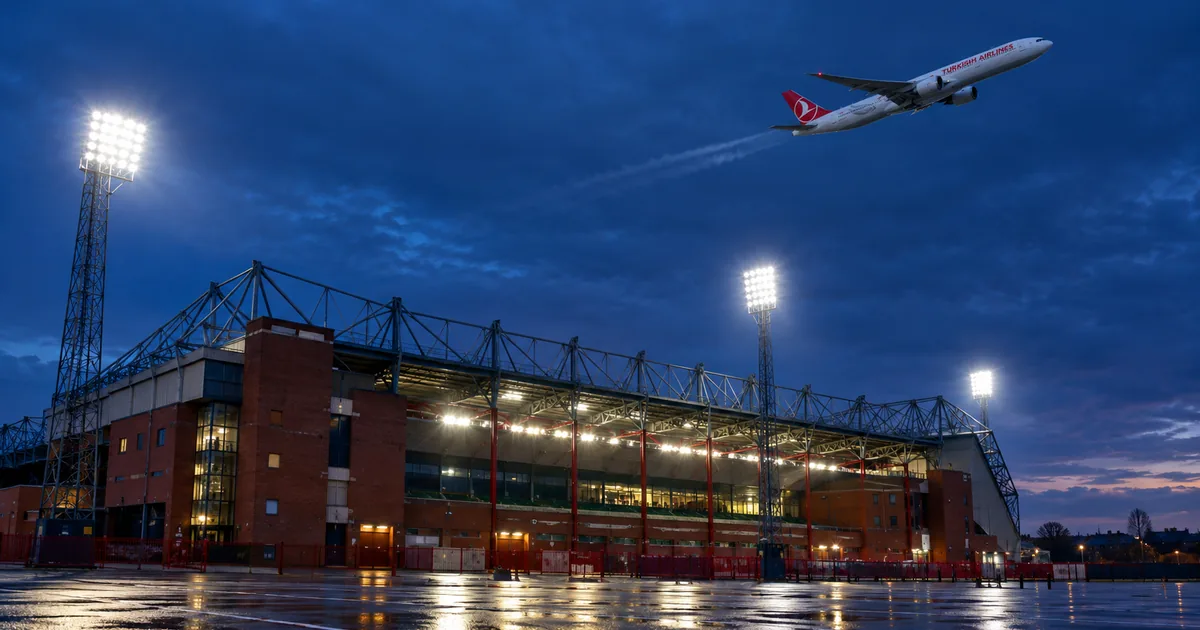
Liverpool confirmed on Tuesday that Turkish Airlines becomes its main club partner from June 1, 2027, putting the carrier on the front of the men’s, women’s and Academy shirts from the 2027-28 season. Turkish Airlines is 49 percent owned by Turkey’s sovereign wealth fund, and no Premier League rule requires anybody to check whether the price is real.
That second sentence is missing from essentially all of the coverage, which has run the story as a record and a nostalgia beat: the biggest front-of-shirt deal in Premier League history, the end of seventeen years of Standard Chartered. Both true. But English football spent the better part of a decade building a rulebook to stop state money from inflating club revenues, and the rulebook does not touch this deal, because it was written to catch state money arriving through the owner’s door rather than the sponsor’s.
The Record Comes With a Category Attached
Start with the number, which the club itself did not publish. Liverpool’s official announcement confirms the partnership, the start date and the shirt rights, and discloses no financial terms at all. The figures everywhere else, more than £60m a year across five years for a total north of £300m, are reported estimates. Goal’s write-up carries them, as does most of the British football press, and they are probably close. They are not confirmed.
The record itself is real but narrower than the headlines suggest, because it is a record within a category. This is the most valuable front-of-shirt-only agreement the league has seen. Arsenal’s arrangement with Emirates is understood to be worth around £70m a season, and it bundles in stadium naming rights and training kit. Comparing the two as if they measure the same thing is how a large deal becomes the largest deal.
There is also nothing to look at for a while. Standard Chartered, on the shirt since 2010, stays there through the whole of 2026-27 and then shifts to a global partner role rather than leaving. Turkish Airlines will be Liverpool’s sixth front-of-shirt sponsor, after Hitachi, Crown Paints, Candy, Carlsberg and the bank. The change arrives in two seasons.
“The front of the Liverpool shirt holds a special place in the history of our club.”
That is Ben Latty, Liverpool’s chief commercial officer, in the announcement. He is right, which is exactly why the identity of who is renting that space is worth more than a paragraph.
Forty-Nine Percent and a Privileged Share
Turkish Airlines is not a private company that happens to be Turkish. The Türkiye Wealth Fund holds 49.12 percent of it, a stake transferred to the fund from the state privatisation administration in February 2017 along with holdings in banks and other state enterprises. The remaining 50.88 percent trades publicly. On top of the minority stake, the airline’s own investor disclosures describe a share structure in which the state retains privileged rights, the golden-share arrangement that keeps control from tracking the raw percentage.
So the front of Liverpool’s shirt is being leased, at a reported record, to an entity in which a sovereign wealth fund is the largest single shareholder and the state holds a control mechanism on top of that. This is not a scandal. It is a fact that belongs in the first three paragraphs of any story about the deal, and it has been in almost none of them.
The Rule That Was Built for This Does Not Reach It
Here is the part that should interest anyone who followed the Manchester City litigation. The Premier League’s Associated Party Transaction rules exist precisely to stop clubs from booking inflated commercial income from friendly counterparties. Under the league’s own summary of the regime, every associated party transaction goes to the Board for a fair market value assessment.
The trigger is the association. An APT is a deal with a party linked to the club’s ownership, and the entire fair-market-value machinery switches on only when that link exists. That is what City spent years and several rounds of legal challenge fighting about, because its sponsors sit alongside it in the Abu Dhabi orbit.
Liverpool is owned by Fenway Sports Group, which is American and has no connection to the Turkish state. The link the rule needs does not exist. So a state-controlled flag carrier can pay whatever it likes to put its name on one of the most watched shirts in world sport, and the number never crosses a Premier League desk for review.
What We Think Is Actually Going On Here
Liverpool has done nothing wrong and this should be said plainly, because the temptation with a story like this is to imply otherwise. The club ran a commercial process, took the best offer, and disclosed the partnership properly. The failure is the rulebook’s.
The Premier League built a fair-value test around a definition of association that assumes state influence arrives as ownership. It regulates the Abu Dhabi route and ignores the Ankara route, and the second one is cheaper, faster and carries no regulatory risk at all. If the league’s position is that inflated related-party sponsorship distorts competition, then the mechanism it cares about is the money, not the org chart, and the current rule catches the org chart. If the league’s position is instead that sponsorship from any state-controlled entity is simply normal commerce, that is a defensible view, and it should say so out loud rather than leaving the inconsistency to sit there while City’s lawyers take notes.
The next few deals will tell you which it is. There are a lot of state-backed carriers with marketing budgets, a lot of clubs with shirt space coming free, and now a worked example showing exactly which door to use.