
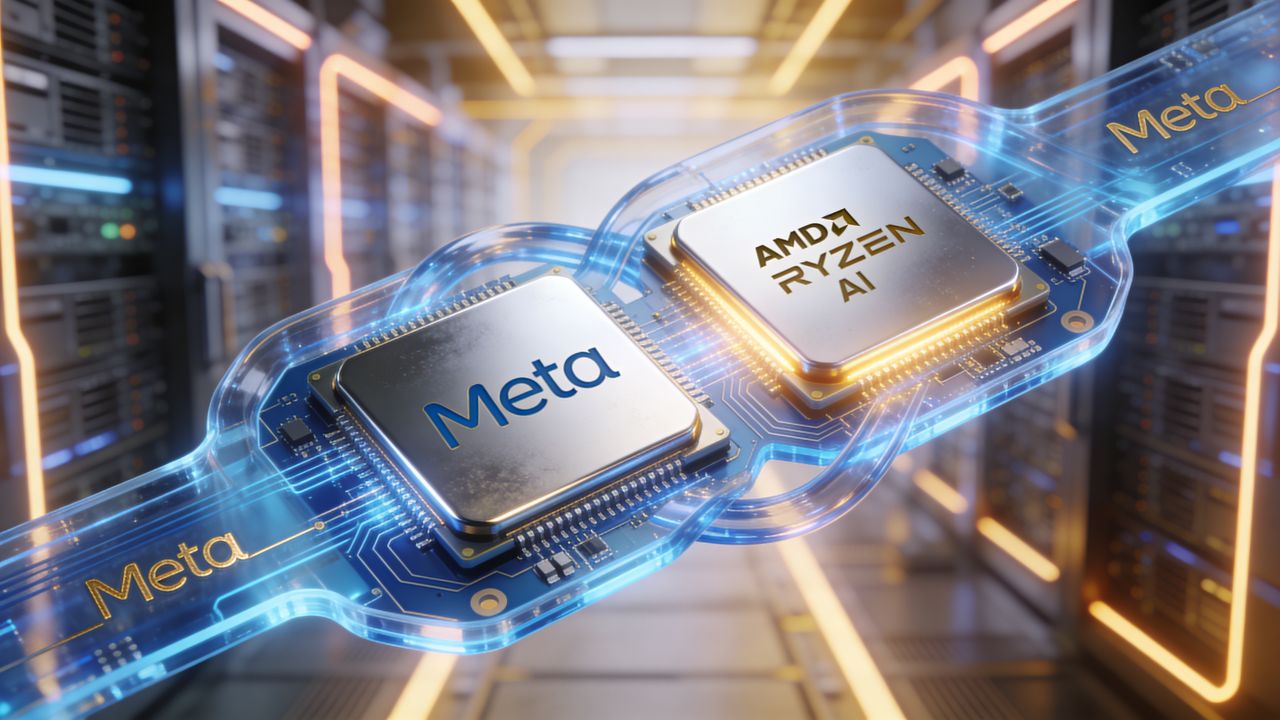
Lisa Su has been playing chess while the rest of the semiconductor industry plays checkers. And on Tuesday morning, she collected her second queen.
Meta Platforms and AMD announced a five-year strategic partnership that commits Meta to deploying up to 6 gigawatts of AMD Instinct GPUs for its AI data center buildout. The Wall Street Journal pegs the deal’s value north of $100 billion. AMD shares exploded 14% higher in pre-market trading, jumping above $218 from a previous close of $196.60.
This isn’t AMD’s first mega-deal. It’s a carbon copy of one. Back in October, OpenAI signed a structurally identical agreement: same 6 gigawatts, same warrant structure, same timeline. Two of the most consequential AI companies on the planet have now placed the same massive bet on AMD within five months. That’s not coincidence. That’s a market shift.
Inside the $100 Billion Handshake
The centerpiece of the agreement is a custom AMD Instinct GPU derived from the MI450 architecture, co-designed with Meta and optimized specifically for inference workloads. Shipments supporting the initial 1-gigawatt deployment begin in the second half of 2026, built on AMD’s Helios rack-scale architecture alongside sixth-generation EPYC “Venice” CPUs and the ROCm software stack.
Then there’s the equity play. AMD has granted Meta performance-based warrants covering up to 160 million shares at a penny apiece. Full vesting requires Meta to hit deployment milestones, meet technical benchmarks, and for AMD’s stock to reach $600 per share, roughly three times where it trades today. If everything clicks, Meta walks away owning close to 10% of AMD.
The identical structure appeared in the OpenAI partnership last fall. Both deals offer the same share count, the same gigawatt targets, the same $600 stock price hurdle. AMD has essentially created a repeatable template for locking in hyperscaler customers while aligning financial incentives across the entire relationship.
One Week After Going All-In on Nvidia, Meta Doubled Down on AMD
Context matters here. Seven days before signing with AMD, Meta announced a sweeping commitment to deploy millions of Nvidia processors, becoming the first hyperscaler to run standalone Nvidia Grace CPUs in production. AMD stock dropped 4% on that news.
The reversal is less contradictory than it appears. Meta plans to spend up to $135 billion on capital expenditures in 2026 alone, up from $72 billion last year. The company is building 30 data centers. At that spending velocity, relying on a single chip supplier creates supply chain risk that no CFO can justify.
Chip analyst Ben Bajarin of Creative Strategies, who was briefed on the deal, put it plainly: “We are compute constrained, and deals will be done across the board.” Mark Zuckerberg himself called AMD “an important partner for many years to come,” while Meta’s infrastructure lead Santosh Janardhan emphasized that a buildout this large demands multiple silicon vendors.
The Custom Silicon Play That Threatens Broadcom
What makes this partnership more than a bulk purchase order is the depth of technical collaboration. Meta didn’t just agree to buy MI450 chips off the shelf. The company actively shaped the processor’s design, tailoring it for the inference tasks that power AI responses at scale. AMD’s chiplet-based architecture enabled this level of customization, a flexibility advantage over monolithic chip designs.
That positioning puts AMD squarely in Broadcom’s crosshairs. Broadcom has dominated the custom AI chip market, but AMD is now offering hyperscalers something similar through its existing GPU platform. Su acknowledged the competitive stakes directly: “Meta has a lot of choices. I want to make sure that we are always a clear seat at the table when they think about what they need next.”
The deal extends well beyond graphics processors. Meta will act as lead customer for two upcoming generations of AMD EPYC server CPUs, including a custom variant engineered for Meta’s specific performance and power efficiency requirements. The company has already deployed millions of EPYC processors across its existing global infrastructure.
Revenue Visibility AMD Has Never Had Before
AMD CFO Jean Hu told investors to expect “substantial multi-year revenue growth” from the partnership, noting it will be accretive to non-GAAP earnings per share. Su quantified each gigawatt of deployed compute as worth “double-digit billions” in chip revenue. Six gigawatts, theoretically, represents a transformative revenue stream, though the “up to” qualifier means Meta is not locked into purchasing the full amount.
Combine the Meta commitment with the OpenAI deal from October, and AMD now has 12 gigawatts of potential AI GPU deployments on its books with two of the world’s most aggressive AI spenders. The company reported Q4 2025 revenue of $10.27 billion, up 34% year over year, and carries a market capitalization around $320 billion.
For perspective, Nvidia’s market cap sits at $4.66 trillion. Nvidia controls approximately 90% of the AI accelerator market and reports its own quarterly earnings on Wednesday. This week will test whether Wall Street sees AMD’s deal-making as a genuine threat to Nvidia’s dominance or a well-structured consolation prize.
Execution Is Everything Now
Paper commitments are one thing. Shipping racks of custom silicon on time is another. The first MI450 deployments need to begin arriving at Meta’s data centers in the back half of this year, and AMD’s ability to hit that window will determine whether these deals generate the revenue they promise or become cautionary tales about overpromising in a hype-driven market.
If both OpenAI and Meta fully exercise their commitments, they could collectively own warrants on 320 million AMD shares, a significant chunk of the company. The $600 stock price target baked into those warrants would represent a market cap above $960 billion. Getting there requires AMD to not just sign deals, but deliver chips that perform, ship on schedule, and convince customers to keep buying generation after generation.
The AI infrastructure supercycle has room for more than one chip supplier. Meta just proved that with its checkbook. Now it’s on AMD to prove it with its fabrication partners, its engineering teams, and its ability to scale production at a pace the company has never attempted. The stock surge says investors believe the story. The next twelve months will determine whether the story holds up.