
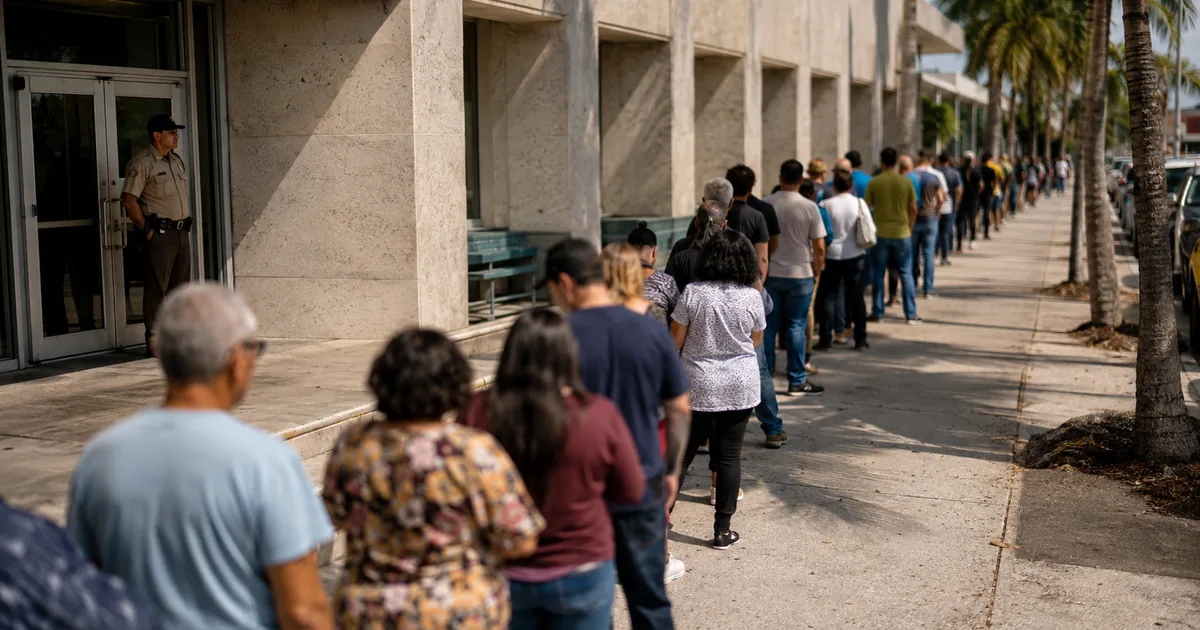
Immigration judges in Miami started calling more than a hundred people into a courtroom at once this summer, and the number of people ordered deported without being present went from 1,383 in May to 2,886 in July. Nearly every account of that has treated the line outside the building and the spike inside it as two adjacent facts about a chaotic few weeks. They are one fact, and the thing connecting them is a piece of law that has gone almost entirely unmentioned.
An order entered because you were not in the room is not the same as losing your case. It is called an in-absentia removal order, and it is the hardest order the immigration system produces to undo. The Justice Department’s own policy manual for the immigration courts gives a person who missed a hearing exactly one motion to reopen, a 180-day window to file it, and a standard to meet: “exceptional circumstances beyond the control of the alien.” The rule then lists what counts. Battery. Extreme cruelty. Serious illness. The death of a spouse, a child, a parent. And then the clause that decides most of these cases: “but not including less compelling circumstances.”
A line at the courthouse door is a less compelling circumstance. So is a docket so large the judge reached your name while you were still on the sidewalk. That is the story here. The crowd is not the chaos. The crowd is the mechanism.
What a Mega Master Hearing Is
The Executive Office for Immigration Review calls the first appearance in a deportation case a master calendar hearing. It is short, procedural, and usually the moment a person learns what they are charged with and what relief they might apply for. Under the old rhythm, an immigration judge worked through roughly three dozen of them in a day.
This summer the department began scheduling what practitioners now call mega masters. NPR watched one play out in Miami, where judges are being handed dockets of more than a hundred people and calling them in groups of thirty. David Wilson, who vice-chairs the American Immigration Lawyers Association’s immigration court committee, described the practice to NPR in a single sentence that deserves to be read twice: it is “a very unfair, but a very effective tactic.” Avene Jeanite, a 52-year-old Haitian man waiting outside, told the network the difference plainly. “It was not like this, you would go to the door and they’d let you in. Today is completely different.”
Massachusetts is running the same play. The Christian Science Monitor found a judge in Chelmsford scheduled to hear 56 cases involving 86 people in a single afternoon, with more than 200 people on the morning list and a third of the cases carrying no attorney at all. Nationally, the Monitor reported, the number of non-detained people summoned to master calendar hearings rose 66 percent between May and July, to 179,932, and in-absentia orders rose 56 percent over the same stretch, to more than 54,000.
The Number the Department Is Calling Progress
Here is where the framing breaks down. The administration’s defense of the accelerated calendar is backlog reduction, and on its own terms the numbers cooperate. The Transactional Records Access Clearinghouse counted 100,773 immigration court case closures in June 2026, an all-time high, driven by 78,882 removal orders and a 30 percent jump in orders issued by judges.
Then TRAC published the line that should have led every story about it. In more than two-thirds of those cases, 68 percent, the person ordered removed was not at the hearing.
A backlog closed by ordering absent people deported has not been decided. It has been forfeited, and the forfeit is nearly impossible to appeal.
That distinction is not academic, and it is why the reopening standard matters so much. When a case is heard and lost, there is a record, an appeal to the Board of Immigration Appeals, and a path into the federal circuit courts. When a case is closed because a name was called into a room the person could not reach, the person gets one motion and a standard written to exclude exactly the kind of ordinary obstacle a mega master hearing manufactures. There are two escape hatches, and both are narrow: no time limit applies if the government never gave proper notice under the statute, or if the person was in federal or state custody through no fault of their own. Neither covers the man standing in a queue that did not move.
NPR reported this week that the courts themselves are being relocated into what advocates are calling hidden tribunals, which does not make the notice problem better.
Nobody Stumbled Into This Docket
The docket sizes did not appear on their own, and neither did the judge shortage they are supposedly a response to. This site covered the Justice Department’s decision to fire more than 100 immigration judges and recruit replacements pitched explicitly as deportation judges back in May. By July, the president of the immigration judges’ association was telling PBS that at least 200 judges had been fired, had resigned, or had retired, each departure sending roughly 700 cases somewhere else. The department thinned the bench, and then cited the resulting pile-up as the reason to hear a hundred people at a time.
Our read: this is not an emergency response to a backlog. It is a design choice, and the design wins by default. Billie Botch, observing for the American Friends Service Committee, described the causal chain to NPR without any hedging. “You put more people into proceedings on shorter notice. You’re going to end up with more removal orders.” That is not a critic’s prediction. It is a description of what the schedule was built to do.
We have watched the same instrument work in a case with a household name. When ICE detained Milo Yiannopoulos, the government did not need a case against him, only a hearing he had skipped. What is happening in Miami is that machinery applied at volume to people with no name recognition, no lawyer in a third of cases, and no prospect of a story like this one being written about them individually.
What Would Actually Fix It
Two things, neither of them radical. EOIR should publish per-courtroom appearance data, including how many people were physically present in the building when their case was called, because right now the agency is the only party that knows whether its own line produced its own results and it has no reason to volunteer that. And where a court’s intake was demonstrably unable to process the people it summoned, the resulting in-absentia orders should be reopened on the agency’s motion rather than left to a 180-day clock most respondents will never learn is running.
The counterargument is that people who skip hearings should face consequences, and in the ordinary case that is right. But the ordinary case assumes a hearing a person can attend. When the government schedules 200 people into a morning session, staffs a single door, and then counts everyone it could not get through that door as having failed to appear, it is not enforcing a rule about showing up. It is running out the clock on people who did.