
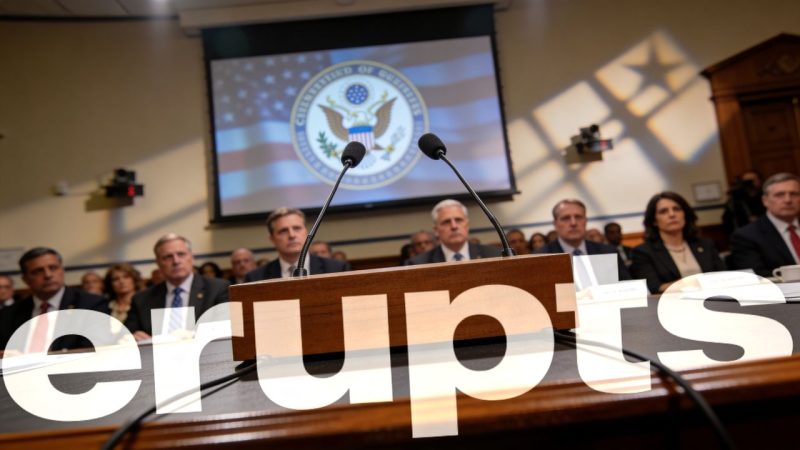
Sen. Markwayne Mullin walked into his confirmation hearing Wednesday morning expecting a policy discussion about border security and the DHS shutdown. What he got instead was three hours of friendly fire from his own party’s committee chairman, pointed questions about whether he fabricated military service, and an uncomfortable reversal on calling a dead American citizen “deranged.”
Welcome to the Trump administration’s attempt to replace one embattled DHS secretary with another controversy magnet.
Rand Paul Opens Fire On His Own Nominee
The hearing before the Senate Homeland Security and Governmental Affairs Committee went sideways before Mullin even finished adjusting his microphone. Committee Chairman Rand Paul, the Kentucky Republican who controls the entire confirmation process, used his opening statement to confront Mullin over personal attacks, not policy disagreements.
Paul described the 2017 assault by a neighbor that left him with six broken ribs, then turned to Mullin with barely concealed fury. The Oklahoma senator had reportedly called Paul a “freaking snake” and told him directly that he “completely understood” why his neighbor attacked him. Paul challenged Mullin to explain to the American public why someone who applauds violence against political opponents should be trusted to set the standard for ICE and Border Patrol agents.
Mullin did not apologize. He did not back down. Instead, the former MMA fighter leaned into the confrontation, telling Paul flatly that they “just don’t get along” and offering to set their differences aside. Paul was not satisfied, noting for the record what he characterized as a complete lack of contrition.
Paul then played video of Mullin’s 2023 incident where he challenged Teamsters President Sean O’Brien to a physical fight during a Senate hearing, with Sen. Bernie Sanders literally yelling at both men to sit down. The message was unmistakable: this is who you want running a department with 260,000 employees and a history of excessive force complaints?
The Stolen Valor Problem Nobody Can Explain
If the Paul confrontation was uncomfortable, the stolen valor questioning was genuinely bizarre. Mullin has no history of military service. He was an MMA fighter and plumbing business owner before running for Congress in 2012. Yet he has repeatedly made cryptic comments suggesting he served in war zones, including telling Fox News earlier this month that “war is ugly, it smells bad.”
Sen. Gary Peters, the committee’s top Democrat, pressed Mullin on what exactly he was referring to. Had he ever traveled to a foreign country before Congress, other than family vacations? Mullin’s answer was a tangled web of vague references to classified missions. He claimed that in 2015, while serving in the House, he was asked to train with “a very small contingency and go to a certain area.” He said this involved Survival, Evasion, Resistance, and Escape (SERE) training, which he simultaneously described as “kind of fun” and “absolutely awful.”
Peters wasn’t buying it. He told Mullin he had reviewed his FBI background report and asked directly whether anything in it was classified. According to Peters, the answer was no. The FBI report did show some foreign travel, including trips to Georgia and Azerbaijan that weren’t for tourism purposes, but nothing suggesting classified operations.
Mullin insisted the details were classified and he could only discuss them in a secure facility. This prompted Paul to threaten to cancel Thursday’s committee vote entirely unless Mullin provided more information in a classified setting. The two eventually agreed to meet in a SCIF after the hearing, and Paul indicated the Thursday vote would likely proceed.
Axios reported Wednesday that Mullin has privately hinted to former House colleagues about involvement in dangerous private security work in the Middle East before his congressional career, though no public record of such work exists.
Walking Back The Alex Pretti Attack
Perhaps the most politically significant moment came when Peters confronted Mullin about his response to the January killing of Alex Pretti, the 37-year-old ICU nurse and VA hospital employee who was shot and killed by ICE agents during a protest in Minneapolis.
After Pretti’s death, Mullin went on Fox News and called him “a deranged individual that came in to cause max damage.” On Wednesday, facing the committee, Mullin reversed course. He acknowledged the words should have been retracted and admitted he spoke too quickly without the facts. Asked if he would apologize to Pretti’s family, Mullin said he regretted his statements but stopped short of a direct apology, saying he would “absolutely” apologize if the ongoing investigation proves him wrong.
The walkback stands in stark contrast to outgoing Secretary Kristi Noem, who refused during her own Senate hearing earlier this month to retract her claims that both Pretti and Renee Good, another citizen killed by immigration officers in Minneapolis, were “domestic terrorists.” Mullin also declined to retract his characterization that the shooting of Good was “absolutely” justified, saying the officer made a split-second decision when a car struck him.
The Minneapolis killings triggered the DHS shutdown that has now dragged on for more than four weeks, with Senate Democrats refusing to fund the department until reforms to immigration enforcement are codified.
A Policy Shift On Warrants And ICE Operations
Buried under the personal drama were actual policy commitments that could matter. Mullin told the committee he would require judicial warrants for immigration agents to enter private homes or businesses, unless agents are in active pursuit of someone who runs into a property. This would reverse an internal ICE memo under Noem that permitted warrantless entry and arrest.
Mullin also signaled he wants to shift how ICE operates, telling senators he believes there is a “better approach” and that he would prefer ICE to function more as a transport and processing operation working alongside local law enforcement rather than conducting the kind of dramatic, high-profile raids that have defined the current administration’s enforcement posture.
He also pledged to cooperate with the DHS Inspector General, whose office has accused the department of “systematically obstructing” oversight during Noem’s tenure. And he committed to putting forward an actual nominee to lead FEMA, which the administration has cycled through three acting directors without ever submitting someone for Senate confirmation.
On management style, Mullin drew a clear line between himself and Noem. He said he would not continue her practice of personally reviewing every contract over $100,000, calling it unrealistic micromanagement that creates unnecessary red tape.
The DHS Shutdown Hangs Over Everything
The entire hearing unfolded against the backdrop of a department in crisis. DHS has been shut down since February 14, with over 100,000 employees furloughed or working without pay. TSA agents are quitting or calling out sick rather than working without paychecks. Airport security lines have become a national headache. FEMA disaster response has been scaled to bare minimum operations. The Coast Guard, cybersecurity operations, and first responder training have all been degraded.
Democrats and the White House are trading counteroffers on immigration enforcement reforms, with Senate Minority Leader Chuck Schumer saying Tuesday that the administration has not budged on key issues like requiring warrants and visible identification for officers. House Democrats, meanwhile, are launching a discharge petition to fund every DHS agency except ICE and Customs and Border Protection, essentially trying to separate the immigration fight from the broader security consequences.
Mullin pleaded with both parties in his opening statement to fund the department. His six-month goal if confirmed? That DHS stops being the lead story in the news every day.
What Happens Next
Despite the fireworks, Mullin’s path to confirmation appears intact, if bruised. Republicans hold an 8-7 edge on the committee. Even if Paul votes against him, Sen. John Fetterman, the Pennsylvania Democrat who has broken with his party on immigration, told CNN he has an “open mind” about the nomination and has only said positive things about Mullin. The two have reportedly been planning a family dinner together.
Sen. Rick Scott said he would be “surprised” if the nomination fails to advance. Sen. Katie Britt leapt to Mullin’s defense, insisting the hearing should have focused on homeland security rather than personal feuds. Mullin was flanked at the hearing by bipartisan support, including former House Speaker Kevin McCarthy and Fetterman himself, who called Mullin someone with “tenacity” and “heart.”
The committee vote is still scheduled for Thursday morning. A full Senate floor vote could come as soon as next week. If confirmed, Mullin would become the second DHS secretary under Trump’s second term, taking over from Noem, who departs March 31 as the first Cabinet secretary to leave the administration.
The real question isn’t whether Mullin gets the job. It’s whether a man who picks fights with union bosses, applauds assaults on colleagues, makes unverifiable claims about classified military service, and rushes to smear dead citizens on cable news is actually the temperament upgrade this administration thinks it’s making.