
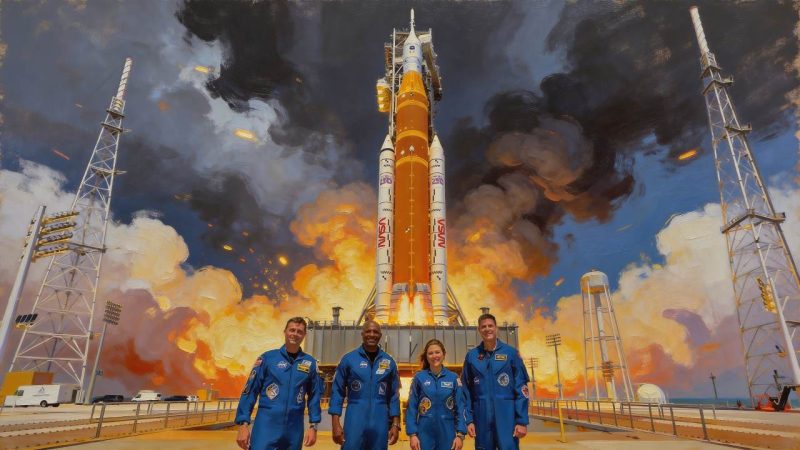
Sometime around 6:24 p.m. on Wednesday evening, if the weather cooperates and the engineering holds, four human beings will strap into a capsule atop the most powerful rocket ever built and leave Earth’s orbit for the Moon. It will be the first time humans have traveled beyond low Earth orbit since December 1972, when Apollo 17 astronauts Gene Cernan and Harrison Schmitt drove a rover across the lunar surface and came home.
That was 54 years ago. More than half a century. The entire internet was invented, matured, and reshaped civilization in the gap between those two missions. The Soviet Union collapsed. The smartphone was born. We mapped the human genome. And through all of it, no human being ventured farther than a few hundred miles above the planet.
On April 1, 2026, that changes.
What The Mission Actually Is
Artemis II is not a lunar landing. It is a flyby, a 10-day voyage that will carry four astronauts around the Moon and back, testing the systems that will eventually put boots on the surface during Artemis III. Think of it as the dress rehearsal before the main event, except the dress rehearsal involves traveling 4,700 miles beyond the far side of the Moon at speeds no human crew has ever reached.
The spacecraft is Orion, a capsule built by Lockheed Martin and powered by the European Service Module, which was contributed by the European Space Agency. The rocket is the Space Launch System, or SLS, standing 322 feet tall at Kennedy Space Center’s Launch Pad 39B, the same pad that launched Apollo missions half a century ago.
The mission timeline is elegant in its ambition. After liftoff, the crew will spend the first day orbiting Earth, testing Orion’s life-support systems, the hardware that will keep them breathing, hydrated, and alive in the vacuum of space. On day two, the spacecraft’s engines fire to set a course for the Moon. Four days later, they arrive, swinging around the far side in a free-return trajectory that will carry them farther from Earth than any human has ever traveled, about 4,700 miles past the lunar surface.
Then they come home. Atmospheric reentry at approximately 25,000 miles per hour, faster than any crewed vehicle has ever traveled, splashing down in the Pacific Ocean.
The Crew That Makes History Before They Leave The Ground
The four astronauts selected for Artemis II represent more than just exceptional piloting and engineering credentials. They represent a statement about who gets to explore.
Commander Reid Wiseman is a Navy test pilot and former International Space Station resident who was named chief of NASA’s astronaut corps before being assigned to Artemis II. He is the mission’s veteran steady hand.
Pilot Victor Glover is a Navy commander who flew aboard a SpaceX Crew Dragon to the International Space Station in 2020. When Artemis II clears Earth’s orbit, Glover will become the first person of color to travel beyond low Earth orbit. Every previous deep-space astronaut, all 24 of them across the Apollo program, was a white man.
Mission Specialist Christina Koch holds the record for the longest continuous spaceflight by a woman, 328 days aboard the International Space Station. She was also part of the first all-female spacewalk in 2019. When Orion leaves Earth orbit, Koch becomes the first woman to travel to deep space, period. Across six decades of crewed spaceflight, no woman has ever gone this far.
Mission Specialist Jeremy Hansen is a Canadian Space Agency astronaut and former CF-18 fighter pilot. He has never been to space before. His first trip will be to the Moon, making him the first non-American to travel beyond low Earth orbit.
The diversity of this crew is not incidental. It is the product of decades of institutional change at NASA, from an agency that selected exclusively white male military pilots in the 1960s to one that recognizes exploration as a human endeavor, not an American, male, or white one.
Why It Took 54 Years
The honest answer is a combination of politics, budgets, and risk tolerance.
After Apollo 17, NASA pivoted to the Space Shuttle program, which promised routine access to low Earth orbit but never ventured beyond it. The shuttle flew for 30 years, built the International Space Station, and lost two crews, Challenger in 1986 and Columbia in 2003, in disasters that each reshaped the agency’s relationship with risk.
The Constellation program, announced by President George W. Bush in 2005, was supposed to return humans to the Moon by 2020. It was canceled by President Obama in 2010. The Artemis program, which repurposed much of Constellation’s hardware, was announced by the Trump administration in 2017 and survived the Biden administration largely intact.
Artemis I, the uncrewed test flight, launched successfully in November 2022, sending an empty Orion capsule around the Moon and back. It worked. But converting that success into a crewed mission took more than three years, delayed by problems with the SLS heat shield, a helium flow issue in the rocket’s upper stage (which scrubbed the original February 2026 launch window), and the sheer complexity of certifying a spacecraft to carry human beings into deep space.
The cost has been staggering. The SLS program alone has consumed more than $23 billion. Orion adds billions more. Critics argue NASA could have achieved the same goals faster and cheaper using commercial vehicles. As we covered when SpaceX shifted its focus to the Moon, the commercial space race is intensifying and putting pressure on NASA’s traditional approach. Defenders counter that SLS provides capabilities, specifically the ability to launch the massive Orion capsule on a direct trajectory to the Moon, that no commercial rocket currently matches.
How To Watch
NASA is going all in on accessibility for this one. Coverage begins at 7:45 a.m. EDT on April 1 with live views and audio commentary of tanking operations on NASA’s official Artemis II mission page. Full broadcast coverage on NASA+ starts at 12:50 p.m. EDT.
The launch itself, targeted for a two-hour window opening at 6:24 p.m. EDT, will stream live across NASA+, YouTube, Facebook, Twitch, and X. ABC News will carry live coverage on ABC News Live, with streaming available on Disney+ and Hulu. C-SPAN is devoting daily coverage to the mission through Sunday, April 5.
If the April 1 window is scrubbed for weather or technical issues, NASA has backup windows on April 2 through 6, and again on April 30.
Weather forecasts currently show an 80% chance of favorable conditions for Wednesday. The primary concerns are cloud coverage and ground-level winds, not the kind of showstoppers that tend to delay launches.
What Comes Next
Artemis II is the proof-of-concept mission. If Orion performs as expected, if the life-support systems hold, if the heat shield handles reentry at 25,000 mph, the program moves to Artemis III: the actual lunar landing.
Artemis III is currently targeted for 2028 and will use a SpaceX Starship variant as the lunar lander, a vehicle that has yet to complete a successful uncrewed landing on the Moon. That timeline is, to put it diplomatically, ambitious. But Artemis II does not need Artemis III to matter.
What matters on Wednesday is simpler and more profound than any future mission plan. Four human beings, representing three countries, two genders, and the full spectrum of human diversity, will travel farther from Earth than anyone in history. They will see the far side of the Moon with their own eyes. They will test the spacecraft that will carry the first woman and the first person of color to the lunar surface. And they will prove, after 54 years, that the species that walked on the Moon has not given up on going back.
The countdown clock is running. Launch is at 6:24 p.m. EDT, Wednesday, April 1, 2026. Watch it. This one counts.