
Netflix didn’t just buy a studio. It effectively bought half of Hollywood’s history — and a big chunk of its future — in one shot.
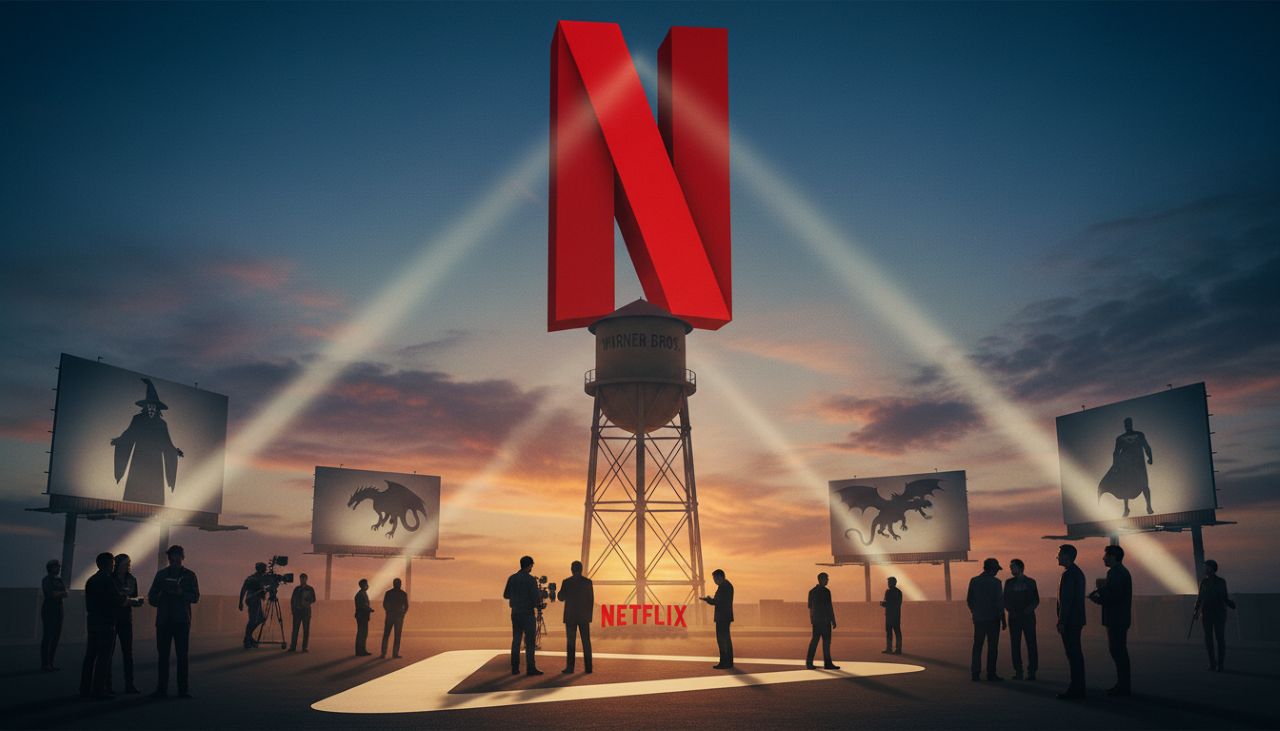
On Friday, Netflix agreed to acquire Warner Bros. Discovery’s studio and streaming businesses in a deal valued at about $82.7–83 billion, with an equity value of $72 billion.
The transaction hands Netflix Warner Bros. film and TV studios, HBO and HBO Max, and one of the deepest libraries in media, from Harry Potter and Batman to Game of Thrones and Friends as per MSNBC/MSNOW.
This is the streaming wars equivalent of Disney buying Fox — except this time it’s the tech-adjacent insurgent absorbing the legacy giant.
What Netflix Is Actually Buying
The Crown Jewels Of Old Hollywood
Under the deal, Netflix acquires:
- Warner Bros. film and TV studios – the engine behind Harry Potter, DC, The Wizard of Oz, Casablanca, The Sopranos, and more.
- HBO and HBO Max – prestige TV’s gold standard: Game of Thrones, The White Lotus, Succession.
- A vast TV archive – including Friends and The Big Bang Theory.
Warner Bros. Discovery will first spin off its cable networks — CNN, Discovery, TNT, etc. — into a separate company, Discovery Global. Only after that separation, expected in Q3 2026, will the Netflix transaction close.
The structure matters: Netflix gets the IP and the streaming future; someone else inherits the cable news and legacy bundle problem.
How The Deal Works On Paper
The Money And The Math
- Enterprise value: about $82.7–83 billion including debt.
- Equity value: $72 billion, or $27.75 per WBD share.
- Consideration to WBD shareholders:
- $23.25 in cash
- $4.50 in Netflix stock per WBD share, subject to a collar on Netflix’s share price.
- Timeline: Deal expected to close in 12–18 months, after the Discovery Global spin-off and regulatory approvals.
Netflix says it expects $2–3 billion in annual cost savings by year three, and claims the deal will be accretive to earnings by year two as per Variety.
Where will those “savings” come from? Not from making more shows. Think overlapping tech stacks, marketing, back-office, and—let’s be honest—eventually, fewer greenlights and more consolidation of risk.
A Streaming Empire — And An Antitrust Problem
One Giant Platform To Rule Them All
Put it in market-structure terms: a company that already has over 300 million global subscribers now also controls one of the last remaining full-stack Hollywood studios, plus HBO’s prestige pipeline.
Regulators are going to love this one.
- Analysts and industry voices are already flagging “significant competition concerns” about tying together two of the largest streaming ecosystems.
- Rep. Darrell Issa, R‑Calif., has publicly raised antitrust alarms over Netflix’s “unequaled market power” in streaming.
- Netflix agreed to a breakup fee around $5–5.8 billion if regulators block the deal, a tell that they know this is not a rubber-stamp transaction.
On one side, Netflix argues competition isn’t just Disney+ and Amazon Prime — it’s also YouTube, TikTok, and games. On the other, this is exactly the pattern that has hollowed out local news, music labels, and book publishing: relentless consolidation into a few mega-platforms that set the terms for everyone else.
If you care about democratic culture — not just democratic elections — that kind of concentration matters.
What It Means For Viewers, Creators, And Democracy
For Viewers: More Stuff, Less Choice
Netflix and Warner are selling this as a win for audiences: one subscription, more great shows. That’s true in the narrow sense — if you can afford Netflix, you’ll get a library that runs from Citizen Kane to Squid Game.
But there’s a deeper trade-off:
- Higher pricing power: With a larger must-have catalog, Netflix can nudge prices up with less fear of churn. Analysts already expect stronger pricing leverage if the deal closes.
- Fewer viable rivals: Paramount and Comcast just lost the bidding war. They don’t disappear, but they become clearly second-tier streamers in a market dominated by one or two global giants.
- Algorithmic gatekeeping: When one company’s recommendation system can make or bury an HBO drama, a mid-budget film, or a political documentary, that’s not just an entertainment question. It’s an information-power question.
For Talent And Workers: “Efficiencies” With Human Costs
Netflix promises “more opportunities for the creative community” and more investment in original content. Some of that may be real: Netflix’s global reach plus Warner’s IP is an irresistible Playground for certain writers and showrunners.
But the last decade of media M&A is a graveyard of similar promises. In practice:
- Cost “synergies” usually mean layoffs, production cuts, and fewer buyers in town.
- Consolidation shrinks the number of places creators can take projects, weakening their bargaining power — even post‑strike.
- Libraries get locked behind exclusivity strategies that are about shareholder value, not cultural access.
One former Warner chief, Jason Kilar, put it bluntly on X: “I could not think of a better way to reduce competition in Hollywood than selling WBD to Netflix”.
For Democratic Culture: Fewer Gatekeepers, Bigger Gates
Warner Bros. is not just a content farm; it is a century of shared references — from Wizard of Oz to the CNN news architecture that reshaped how Americans experienced live events.
Splitting news (CNN, etc.) into Discovery Global and handing the culture IP and streaming rails to Netflix draws a sharper line:
- One entity optimizes for clicky news and cable economics.
- Another optimizes for global subscriber engagement and shareholder returns.
Neither is primarily optimizing for democratic discourse. But when more of the stories that define politics, identity, and social conflict are brokered through a handful of global platforms, the risk isn’t censorship in the old sense. It’s slow, opaque modulation: which topics get a prestige HBO docuseries and which issues disappear into the algorithmic long tail.
The Global Stakes: Exporting A Consolidated Culture
Netflix is already the de facto TV network of the world. This deal bolsters that position with:
- A deeper English-language premium catalog.
- Massive franchise IP that can be endlessly rebooted, localized, and spun out.
- Even more leverage with local regulators and production ecosystems.
Expect this to ripple through Europe and other democracies that are already struggling with how to tax, regulate, and culturally balance U.S. platforms.
The real tension: countries that want vibrant local production and pluralistic media now have to negotiate not with a fragmented Hollywood but with a vertically integrated, data-driven global giant whose incentives run through Wall Street, not public-interest mandates.
The Question Regulators Should Actually Ask
Antitrust law in the U.S. has been allergic to non-price harms for decades. But this deal poses three non-trivial questions:
- Does concentrating this much IP and distribution in one platform risk “gatekeeper” power over culture and information akin to Big Tech platforms?
- Will reduced competition in premium streaming lead to higher prices and fewer options for consumers, especially lower-income households already juggling multiple subscriptions?
- What happens to independent film and TV when one mega-buyer can dictate terms — from windowing to residuals — for such a massive share of high-end content?
Europe may be more willing than the U.S. to use cultural-policy arguments alongside pure competition metrics. But in both systems, this is going to be a high‑stakes test of whether regulators believe media consolidation is just another industry or something structurally tied to democratic health.
Where This Likely Goes
Barring a dramatic regulatory turn, the odds favor eventual approval — maybe with behavioral conditions: promises about theatrical windows, some licensing to third parties, maybe constraints on how quickly HBO Max is folded into the Netflix app.
If that happens, the streaming wars don’t end. They just become something else:
- Netflix + Warner as the default subscription.
- Disney and Amazon as heavyweight but clearly trailing ecosystems.
- Everyone else — Paramount, Comcast, Apple — forced into niche strategies, partnerships, or further consolidation.
For viewers, that might feel convenient in the short term. One bill, an ocean of content, fewer apps. For culture and democracy, it’s something more fragile: a bet that a single, profit-maximizing global platform can also be the careful steward of the stories that tell us who we are.