
Something is building in America that the White House can no longer wave away with a Truth Social post.
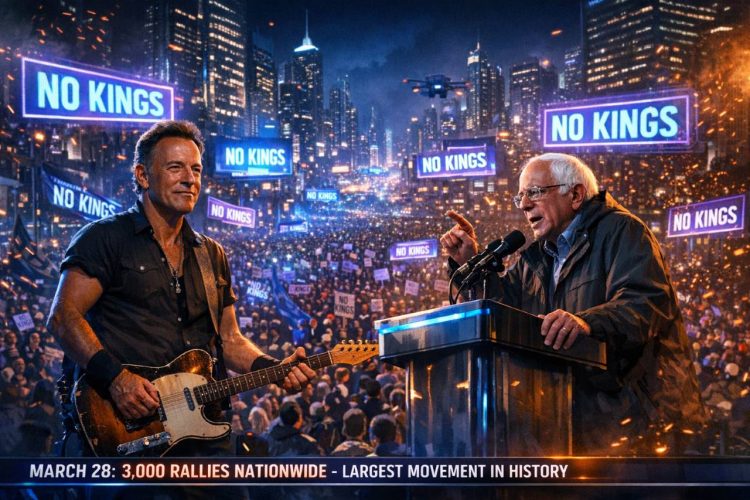
On Saturday, March 28, more than 9 million Americans are expected to take to the streets in what organizers say will be the largest nonviolent protest in United States history. The third No Kings rally spans more than 3,100 events across all 50 states and six continents. The flagship event at the Minnesota State Capitol in St. Paul is projected to draw 100,000 people, headlined by Bruce Springsteen performing his protest anthem “Streets of Minneapolis” alongside speakers including Senator Bernie Sanders, Jane Fonda, and Joan Baez.
If those names sound like a greatest hits album of American dissent, that is precisely the point. The No Kings movement has evolved from scattered weekend marches into something with genuine institutional muscle, backed by nearly 300 organizations including the ACLU, Planned Parenthood Action Fund, SEIU, and Indivisible, the group that has served as the movement’s operational backbone since its founding.
What Sparked The Third No Kings Rally
The first No Kings protest in June 2025 drew roughly 5 million participants across 2,100 events. The second, in October 2025, pulled an estimated 7 million across 2,700 events. Each wave has been bigger than the last, and each has been ignited by a specific set of grievances that crystallize the broader fears about democratic erosion under the Trump administration.
This time, the catalyst is blood. Three Americans killed by immigration enforcement officers in a span of weeks.
Keith Porter Jr., age 43, was shot on New Year’s Eve 2025 by an off-duty ICE officer in Los Angeles. Renée Good, 37, was killed on January 7 in Minneapolis by ICE agent Jonathan Ross while sitting in her car. Alex Pretti, a 37-year-old ICE nurse, was shot on January 24 by Customs and Border Protection officers while filming agents and directing traffic during Operation Metro Surge, a massive enforcement action that resulted in more than 3,000 arrests in the Minneapolis-St. Paul area.
The deaths did something that policy debates alone could not. They gave the movement a narrative with faces, with names, with a city that became a symbol. Minneapolis became the protest movement’s ground zero, and Saturday’s flagship rally in neighboring St. Paul is a deliberate act of reclamation.
Springsteen And The Song That Changed Everything
Bruce Springsteen wrote “Streets of Minneapolis” the day Alex Pretti died. He recorded it on January 27, released it on January 28, and it became the movement’s anthem almost overnight. The song mourns Good and Pretti by name, with lyrics that cut through the noise: “Citizens stood for justice, their voices ringing through the night, and there were bloody footprints where mercy should have stood, and two dead left to die on snow-filled streets.”
When asked why he moved so fast, Springsteen told reporters simply: “You want to try to meet the moment.”
On Saturday, he will perform the song live for the first time at the St. Paul Capitol rally before launching his “No Kings” tour on March 31 at the same venue. It is a deliberate merging of art and activism that recalls the protest music tradition of the 1960s, except that this time the folk legend is Joan Baez standing beside the rock icon, and the crowds are measured in millions, not thousands.
What Saturday Looks Like In St. Paul
The logistics alone tell a story about how organized this movement has become. Three separate marches will launch at noon from Harriet Island Regional Park, St. Paul College, and Western Sculpture Park, converging on the Capitol for a 2 p.m. main stage program. Live music begins at 11 a.m. at each staging location. Road closures will shut down Wabasha Street from Harriet Island to the Capitol grounds, along with John Ireland Boulevard and the 12th Street Bridge.
The speaker lineup reads like a who’s who of progressive politics and cultural activism. In addition to Sanders, Fonda, and Baez, attendees will hear from Minnesota Lt. Governor Peggy Flanagan, Attorney General Keith Ellison, St. Paul Mayor Kaohly Her, AFL-CIO President Liz Shuler, SEIU President April Verrett, and American Federation of Teachers President Randi Weingarten. Singer Maggie Rogers will also perform.
The Bigger Picture: Why No Kings Keeps Growing
What makes No Kings different from the Women’s March or the George Floyd protests is its escalation curve. Each rally has been substantially larger than the one before, drawing from a widening coalition that now extends well beyond the expected progressive base. Nearly 300 partnering organizations range from the League of Women Voters to the National Organization for Women, from Vote Save America to the Feminist Majority. That breadth matters. It suggests a movement that is consolidating rather than fragmenting.
The timing also matters enormously. Saturday’s protests arrive at a moment when multiple crises are converging: an ongoing partial government shutdown that has left TSA officers unpaid for 42 days, an escalating war with Iran now in its fourth week, and continued ICE operations that have turned cities like Minneapolis into flashpoints of federal overreach. Each of these threads feeds into the movement’s core argument, that democratic norms, institutional guardrails, and basic rule of law are being dismantled at a pace that demands a response beyond the ballot box.
Trump’s response to the movement has been characteristically dismissive. “They’re referring to me as a king. I’m not a king,” he told Fox News. Republicans have labeled the protests “anti-American.” But dismissiveness is a difficult strategy to sustain when the crowds keep doubling.
What Comes Next
The question that hangs over every mass protest movement is whether it translates into durable political power. The Women’s March of 2017 produced a wave of female candidates who reshaped Congress. The Tea Party protests of 2009 transformed the Republican Party. The No Kings movement is approaching a similar inflection point, where the size of the crowds begins to force a reckoning within the Democratic Party about strategy, within media about coverage, and within the broader electorate about what kind of country they want to live in.
On Saturday, the streets will provide one kind of answer. Whether Washington listens is another question entirely.