
Stephen Colbert taped one of his last “Late Show” episodes at the Obama Presidential Center in Chicago, and Barack Obama used it to deliver his sharpest critique of the Trump administration since leaving office: the politicization of the Department of Justice, he said, is the one thing American democracy cannot survive. The interview aired Tuesday on CBS, with Colbert’s run on the show set to wind down by the end of the month.
A network’s farewell, used for institutional warning
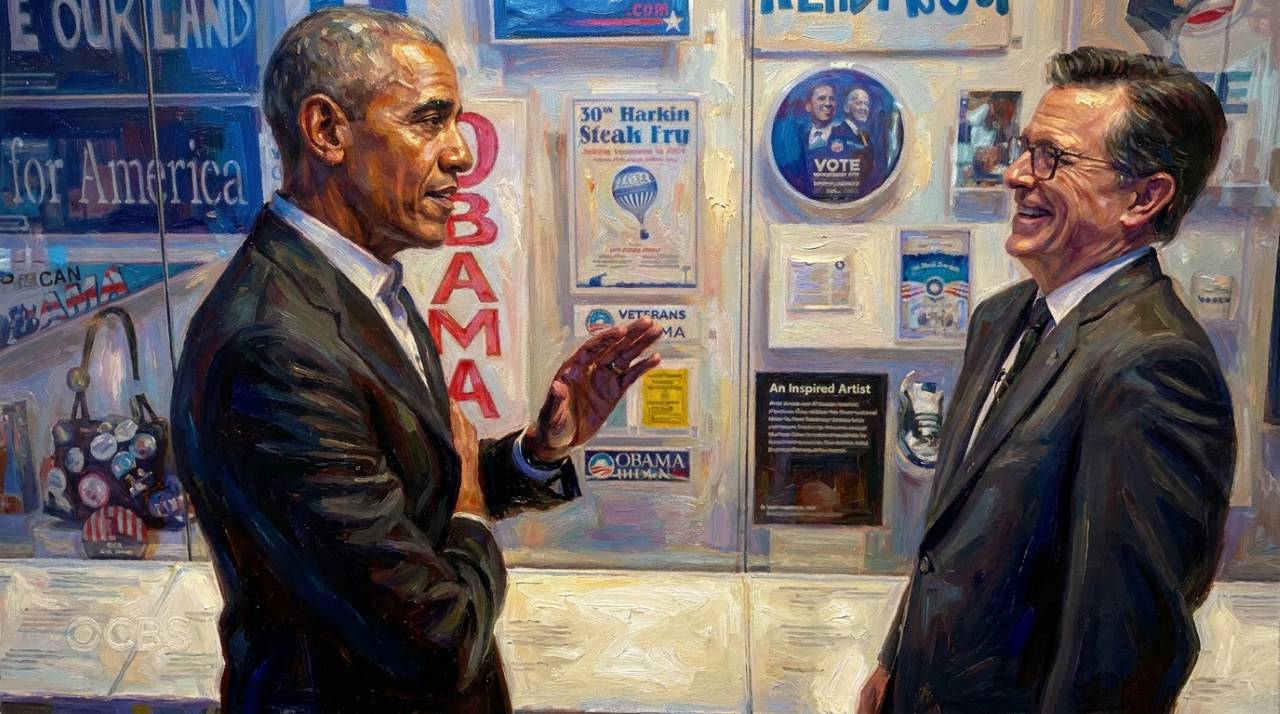
CBS announced last summer it would end “The Late Show” when its current contracts close, citing economic pressure on linear late-night television.
The show’s final stretch was always going to attract premium bookings, but Colbert’s choice to spend one of his last hours with a former president, on tape, inside that president’s archive, is its own statement. Late-night comedy in 2026 is no longer a stop on a press tour. It is, when the host wants it to be, a venue for arguments that wouldn’t survive the cable-news interview format intact.
Obama’s argument was direct. Per CBS News, May 2026, the former president told Colbert that the country can absorb policy reversals, court fights, and adversarial press cycles. What it cannot absorb is a federal prosecutorial apparatus directed at political enemies. He framed the line as a structural concern, not a partisan complaint, which is the framing that has been missing from most Democratic messaging on the same issue.
The Presidential Center as set design
The interview was pre-taped at the Obama Presidential Center, which opens to the public on June 19, 2026. That date is not accidental. Juneteenth as a national holiday was federalized during the Biden administration, and the Center’s leadership has emphasized civil-rights archives as a programming priority. Filming with Colbert there, with a brief tour and an Oval Office basketball segment cut into the broadcast, treats the building as a working stage for political messaging rather than a passive monument.
The Obama post-presidency has been criticized by progressives for what they describe as institutional caution. The Colbert interview suggests something else: deliberate selection of platforms. A late-night comedy show in its final weeks, hosted by a journalist-turned-comedian whose audience already shares the worldview, is a low-friction venue for landing a thesis line. It does not require the former president to take heat from a hostile interviewer or to compete for airtime against breaking news.
Colbert-for-president, and the joke that wasn’t a joke
When Colbert raised the running-joke notion of a presidential bid, Obama did not deflect. He told Colbert he could perform significantly better than some recent occupants of the office. The line read as a quip on broadcast, but in the wider 2026 context, it is also a cultural data point. The bar for what counts as a credible presidential profile, after Donald Trump’s two non-consecutive terms and the various celebrity flirtations that followed, has changed. Saying so on television is no longer a transgression.
Whether Obama actually thinks Colbert would run is beside the point. The relevant signal is that the former president is willing, on the record, to make the comparative claim out loud. Democratic operatives have spent two cycles trying to figure out how to credential their candidates against a competition that no longer privileges credentials. Telling viewers that a comedian would be a better choice than the incumbent is an unusual move for a former president, even in jest, and it tells you something about how the institutional left now thinks about the post-credential political market.
What’s next for the post-CBS Colbert audience
The “Late Show” audience is not small. It has been the most-watched late-night network broadcast for several years running, even as the format declined as a category. When the show ends, those viewers split. Some go to streaming alternatives, some to social platforms, some out of the late-night habit entirely. The hosts who pick up that audience inherit a significant political megaphone. Colbert himself has not announced a next move, though Deadline reported in April 2026 that his final stretch would feature several headline interviews of this caliber.
For LNC readers who follow the network programming side, the question worth tracking is which CBS slot replaces the show, and whether the network treats the time as an entertainment property or quietly moves toward additional news programming. Linear network late-night, as a format, is being slowly written out of the schedule. What replaces it determines whether the political-interview function Colbert occupied moves to streaming, gets distributed across podcasts and social platforms, or simply disappears as a public commons. If you want to track the live network in the meantime, our CBS live stream page carries the broadcast feed and the schedule for the remaining episodes.
A closing argument, not a victory lap
Obama’s appearance was not, despite the comedy framing, a victory lap. He used a friendly format to make a structural argument about the rule of law, on a network that is closing his interviewer’s program. The combination is unusual enough to be worth noticing. Whether the politicization line lands as a Democratic talking point, gets absorbed into the news cycle, or fades by next week is the question that matters more than any of the content that gets clipped on social.
What is clear is that the venues for this kind of argument are shrinking. When Colbert’s show goes dark at the end of May, one of the few remaining late-night spaces for a former president to take a forty-minute, on-tape conversation closes with it. The next set of hosts, on whatever platforms inherit that audience, will decide whether the function continues or becomes a thing the format used to do.