
OpenAI is betting $6.5 billion that the next big thing in AI isn’t another chatbot. It’s a pen.
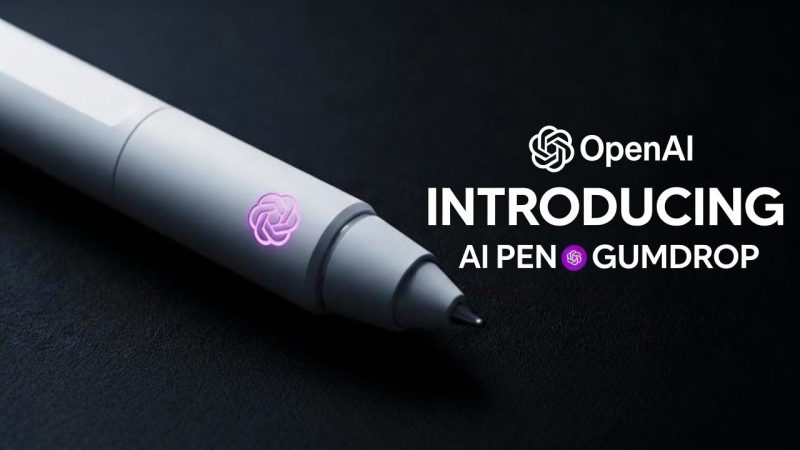
Recent leaks reveal that the company’s secretive hardware project with legendary Apple designer Jony Ive has taken shape as an AI-powered writing instrument codenamed “Gumdrop.” The device aims to transcribe handwritten notes directly into ChatGPT while enabling voice conversations with the AI assistant, all without a screen in sight. If it works, it could represent the first successful attempt to break AI free from our phones and laptops. If it doesn’t, it joins a growing graveyard of AI hardware ambitions.
What We Know About the Device
According to supply chain reports first surfaced by Taiwan’s Economic Daily, the Gumdrop pen will be roughly the size of an iPod Shuffle and pack a suite of sensors including cameras and microphones. The device is designed to capture handwritten notes, convert them to digital text, and upload everything directly to ChatGPT for processing, organization, and interaction.
Some AI processing will happen locally on the device itself, with more demanding tasks routed to cloud servers. The pen won’t technically be a wearable, but it’s designed to be carried in a pocket or worn on a lanyard. OpenAI envisions it as a “third core device” alongside your smartphone and laptop, not a replacement for either.
The pen is reportedly the first of three hardware products in development. A separate “to-go” audio device is also in the pipeline, designed as a voice-first AI companion for hands-free interaction. Both represent OpenAI’s larger bet on screenless, audio-first AI experiences.
The Jony Ive Factor
OpenAI’s hardware ambitions became serious in May 2025 when the company acquired Ive’s hardware startup io Products for approximately $6.5 billion in an all-stock deal. The acquisition brought roughly 55 engineers into OpenAI’s fold, along with the man who designed the iPhone, iPad, MacBook Air, and countless other products that defined consumer electronics for a generation.
The collaboration between Sam Altman and Ive reportedly began in 2023 and gained momentum through 2024. In an open letter published in May 2025, they articulated a vision for AI hardware that “enhances creativity and focus rather than distracts.” Altman has described the device’s intended vibe as “simple, calming, devoid of distractions.” When people see early prototypes, he said, they react: “That’s it? It’s so simple.”
That minimalist philosophy extends to avoiding what Ive has called “screen overload.” The goal is AI that doesn’t demand your attention through another glowing rectangle but instead integrates naturally into existing workflows like note-taking and brainstorming.
Manufacturing and Timeline
OpenAI initially selected Chinese manufacturer Luxshare for production but has since shifted to Foxconn, the world’s largest electronics assembler. The company specifically wants manufacturing to occur in Vietnam or the United States rather than mainland China, a decision that carries both political and supply chain implications.
Foxconn is already OpenAI’s partner on AI data center infrastructure, handling everything from co-designing facilities to overseeing deployment. Adding consumer hardware to that relationship signals serious commercial intent.
Current estimates place a launch window in late 2026 or 2027, though Sam Altman has cautioned against expecting anything soon. “Do not expect anything very soon,” he warned late last year, acknowledging that fundamental challenges around form factor, voice interaction, and privacy remain unresolved. Launch pricing is estimated between $650 and $775, positioning Gumdrop firmly in premium territory.
Learning From AI Hardware Failures
OpenAI’s pen arrives in a landscape littered with AI hardware corpses. The Humane AI Pin launched with $230 million in funding and promises to “redefine human-computer interaction,” only to be discontinued less than a year later after brutal reviews and nonexistent adoption. HP acquired the company’s assets for a fraction of its fundraising, primarily to absorb patents and retain operating system engineers.
The Rabbit R1 fared slightly better but still earned designation as one of 2024’s biggest hardware failures. Both devices shared a fundamental problem: they tried to replace smartphones without doing anything smartphones couldn’t do faster and better.
OpenAI appears to be learning from these disasters. Rather than positioning the pen as a phone replacement, the company is targeting a specific use case with broad appeal: handwriting and note-taking. The device doesn’t need to do everything. It needs to do one thing exceptionally well while leveraging ChatGPT’s existing capabilities.
The Privacy Question
Any device that constantly listens and watches raises immediate privacy concerns. The pen’s camera will observe what you write. Its microphone will capture ambient audio. All of that data flows either to local processing or OpenAI’s cloud servers.
OpenAI will need to answer fundamental questions before launch: Where does captured content get stored? How long is it retained? Can users delete their data? Will third-party services get access? These concerns helped sink the Humane AI Pin, and OpenAI cannot afford similar mistakes.
The company is reportedly investing in custom AI chips and smaller language models that could enable more on-device processing, which would improve both privacy and response times. But the balance between local and cloud processing remains one of the project’s core technical challenges.
Why This Might Actually Work
Despite the cautionary tales, OpenAI has several advantages its predecessors lacked. First, ChatGPT represents the most widely adopted AI system in consumer history. The pen doesn’t need to convince users that AI is useful. It just needs to give them a new way to access something they already use.
Second, Jony Ive’s involvement adds credibility that no AI hardware startup has matched. His design philosophy has shaped how billions of people interact with technology. If anyone can make an AI pen feel like a natural extension of daily life rather than a novelty gadget, it’s the team that made the iPhone feel inevitable.
Third, the pen targets an existing behavior rather than trying to create new ones. People already take notes. They already carry writing instruments. Converting that familiar action into an AI-enhanced experience represents a lower friction path to adoption than asking users to speak to a pin on their chest.
The Stakes for OpenAI
OpenAI’s hardware push represents more than product diversification. It’s a strategic bet on controlling how people experience AI in the physical world. As long as ChatGPT lives primarily in web browsers and smartphone apps, OpenAI remains dependent on distribution platforms controlled by Apple and Google.
The pen, if successful, gives OpenAI its own direct relationship with users. It creates a hardware platform that could eventually expand into other form factors. And it generates recurring revenue through potential subscription requirements for full functionality.
Gene Munster of Deepwater Asset Management has argued that OpenAI poses Apple’s first meaningful competitive challenge in nearly 20 years. That may be hyperbolic for now, but the underlying logic is sound: if AI becomes the primary way people interact with computers, controlling the hardware layer matters enormously.
For all the failed AI gadgets cluttering landfills, someone will eventually crack the formula for AI hardware that people actually want. OpenAI, armed with Ive’s design sensibility, $6.5 billion in investment, and the world’s most popular AI assistant, has as good a shot as anyone. Whether a pen is the right form factor remains an open question, but at least they’re not trying to sell us another thing to strap to our faces.