
David Ellison didn’t blink when Netflix won the Warner Bros. auction last Friday. He just went straight to the people who actually own the company.
On Monday morning, Paramount Skydance launched a hostile takeover bid for all of Warner Bros. Discovery—$30 per share in cold, hard cash, an enterprise value of $108.4 billion (including debt). The move is audacious, theatrical, and probably doomed. But it’s also a stunning indictment of how fragile Netflix’s supposedly victorious deal really is, and what happens when you have a billionaire backed by another billionaire who refuses to lose.
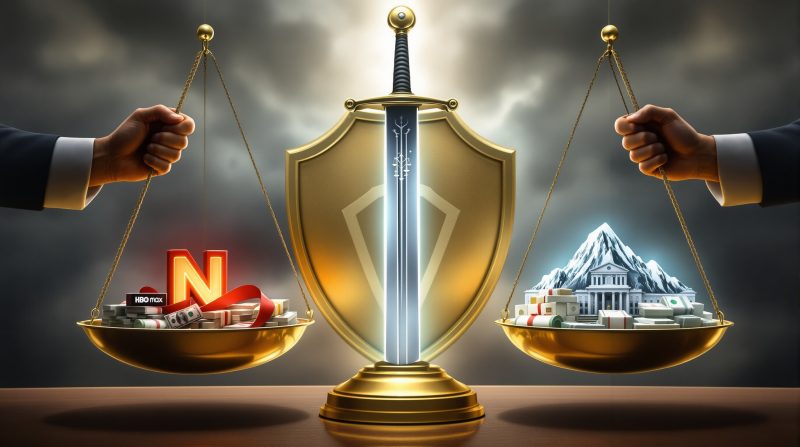
The headline numbers tell you something: Paramount is offering WBD shareholders $18 billion more in cash than Netflix’s proposal. Netflix offered $27.75 per share in a mixed package of cash ($23.25) and stock ($4.50), with the streaming giant acquiring only the studio and HBO Max operations—not the cable networks set to spin out as “Discovery Global.” The enterprise value: $82.7 billion. Paramount wants it all, and it’s betting cash is king on Wall Street.
“We’re really here to finish what we started,” Ellison told CNBC on Monday, with the kind of competitive hunger that sounds reasonable until you remember his father is Larry Ellison, Oracle’s co-founder and the world’s second-richest person. The Ellisons have already backstopped $40.7 billion in equity, with $54 billion in debt commitments from Bank of America, Citi, and Apollo. The deal is fully financed by the family’s fortune—which is the whole point. Ellison’s betting that when it comes to hostile bids, execution certainty beats regulatory uncertainty every time.
But here’s the thing: he might be right. And Netflix knows it.
The Regulatory Sword Hanging Over Everything
Netflix’s $72 billion victory was never really a victory. It was a fragile deal walking a tightrope over a regulatory minefield, and now Trump administration officials are openly questioning whether it survives the journey.
On Sunday, before Paramount’s bid was even announced, President Trump raised alarms. “It’s a big market share, and when they have Warner Brothers, you know, that share goes up a lot,” he said at the Kennedy Center. “It could be a problem.” That wasn’t casual commentary. Trump has already intervened in major tech deals, and his administration’s antitrust division—led by Gail Slater, a former Roku executive and Trump ally—is unlikely to rubber-stamp a transaction that puts the streaming market’s market share over the DOJ’s presumptive 30% threshold.
Netflix would control roughly 43% of the streaming market when combined with HBO Max. That number alone is challenging to defend. Senator Elizabeth Warren, never shy about antitrust, called the deal “an anti-monopoly nightmare.” But she wasn’t alone. Republican senators Mike Lee and Roger Marshall also flagged serious concerns. Even Jason Kilar, Warner Bros. Discovery’s former CEO, posted on X: “If I was tasked with doing so, I could not think of a more effective way to reduce competition in Hollywood than selling WBD to Netflix.”
Netflix is banking on a sophisticated argument: count YouTube, TikTok, and other ad-supported services in the competitive universe, and its market share drops below 5% of total consumer entertainment time. It’s a defensible position. But it requires Netflix to convince regulators that the relevant market isn’t “streaming” or “premium content”—it’s basically everything people watch. That’s a harder sell than Netflix executives have publicly acknowledged.
Paramount, meanwhile, has been weaponizing these regulatory headwinds. Its lawyers sent a 4,000-word letter to WBD claiming Netflix’s deal “would face grave uncertainty and significant opposition by competition law enforcement agencies.” Whether that’s accurate legal analysis or tactical noise designed to spook shareholders is an open question. But the uncertainty is real enough that prediction markets dropped the probability of Netflix closing the deal from 60% to 23% after Trump’s comments.
The Cash vs. Certainty Gamble
Paramount’s hostile bid isn’t about winning the auction in traditional terms. It’s about exploiting Netflix’s regulatory vulnerability by offering something Netflix can’t: all-cash certainty and a faster closure timeline. Paramount says it can close in 12 months. Netflix projects 12 to 18 months, pending regulatory approval and the complex spinoff of Discovery Global.
That’s a real competitive advantage in a shareholder vote. Warner Bros. Discovery shareholders are locked into a deal that comes with a $5.8 billion break-up fee if it falls apart—one of the largest reverse termination fees ever imposed. If the Netflix deal collapses for regulatory reasons, WBD shareholders get nothing but broken promises. With Paramount’s all-cash offer, the downside is much clearer: shareholders get $30 per share, period. No regulatory roulette. No spinning out cable networks that may be worth $1 per share or $5 per share depending on how you model it.
WBD’s board will likely recommend against the Paramount offer. Netflix already has their support, and the Netflix deal includes governance commitments the board spent weeks negotiating. But the board also faces a fiduciary duty problem: if Netflix’s deal is structurally vulnerable to regulatory rejection, did they really serve shareholders by choosing it? That’s precisely the kind of question hostile tender offers are designed to exploit.
The Political Wild Card
Here’s where it gets truly interesting: David Ellison’s political positioning is far more sophisticated than it appears on the surface.
The Ellisons are genuinely close to Trump. Larry Ellison was at Mar-a-Lago constantly during Trump’s first term and has attended multiple UFC events with the president. David Ellison has been carefully cultivating the relationship, too. When he acquired Paramount in August, he agreed to Trump administration conditions on the deal, and he’s since been pouring money into transforming CBS News—appointing Bari Weiss, founder of the right-leaning Free Press, to oversee the division. Trump has publicly praised that move.
Paramount’s financing coalition is deliberately designed to signal that this deal works within the Trump administration’s framework. The equity is backed by the Ellisons and RedBird Capital (also known as being close to Trump’s world). The debt includes $24 billion from Saudi Arabia, Qatar, Abu Dhabi, and Jared Kushner’s Affinity Partners. Paramount made a deliberate choice to structure the Middle Eastern investments as non-voting to avoid CFIUS (Committee on Foreign Investment in the United States) complications—removing a regulatory red flag that might otherwise derail the bid.
In other words: Paramount built a deal that looks politically acceptable to Trump. Netflix built a deal that made sense from a content and subscriber perspective, but politically, it looks like the kind of mega-merger that triggers populist antitrust pushback.
The Real Question: Does Any of This Actually Close?
Here’s the uncomfortable reality: Paramount’s hostile bid might fail, and Netflix’s deal might still not close.
WBD’s board has fiduciary duties to shareholders, and if they genuinely believe Netflix has serious regulatory risk, they could flip to Paramount. But if they do, Netflix has already won the auction and negotiated board support. Walking back from that publicly would be ugly. Meanwhile, shareholders who smell regulatory uncertainty might actually tender into Paramount’s offer, particularly given that Paramount is putting the sale directly to them (a tender offer bypasses the board).
Netflix could counter with a higher offer. That’s entirely possible, though the company has been publicly confident about regulatory approval, which somewhat limits its negotiating flexibility.
But the real wild card is Trump himself. The president has shown willingness to get directly involved in major deals. He fought the AT&T-Time Warner merger tooth and nail and lost, but that was before he had his own administration in place. Now, with a sympathetic antitrust division and close ties to David Ellison, does Trump subtly signal that Netflix’s deal faces headwinds while Paramount’s faces smooth sailing?
That wouldn’t be market manipulation. That would be politics in a post-2008 world where even Republicans openly use antitrust as a tool for picking winners and losers.
The Deeper Business Problem
What’s really stunning about this entire saga is what it reveals about the streaming wars: they’ve become unsustainable.
Netflix, Amazon Prime, Disney+, HBO Max, Paramount+, Apple TV+—the market can’t profitably support all of them. Content costs are astronomical. Linear cable is collapsing. Subscriber growth is slowing. Everyone is raising prices and re-introducing ads. The creative community is exhausted by layoffs and fewer theatrical releases.
Netflix winning this auction and acquiring HBO Max makes strategic sense on the content side. But it also looks like the exact kind of mega-consolidation that brings regulatory scrutiny in 2025. You can’t build a streaming monopoly and expect nobody to notice.
Paramount’s bid, by contrast, would create something genuinely different: a combined studio, streaming platform, and cable network operator that maintains some of the old television economics while building the new ones. That’s not necessarily better for consumers (cable networks often mean higher costs). But it’s politically easier to defend as “creating a healthy competitor to Netflix” rather than “consolidating the streaming market.”
What Happens Next
Shareholders have until January 8 to respond to Paramount’s tender offer (unless the timeline is extended). Warner Bros. will likely issue a formal statement rejecting Paramount’s bid and defending the Netflix deal. Netflix might raise its offer, particularly if Trump’s administration sends more signals of regulatory doubt. Paramount will probably remind everyone that Netflix’s deal “likely never closes” due to antitrust risk.
Behind the scenes, lawyers on both sides will be crafting arguments for their eventual regulatory filings. Netflix’s antitrust team will prepare a 200-page brief explaining why this deal is pro-consumer and pro-competition. Paramount will argue the opposite.
The most likely outcome is still that Netflix closes the deal. The company has scale, credibility, and regulatory experience. But for the first time, there’s genuine daylight between “likely” and “certain.” And David Ellison just proved that if you have enough cash and political cover, you can stay in the fight longer than anyone expected.
That’s the real story here: not that Paramount might somehow win a $108 billion bid against Netflix, but that the streaming wars have become so economically and politically unstable that victory on an auction is actually defeat in a regulatory battle.
In entertainment M&A in 2025, certainty is worth more than market share. Paramount just reminded everyone of that truth.